

13 Jun 2026
An Evening of Wonder with Alan Lightman
Can science explain transcendence? Physicist Alan Lightman reflects on extraordinary moments in nature and the transformative power of awe and wonder.
0:00 / 0:00
13 Jun 2026
An Evening of Wonder with Alan Lightman
Can science explain transcendence? Physicist Alan Lightman reflects on extraordinary moments in nature and the transformative power of awe and wonder.
ShareEpisode Notes
What happens when a physicist experiences a moment of transcendence that science cannot explain?
Alan Lightman has spent much of his life exploring the mysteries of the universe—from black holes and the nature of time to the fundamental laws that govern reality. A physicist, novelist and longtime professor at MIT, he's fascinated by the transformative power of awe and wonder.
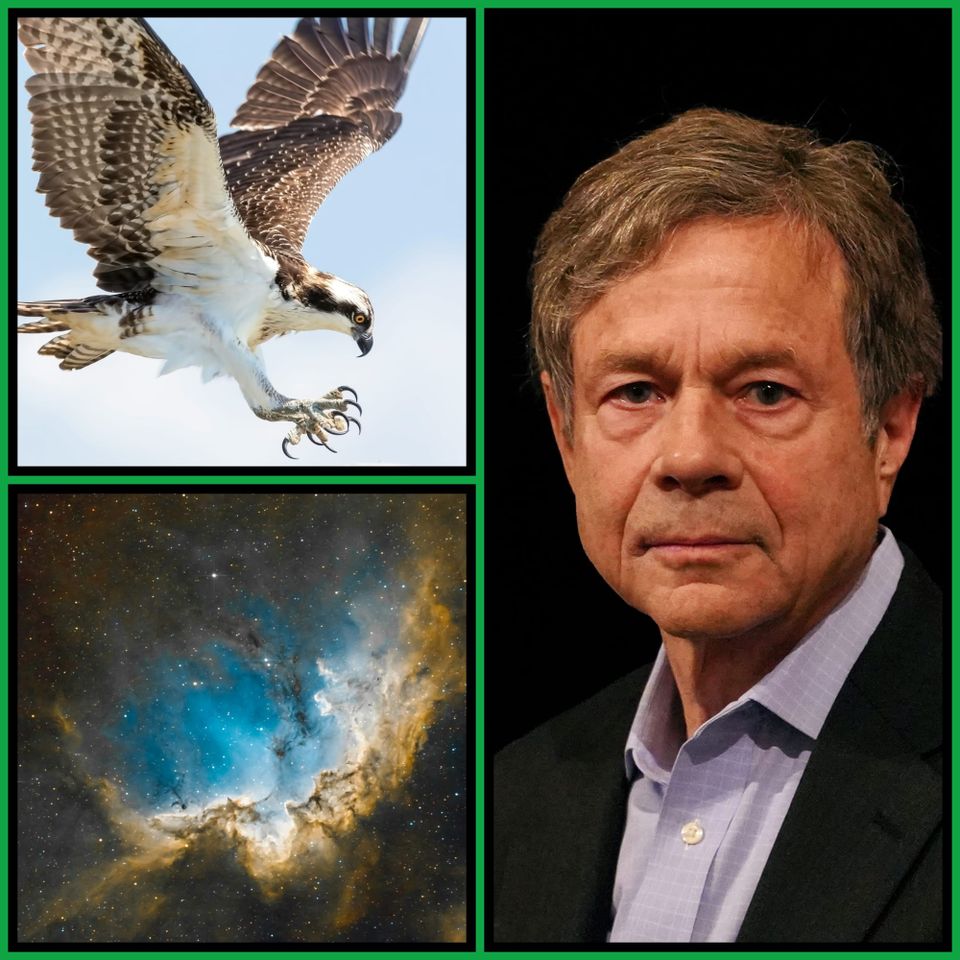
In this live conversation recorded at New York's Morgan Library, Lightman reflects on extraordinary encounters in nature—from a startling moment with two ospreys to a solitary night beneath the stars—that shook him to the core and left him feeling as though he had somehow "fallen into infinity." Calling himself a "spiritual materialist," he seeks to bridge the divide between science and religion, between mathematics and art.
Can a scientific worldview make room for awe, transcendence, and mystical experience? Lightman says these fleeting moments reveal something essential about being human: our longing to connect with something larger than ourselves.
This event at the Morgan Library was co-sponsored by the Nour Foundation as part of our series “Spirituality in the Age of Science: Conversations on God, Transcendence and Mortality.”
Physicist Alan Lightman in conversation with Steve Paulson at the Morgan Library and Museum on December 5, 2023.
- Video of Steve’s complete conversation with Alan Lightman at Morgan Library
- MIT website
- Books
- PBS series: "Searching: Our Quest For Meaning in the Age of Science"
Transcript
Anne Strainchamps: Welcome to Wonder Cabinet. I'm Anne Strainchamps.
Steve Paulson: And I'm Steve Paulson. There are a few natural marvels that always amaze me, like watching a flock of geese migrating in that perfect V formation, wondering how one bird decides to fly out in front.
Anne Strainchamps: Or baby sea turtles who hatch and then crawl to the ocean, where they swim thousands of miles together to a place they've never been.
Steve Paulson: Nature is full of mysteries, especially the complex behaviors called “emergent phenomena.”
Alan Lightman: One example of an emergent phenomenon is certain species of fireflies. You get a group of these fireflies together in a field at night in the summer, and they begin by blinking randomly, like Christmas tree lights. But after about a minute or so, they start blinking in synchrony. We understand everything about the chemical reactions that make light in an individual firefly, but we don't really understand how this group of fireflies starts blinking in synchrony.
Another example is termite cathedrals — these magnificent mounds termites build that have intricate passageways to control airflow and humidity. And you wonder, how did the termites know to build that thing? There's no boss termite. There's no architectural plan. In fact, individual termites are blind. But somehow this collection of ten thousand termites built this magnificent thing.
Steve Paulson: Welcome to a conversation about nature and transcendence with physicist Alan Lightman, recorded live in New York at the Morgan Library.
Anne Strainchamps: in what has to be one of the most beautiful rooms in the whole city — J.P. Morgan's personal study.
Steve Paulson: We're gathered together under walnut bookcases that are three stories tall and a vaulted ceiling covered in gold-leaf frescoes of Renaissance angels.
Anne Strainchamps: This was part of a “Spirituality in the Age of Science” public conversation series Steve did, a partnership with the Nour Foundation. So Steve, before we begin, what should we know about Alan Lightman?
Steve Paulson: So Alan Lightman is both a scientist and a writer. He's probably best known for his novel Einstein's Dreams, in which he imagines Einstein dreaming of different versions of time. And that book has been translated into thirty languages and adapted into plays and musicals and choral works. He's also an astrophysicist who's worked at Harvard and MIT on gravitation theory, black holes, and the warping of space and time.
Anne Strainchamps: Okay, let's listen.
Steve Paulson: It is wonderful to be back at the Morgan Library. We're going to be talking about transcendence this evening, and I have to say, I can't imagine a better place to have this conversation than in this room.
I think Alan Lightman occupies a really distinctive place in our intellectual culture because he straddles several divides that are often very contested. He's both a scientist and a novelist. When you read his books, his essays, and his fiction, you get a sense of his insatiable curiosity. We live in a wondrous and mysterious world, and he is continually exploring the question: how much can science explain the mystery?
So Alan, there is a remarkable experience that you have written about when you were spending a summer in Maine and you had a close encounter with a couple of ospreys. Can you describe what happened?
Alan Lightman: Well, my wife and I have spent the last thirty years or so on a small island in Maine, and there's an osprey nest that is a couple hundred feet from the house. We have a very large picture window that looks out at the osprey nest, and the ospreys are always coming and going, so instead of watching TV, we watch the osprey nest.
The typical pattern of the ospreys is the parents, who've been vacationing in South America, come back. In the springtime, the mother osprey lays eggs in April. The eggs hatch in June. And then the father starts going out and catching fish to feed the family. The babies start growing up and getting bigger and bigger, and by mid-August they're adolescents by this time. They're strong enough to take their first flight.
So one summer I'd been watching the babies get bigger and bigger and bigger. And then I was standing on a second-floor circular deck, and the growing children ospreys were looking at me as I was looking at them. So to them, it must have looked like I was in my nest, because there's a circular deck.
One afternoon, the two adolescents now took their maiden flight, the first time they'd ever left the nest. An adolescent osprey is pretty big and strong. They have powerful claws. And the two adolescent ospreys on their maiden voyage took one loop out over the ocean and back toward me, maybe about a half-mile diameter. And they started flying straight at me.
At first I was very frightened, because an adolescent osprey can rip your face off. My first thought was to run back into the house, but something made me stand there, and I was looking at them coming at me at great speed. They were looking at me. When they were about maybe twenty feet away, they suddenly made a very high-G upward vertical climb and went over the roof of the house. But in the last second before they made that vertical climb, we made eye contact.
And it was the most profound communication I've ever had with a non-human animal — and also with some humans. I can't really describe in words what that moment was like, but I felt like they were talking to me. It was something like, we've shared this land together. We're kindred spirits.
Steve Paulson: The way you write about this, you said that you were shaking, maybe even crying.
Alan Lightman: I was shaking and I was in tears. I didn't realize that I was in tears, but after they flew away, I realized that I was in tears. It was just that electric an experience.
So that's the osprey story.
Steve Paulson: I want to try to unpack what happened there and why it was so profound, because it seems like there's something that can be very powerful about an eye-to-eye encounter with another animal, a non-human animal. And Jane Goodall writes about this kind of thing — her first encounter with David Greybeard, the first chimpanzee she befriended. What is it about this contact with a being outside of our own species that makes it so extraordinary?
Alan Lightman: Well, first of all, I felt that there was a mind behind the gaze of these two birds, but also that a really intimate, powerful connection with a non-human species made me feel like I was part of nature, that we were all connected. I felt that there was a unity to life in the world.
Steve Paulson: How important was it that this all happened at a nonverbal level? Because when we hear about experiences of awe, it's typically outside of language, it seems.
Alan Lightman: I've tried to describe it to you just now, but I don't think that words would have been very adequate. And I do think that our transcendent experiences, experiences or feelings of awe, are beyond the verbal level. They're more primitive than that. They're something very deep in us, before language.
Steve Paulson: You've described this as a transcendent experience. What do you think you're transcending?
Alan Lightman: That's a great question. Well, I'm transcending my physical body. I'm transcending my ego. I'm transcending my sense of self. I'm transcending the moment in time, because I think in these experiences you're not aware of time and you're not aware of place either. So time, place, ego, physicality — all of that is being left behind somehow. So that's what I think you're transcending.
You have a sense of being alive in the world, which is different than taking your kids to school or going to the dentist appointment. It's a vivid moment of being present in the world. And I think those are some of the most beautiful moments that we have.
Steve Paulson: You have called yourself a “spiritual materialist.” Do you want to tell us what that means?
Alan Lightman: Well, I'm a materialist in that I think that the world is made out of atoms and molecules. And even the magnificent experiences that we have, the mental experiences — even though we don't understand exactly how they arise from atoms and molecules, I think ultimately that they do come from atoms and molecules. I don't believe there's any supernatural element.
But I'm a spiritual person. I regard myself as a spiritual person in the sense that I have experiences like the communion with the ospreys. I appreciate beauty. I have a sense of awe when I look out on the ocean and it just goes on forever until it meets the sky. I feel a connection to nature. I feel that I'm part of the larger world. I feel that there are things larger than myself. And all of those together are my concept of spirituality.
Steve Paulson: So I want to pick up this thread of religion and how we talk about God and science. Obviously there has been a tremendously fraught relationship between science and religion, especially in the last few decades. Some people think they are irreconcilable. Plenty of other people think the two can coexist. What's your take on this?
Alan Lightman: First of all, I separate spirituality from religion in the way that I've described it. But now we're talking about religion proper. I think in most religious traditions, God is a being that not only exists outside of time and space, but occasionally intervenes in the physical world to perform miracles. We have the parting of the Red Sea. We have Mohammed splitting the moon in two. There are countless stories of miracles. And by miracle, I mean an event that cannot be explained in terms of logical laws, either now or in the indefinite future. Miracles are absolutely inconsistent with the scientific view of the world.
Now, there are some religions, like pantheism, that identify God with nature, and that's completely consistent with science. And there might be a religious tradition, I'm not sure, where God was the clockmaker who set the clock in motion but then stood back and did not intervene after that. And that's also consistent with science.
Steve Paulson: That's the deist position.
Alan Lightman: That's the deist position, right. And that's also consistent with science, because we will never know exactly how the universe started, although we have theories. But an all-powerful being that exists outside of time and space and occasionally steps in and performs a miracle — that is incompatible with science. So that's my view.
Steve Paulson: So the religion that most scientists tend to love is Buddhism, especially Zen Buddhism.
Alan Lightman: Yes.
Steve Paulson: Do you go there as well?
Alan Lightman: I go with Buddhism. In fact, I've gone to a Buddhist retreat myself. My wife is a pretty serious Buddhist. I embrace all of Buddhism except the rebirth idea.
Steve Paulson: Reincarnation.
Alan Lightman: Reincarnation. So that I can't accept, because as a scientist, that doesn't make sense to me. But I love everything else about Buddhism, especially the idea of impermanence — which of course science tells us over and over again, that even the stars will burn out. And also the idea of being present, of mindfulness. I think that's a wonderful, lovely idea.
Steve Paulson: So I want to go back into your own background, because you have a really interesting personal history. You've written about how you kind of were this budding scientist at a really early age. You set up a little science lab in the closet of your bedroom, is that right?
Alan Lightman: That's right.
Steve Paulson: What did you do there? And how old were you?
Alan Lightman: Well, I started doing scientific experiments probably around the age of seven or eight. I made ugly stains on the carpet that my parents couldn't clean out. And I made explosions. I built rockets.
Steve Paulson: Wait, you made explosions in your closet?
Alan Lightman: Not in my closet. No, in my closet I had lots of electrical equipment — capacitors, resistors, batteries, photo cells. I had test tubes and chemicals. I didn't actually do the experiments in the closet. The closet was where I kept everything.
I loved doing experiments. I loved building things. It's interesting — I think that a lot of scientists start off that way. When I got into college, I realized that there were other science majors who were much, much better than me with their hands, and they became experimentalists. When I built things in my college labs, they blew up when they weren't supposed to. I'm not very good as an experimentalist at the professional level. So I retreated into mathematics and became a theoretical scientist.
Steve Paulson: Did you know, when you were doing those science experiments — I don't know, when you were ten or twelve or whatever — did you know that you wanted to become a physicist then?
Alan Lightman: No. I probably didn't know what physics was, but I did physics-type things, like making pendulums with weights on the end of strings and timing their periods. I knew that I was interested in science. I was interested in how the world works.
Steve Paulson: Is that the core attraction of science to you, trying to figure out how the world works?
Alan Lightman: Yes, I think so. There's a great emotional satisfaction in discovering something where you're the first person who found out that thing, even if it's a minor thing. If you're the first person who found out this thing about the physical world, and there's a truth to it. People can debate endlessly on what caused the Civil War, with good arguments on all different sides — from the social, political, economic side. But when you find out something that's equivalent to "the area of a circle is pi r squared," no one can deny the truth of that. And there's something very reassuring about being able to find something that you know is true.
On the other hand, I think that all of the debating of the Civil War, the causes of the Civil War, and all the questions that the humanities ask that don't have answers — like, would we be happier if we lived to be a thousand years old? Or, is it moral to steal food to feed your family? Why did Raskolnikov, in Dostoevsky's Crime and Punishment, why did he kill the old lady? These questions without answers are also extremely valuable. And I think that both the questions of science, which have answers, and the questions of the arts and humanities, which don't have answers — they're all part of being human. We need questions with answers, and we need questions without answers.
Steve Paulson: Well, let me ask you about the other hat you wear, which is, you're a novelist. I'm just trying to figure out, how did you do this? How did you become a physicist, an astrophysicist doing all of this high-level theory, and also write all these novels? How did that fit into your career trajectory?
Alan Lightman: Well, I was a writer from a young age. I wrote poetry, and then I wrote some bad short stories. So I had the dual interest in the arts as well as the sciences from a young age.
Steve Paulson: Did they have equal weight for you?
Alan Lightman: I think they did. And what I realized later, much later, was that I had two groups of friends. I had the friends who worked on the literary magazine, and I had the friends who entered the science fair. I had these two groups of friends, and I never thought of them as being distinct. They were just people that I loved to be with and to talk to.
And it was only much later that I began to realize that there are these two different sides of us. Our parents and our teachers and our friends push us to be one way or the other. They push us to either be the spontaneous, intuitive, artistic type, or they push us to be the rational, deliberate, scientific type. From a young age they push us in one direction or the other, because life is easier if you're in one camp or the other. But I think, in fact, that many of us have interests in both the sciences and the humanities and arts. I'm lumping the arts and humanities together for this conversation. It's really a shame that we get funneled into one way of being versus the other.
Steve Paulson: Well, let me ask you about how different those ways of viewing the world actually are. I think the common assumption is that science is about trying to understand the material world, what is observable, whereas writing fiction is about creating imagined worlds. Is that a fair distinction?
Alan Lightman: Yeah, I think so. Another thing you could say is that the humanities and arts are ultimately about our inner world as human beings — our psychology and the expression of our inner selves. Whereas science, other than psychology, is about the external world. And all scientists believe that there is a physical reality outside of our minds. Not everybody believes that. In fact, there are some very well-known philosophers, like George Berkeley, who believe that everything is a mental construction.
Steve Paulson: So for you, who's both had this career in science and also written many works of fiction — do these two different ways of thinking feed on each other? I mean, does writing fiction make you a better physicist?
Alan Lightman: Well, that's a great question, and I don't know the answer to it. There is an intuitive aspect of science. And I think that the greatest scientists, like Darwin and Einstein, had very strong intuition about the world, which went beyond just the facts and the numbers.
I think in my own fiction, I can see the effects of science, of scientific background, in my fiction, because my novels have greater organization than the average novelist. And I'm not saying that that's necessarily a good thing. It's just a feature of my writing. Some reviewers have pointed out that I have a lot of organization in my novels.
Steve Paulson: We've been talking about how you became a scientist and also how you became a fiction writer. I want to pick up the thread of your spiritual history, because you've written about some fascinating experiences. One was when you were quite young — you say maybe nine years old or so, you had almost an out-of-body experience, right?
Alan Lightman: Yes.
Steve Paulson: What happened there?
Alan Lightman: Well, I was standing in one of the bedrooms of my home in Memphis, Tennessee. It was in the mid-afternoon, and there were some train tracks that were near our house, and I heard a train go by. And something about that triggered a very unusual experience — that I suddenly felt like I was not in my body anymore, but I was in outer space. I was sailing through the galaxies.
I think at nine years old, I knew that there was outer space and there were galaxies. I felt like I was part of the cosmos. And I sort of had a sense of a very, very long period of time before I was born, and a very, very long period of time after I would be dead. And I had a sense that I was an insignificant speck in the universe. And that was the experience that I had. And it just lasted like one minute.
Steve Paulson: Any idea what would have triggered that?
Alan Lightman: No, I don't know what triggered it. I mean, I know that the immediate thing was hearing this train go by, but I have no idea why that triggered this expansive feeling that I had. So I can't answer the question.
Steve Paulson: I find it so interesting as you describe this. You said it maybe lasted a minute, but it obviously made a huge impression on you.
Alan Lightman: Yes, it did. Don't we all have experiences that last a minute and have huge impressions on us? I think we all do. Life is made up of those moments.
Steve Paulson: As you've written about this, you have this wonderful line. You say, "Sometimes I wish I believed in the soul, but I've got mathematics." Can mathematics be a replacement for the soul?
Alan Lightman: Well, certainly not completely. But as I was saying a bit earlier to you in the green room, I think many religious traditions have two souls. There's a universal soul that is not connected to you personally. And then there's your personal soul that has your own self-identity. The ancient Egyptian Ka and Ba, for example — the Ka was this universal soul, and the Ba was something that contained part of your individual identity. And when the two souls left your body at physical death, the Ba tried to rejoin with the Ka.
I think that mathematics is very close to this universal soul. It's not personal, but it has an immortality to it, because when we find — I mentioned earlier that the area of a circle is pi r squared — that's not going to change. And if we could talk to Glyptons on the planet Polyak, they would know, as long as they were reasonably intelligent, they would know some version of "the area of a circle is pi r squared." They would know about the number pi, 3.1417, et cetera. That's what mathematics is for me. And the world of mathematics is a beautiful world.
Steve Paulson: Can you explain that? Because I'm not particularly mathematically inclined myself, but I've heard mathematicians talk about the beauty of math. What makes it beautiful?
Alan Lightman: The exactness, the purity. It's not contaminated with human prejudice. It's not contaminated with politics. If you see a mathematical proof — for example, the proof, which is fairly simple, that the square root of two is a number that cannot be expressed as the ratio of two whole numbers, cannot be expressed as a repeating decimal. It's something else, called an irrational number. When you see the proof of that, you just say, wow.
Or if you see the proof of the Pythagorean theorem — that if you have a triangle where one angle is ninety degrees, the square of the side opposite that angle is equal to the sum of the squares of the other two legs of the triangle. When you see the proof of that, it's a beautiful thing. You're asking me to describe the beauty of it. It's precise, it's eternal, it's pure, and it's simple. So those are aspects of beauty. I think that other people would describe beauty in a different way, but that's what, to a scientist or a mathematician, beauty is.
Steve Paulson: Well, let me ask you about the Pythagoreans in ancient Greece, because I know there was this kind of cult — I don't know if that's the right word — a religion that believed there was something eternal. And "eternal" is not even the right word. I mean, there is a religious foundation to numbers, right? There was this whole religion based on numbers. Does that do anything for you, that idea?
Alan Lightman: Yes, it does. There's this wonderful debate in mathematics about whether mathematics is something that we invent or is it something we discover. Are there mathematical truths out there that are independent of us? Or do we just invent all of the mathematical theorems? I think that there is a mathematical world out there that we discover — although it takes human beings, at least the part of it that we know, it takes a discovery. But I think there's probably a lot of math out there that we don't yet know. And every year you see a new mathematical theorem that was postulated several hundred years ago and is now proven. My view of that is the same as it is of science: that there's an external world out there that's independent of our minds.
Steve Paulson: Okay, hold that thought for a moment. My guest is Alan Lightman, whose most recent book is called The Shape of Wonder: How Scientists Think, Work, and Live. And when we come back, Alan will talk about what science can tell us about the evolution of spiritual beliefs.
Anne Strainchamps: Hi, it's Anne. I am so glad you're joining us. We have some amazing guests lined up for the weeks ahead, and I'm really excited about them. And here's a tip — maybe you know this already, but if you follow Wonder Cabinet on Apple Podcasts, those new episodes will show up automatically, like a little weekly gift in your podcast feed. I hope you like it.
Steve Paulson: This is Wonder Cabinet. I'm Steve Paulson. Let's return to my conversation with the physicist and novelist Alan Lightman, which took place in front of a small audience at the Morgan Library in New York.
I want to pick up the thread of where the religious impulse comes from for a lot of people, because I have a pet theory about this and I'd love to run this by you. I tend to think that, at root, the reason why people are religious is not particularly because of how they read the Bible or any sacred scripture. It's not even really a set of beliefs. It's the rejection of the idea that it's just an accident that we're here. I think that's just sort of intolerable for a lot of people — that, you know, just like if circumstances were a little bit different, I wouldn't be here. I think the core idea is that there's some underlying purpose and we were meant to be here. And just the idea that you're going to throw that out the window — that is just unacceptable, I think, for most people, actually.
Alan Lightman: I agree with you completely. I would add one more impulse here that is involved with the creation of religion, and that is the desire for immortality. It's just too upsetting for most people to think that this physical body is all there is. You know, I'm going to live my fourscore in seven years or whatever it is, and then I'm going to be no more. That is just a very grim thought for many people.
Steve Paulson: But it's not grim for you, I take it.
Alan Lightman: It's not grim for me, although I'm seeing more and more signs of my aging.
Steve Paulson: Let me ask you about that, because that's a really interesting question. You're in your mid-seventies now, I know. Does the way you think about these existential questions — about why we're here, meaning — has that changed at all for you as you've gotten older?
Alan Lightman: I think it has. I think when you get to be a certain age, you start seeing the full arc of your life. If you haven't asked the question before, you ask: have I done anything that's worth anything? Am I going to leave anything behind? So you begin asking those questions.
Steve Paulson: And for you, how do you start to answer those questions?
Alan Lightman: Well, I have my children, one of whom is sitting right here, who has two children of her own. So that's a very precious way of leaving something behind. I have good friends. I hope that some of my books will last, but I would be very surprised if anything I've written is still here a hundred years from now.
One of the things — you asked me how I've come to terms with my mortality, and I think that I used to think that only things that were permanent had meaning, things that lasted a long time. I've come around to the belief that the moment is what matters, like us sitting here right now talking, in this incredible, extraordinary, beautiful room. All of us right here are experiencing a moment, and I think that that's what matters, because nothing lasts. If you don't at least appreciate the moment, then you don't have anything at all.
And we're so caught up in the busy life that we lead, that has been made more and more busy and frantic by the high-speed communication devices like our phones. We sometimes don't have the time to think about what's important, what our values are, and just experiencing the moment. I mean, we've all seen people walking in the forest looking at their phones, or at a restaurant looking at their phones. They're in hyperspace somewhere. They're nowhere. And at least we can be where we are at that moment, experiencing that moment. And I think that that's all there is.
Steve Paulson: That is wonderful. So well put. Let me ask you about another moment that you've written about. You were in Maine, at your place there. You were out in a boat late at night alone, and something unusual happened. Can you describe what happened there?
Alan Lightman: Well, I was coming back to this island that I live on with my wife and sometimes children, and it was after midnight. There were no other boats out on the water. And it was a clear night and I could see the stars. And I was in the ocean and I decided to turn off the engine of the boat, and it got even quieter. And then I turned off the running lights of the boat, and it got even darker. And I lay down in the boat and just looked up.
And after a few moments, I felt like I was falling into infinity. I felt like I was merging with the stars. I lost all track of my body, lost track of time, lost track of where I was. It was another moment like the eye contact with the ospreys, where I felt like I was part of something much larger than myself. And I don't really know exactly how long I lay there, because I had lost track of time. But at some point I got up and turned the engine back on and went to my dock. So that was another transcendent experience.
Steve Paulson: So I've had a couple of experiences that share some similarities with what you have talked about. They're very similar, these two. One was when I was hiking in the Waimea Canyon in Hawaii, and another was when I was biking very slowly in this nature refuge on Sanibel Island in Florida. And I sort of went into some almost slightly altered state. I felt a little tingling, and I had this powerful sensation that everything was right in the world. And it was sort of this merging with the whole natural world — I mean, they're both very beautiful places.
It didn't matter at all if I was there. This was the feeling that I had at the time. It wouldn't even matter if humanity disappeared. Everything would be right in the world. I don't know what to make of that. My sense of self was still there, but my significance was diminished. Does that resonate with you in any way?
Alan Lightman: Yes, I think that's very similar to the moments that I described. I think probably everybody here has had moments like that, and they are beautiful.
Steve Paulson: And rare. I mean, I've had two like this in my life. I'd like to have another one.
Alan Lightman: Yes. Well, I wish we could order these up. I think you have to be in the moment to feel the vastness of the cosmos. But of course, when you're having one of these transcendent experiences, you do lose track of time. So when we say you're in the moment, in a way that's a paradox right there, because you've lost track of time. So maybe when we use the word "moment," we're meaning something other than chronological time. We mean something like being present, being alive.
Steve Paulson: I mean, they're rare, and yet, as you say, there are moments that might not last. This probably lasted, I don't know, an hour at most for both of those for me, but it's kind of stayed with me. And I still am trying to — I'm puzzling over what that is, and whether that — is that a mystical experience? Somehow that language doesn't really work for me in some way. But it's sort of an ecstatic nature experience that —
Alan Lightman: That seems right. Well, you don't have to use the word "mystical." There's a concept in Hinduism called darshan — D-A-R-S-H-A-N, probably mispronouncing it — which is the opportunity to experience the sacred. And the sacred could be God, the sacred could be the universe, the sacred could be nature. It's recommended to us that we be open to darshan, that we be open to the world and be open to these experiences, like the kind that you described and the kind that I described.
Steve Paulson: And I guess then the question is, what are the conditions that open us up to it? So you have a chapter in your recent book, The Transcendent Brain, where you speculate on the origins of spirituality, and you suggest that it's a spandrel. In other words, it's not a fundamental part of evolution — it's kind of a byproduct of evolution. Can you explain this?
Alan Lightman: Well, there are many aspects of spirituality. But I think that all of them, in my view, either had direct survival benefit or are byproducts of traits that had survival benefit. One example is our feeling of connection to nature, like I had with the ospreys. If you go back in our evolutionary history, say a couple of million years ago, we lived in caves. The selection of a place to live was the most fundamental thing that a group of people could do. If you've chosen the right place to live, you know who your predators are, you know where to find food, you know where to find shelter. You might need to be near a lake or a river. And so there was a very strong survival benefit in being tuned to nature — you know, I'm talking like a hundred thousand generations ago.
Steve Paulson: But being tuned to nature is one thing, and trying to trace these extraordinary experiences that we have that are somehow connected to evolution, to our genetic makeup — how far can you go with that?
Alan Lightman: I think you go pretty far. I think that our affinity for nature is hardwired into our DNA, and that it goes back to: being attuned to nature was a strong survival benefit. I also think that our feeling of connection to other people — if we go back to that same cave, when some people went out to get food, other people had to stay in the cave and keep the fire going or take care of the children. And you really depended upon your community for survival. If you got separated from the group, it was almost certain death, if you wandered out from the cave on your own. And so we really have this codependence on a community as a necessary survival trait.
There are social anthropologists who have argued that our feeling of connection to nature and our feeling of connection to other people are very closely related to each other.
Steve Paulson: My larger question here is: if you are a secular humanist, which I think you would describe yourself as, do you pretty much have to — for the intellectual argument to hold together — do you pretty much have to go back to looking for evolutionary explanations for something like spirituality, something like the origins of religion? As opposed to saying there's just some fundamental mystery there that we really can't explain, like why people develop these feelings or these experiences?
Alan Lightman: I think you can argue either way. I mean, I like mystery. I certainly think that there are a lot of things that we don't understand, so I would accept that argument. But in trying to find a reconciliation of science and spirituality, which is part of my mission, my aim is to try to find a scientific explanation for these things. In doing so, I don't discount at all the magnificence and majesty of these experiences we're talking about. But it's just that this is a way that I can imagine both a scientific and a spiritual world that are the same world.
Steve Paulson: You know, what I find so interesting is, you are carving out the space between, on the one hand, the hardcore atheists like Richard Dawkins, who have absolutely no patience for religion at all. And on the other hand, people who are very religiously minded, who really reject the strictly materialist worldview. And they talk about “scientism” — science trying to explain everything. You're trying to find some middle ground there. And I guess I'm wondering: what's at stake here, and why does this matter?
Alan Lightman: I think that science and religion are the two most powerful forces that have shaped civilization. Of course, I've given my version of religion, which I favor, which is not organized religion but these personal experiences that we have. Religion is not going away; science is not going away. They're both part of who we are.
And one thing I don't like about Dawkins is that he just dismisses religion and people of faith altogether. He says they're ignorant. I think that's condescending, and it's offensive. You know, the amazing thing about human beings is that we are both rational and intuitive. We're scientists and we're artists, we're painters. We have spiritual experiences. We can also work out that the area of a circle is pi r squared. We have all of these capacities. It's just amazing.
The human brain is the most complex object that we know of in the universe. It's more complex than a star. It's more complex than an entire galaxy. And it's just extraordinary what our brains are capable of. I think that non-human animals have extraordinary brains too. I don't think that they have the level of consciousness that we do, but I think that they have pretty amazing brains too. So I'm just constantly amazed and in awe of what the human brain is capable of.
Steve Paulson: So I have one last question. We are in the world of AI now. Do you think AI will ever have spiritual experiences?
Alan Lightman: Well, let's start with consciousness, which is the foundation for all mental experiences. So I think if you made a list of all of the manifestations of consciousness — like being able to plan for the future, being able to express a sense of self, knowing where you are in space and time — if you made a list of all of the attributes of consciousness, I think that pretty soon we will have a computer that checks all the boxes. But whether that thing is conscious or not is a totally different question.
Steve Paulson: In other words, it might look conscious.
Alan Lightman: It might look conscious. It might behave like a conscious thing. But when you come down to it, consciousness is a feeling. You know, it's sensation from all those chemical and electrical exchanges between neurons that's going on. And somehow, in a way that we don't understand and maybe never will understand, it produces this feeling that we have — the feeling of being present in the world, of having a self, of having memory, of being able to plan for the future, of being able to integrate all these sensations of sight and sound that come in. I don't know how we can ever know what a computer feels. So start there.
Steve Paulson: Before we get to spiritual experience.
Alan Lightman: Before we get to spirituality.
Steve Paulson: So the verdict is out for you.
Alan Lightman: We just don't know.
Steve Paulson: It might happen, but we don't know.
Alan Lightman: But an interesting question for me is that once we build this very advanced AI and it has all the manifestations of consciousness, do we have any moral obligation to it? And there are ethicists right now who are pondering this, and there'll be more and more in the coming decade. For example, do we have to ask it permission to unplug it? And there'll be all kinds of issues like this that arise as we get the successors to ChatGPT and the future advanced AI. That's about all I can say.
Steve Paulson: Okay, what a perfect note to end this on. Thank you so much, Alan Lightman. And thank you.
That's the astrophysicist and novelist Alan Lightman at the Morgan Library in New York. This conversation was part of a series of public events we did in partnership with the Nour Foundation.
Anne Strainchamps: If you'd like to see the video of the full conversation, there's a link on our website. It's wondercabinetproductions.com. You can also send your comments and questions there and sign up for the newsletter.
Steve Paulson: Wonder Cabinet is produced in Madison, Wisconsin, and Vershire, Vermont. Our audio engineer is Steve Gotcher, and our digital producer is Mark Riechers. I'm Steve Paulson.
Anne Strainchamps: And I'm Anne Strainchamps. And we have a favor to ask. If you like this podcast, it really helps us when you give a good rating on Apple Podcasts or wherever you listen.
Steve Paulson: Be well, and see you next time.
Subscribe to make sure you never miss an episode.