03 Oct 2026
Being Alive with Melanie Challenger
It’s time to recall the intelligence of our remarkable living bodies. Naturalist and philosopher Melanie Challenger’s path to an ethics of aliveness.
0:00 / 0:00
03 Oct 2026
Being Alive with Melanie Challenger
It’s time to recall the intelligence of our remarkable living bodies. Naturalist and philosopher Melanie Challenger’s path to an ethics of aliveness.
ShareEpisode Notes
Our obsession with the dream of artificial, disembodied intelligence is deadening our experience of life itself. Melanie Challenger — a philosopher, naturalist and National Geographic Explorer — says it’s time to let go of the centuries-old human history of pretending we’re not animals, of separating ourselves from the rest of the natural world. The essence of life, she says, is being a body — the source of the agency, purpose and intelligence that defines every living being, from the plant turning toward the sun to the hawk diving for its prey, to the child reaching for her mother.
In two poetic and rigorously argued books, “How To Be Animal," and “Alive: The Hidden Intelligence of the Natural World," Challenger makes the case for restoring meaning to organisms — a project that is both scientific, philosophical, and profoundly moral. It also offers a path toward re-enchantment: a way to think about how to revive a sense of the pulsating aliveness that surrounds us, and about what might follow if we did.
In this conversation, Challenger talks about her early work with survivors of genocide and war crimes, which led her to think deeply about the psychology of dehumanization. She recounts her first, lyrical trips as a naturalist and writer-in-residence in the Sub Antarctic and following blue whales off the coast of Costa Rica. And she talks about her re-discovery of Aristotle, the ancient philosopher whose concept of life as “en-soulment” showed her how to redefine what it means to be alive.
This interview was recorded at the Island of Knowledge think tank in Tuscany, a project supported by Dartmouth College and the John Templeton Foundation.
- Website
- Book: “How To Be Animal”
- Book: “Alive: The Hidden Intelligence of the Natural World”
- Essay: "On Death and Love"
Transcript
Anne Strainchamps: Welcome to Wonder Cabinet. I'm Anne Strainchamps.
Steve Paulson: And I'm Steve Paulson.
Anne Strainchamps: 2,000 years ago, one of the most famous philosophers who ever lived posed a question we're still asking today.
Melanie Challenger: Aristotle stands on a pale hasp of land, on the crook of one of the crooked fingers that reach out into the Aegean His gaze settles on a difference somewhere out on the distant sea.[...] And then all of a sudden, an arc of flesh lifts clear of the blue, like some of the depths tugged free. Not the wind then, but life, unmistakably. A dolphin. Not one, but four or five of them, maybe more. Aristotle feels a surge of excitement. Why? he asks himself. Why and how and when? And for what purpose?
Anne Strainchamps: That's the perennial question, isn't it? What is life? And if the answer seems obvious, just think of the many ways we're extending it all the time. The Rights of Nature movement considers rivers alive, and at the opposite extreme, there are software engineers who think AI models are conscious and alive. So real-world consequences follow from how you define life.
Steve Paulson: One of the most interesting people writing about life right now is Melanie Challenger. She's both a philosopher and a naturalist, a National Geographic explorer who spent years in the field studying birds and whales and other animals. And she believes that life is neither a machine-like organism programmed by genes nor a disembodied intelligence. To be alive, she says, is fundamentally about being a body. And we're in danger of forgetting that.
Anne Strainchamps: We met Melanie recently at the Island of Knowledge think tank in Tuscany. She was there talking about her most recent book, “Alive, The Hidden Intelligence of the Natural World.”
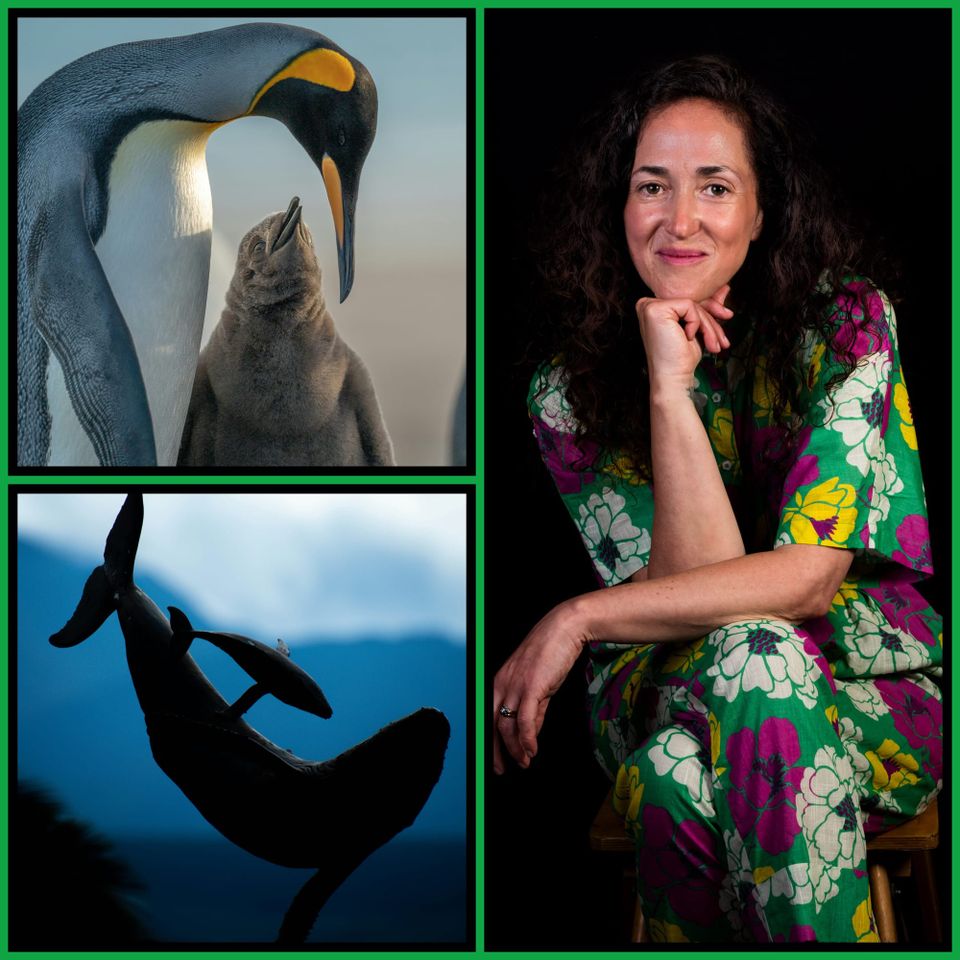
Melanie Challenger: Okay, bonus points for anyone who knows where I am in this picture. I am in the sub-Antarctic. This is King Edward Point, and this is an emperor penguin. I was in my 20s here, a writer in residence for the British Antarctic Survey. But what I fundamentally cared about is why and how is that penguin turning around and responding to me? Why are living beings acting in ways that matter to them? Where is that coming from? Why has it been left out of so many of our discussions of life now? These were the questions I was concerned about.
Steve Paulson: You've talked with Melanie Challenger a couple of times now, and I know her thinking has evolved over the years – maybe taken her to some unexpected places?
Anne Strainchamps: Yeah, the last time we talked, she had just published “How to Be Animal,” a book about the long human history of pretending that we are not animals, of trying to separate ourselves from the rest of nature. It was kind of a call to return to a more embodied relationship with the world.
Steve Paulson: But her new book, “Alive,” seems less about bodies and more about cell biology and microorganisms. Plus ancient Greek philosophy.
Anne Strainchamps: She's extending her argument, making the case that all living beings have purpose and agency, all the way down to the cellular level. And yes, then she winds up reinterpreting Aristotle.
Steve Paulson: But I know you. You are not always a fan of big, abstract, philosophical ideas. So I'm guessing that is not the main reason you wanted to talk with Melanie.
Anne Strainchamps: You know, we just really connected the first time we met. We wound up talking about motherhood and breastfeeding and how having children changes you. At heart, I think of Melanie's project as a form of re-enchantment. It’s about restoring a sense of the pulsating aliveness that surrounds us at all times – and then thinking about what might follow if we really embraced that.
Steve Paulson: That really comes through every time she talks about any of these ideas.
Anne Strainchamps: I wish people could see some of the photographs we've seen of her, looking into the eyes of an emperor penguin or a puffin, or just looking absolutely delighted to be holding a raccoon. But the other thing I really admire is the moral drive behind her work. She doesn't talk about it all that much, but when she started out in her 20s, she was not a naturalist; she was working with war survivors and children of genocide. That's the experience that led to everything else.
Steve Paulson: Wow. It’s so interesting, the turns that a life can take.
Anne Strainchamps: Melanie, I want to take you back to your development as a naturalist and philosopher. You started out by interviewing and working with survivors of genocides, of war crimes. Will you tell me a little bit about that work?
Melanie Challenger: So I was growing up in a generation affected by the environmental crisis, and also in the shadow of the Yugoslavian conflict. From that, I got involved with a very special person – Zlata Filipovic, who lived through the siege of Sarajevo and wrote a diary. She became known as the Bosnian Anne Frank. Her diary, which the UN found, was published in France and became the helping hand that pulled her family out of the siege. Zlata herself then became a spokesperson against war in general. And together we worked on an epistolary history of 20th century conflict, a book called “Stolen Voices.”
Anne Strainchamps: So this wasn't only stories of the conflict in Yugoslavia?
Melanie Challenger: No, this was all 20th century conflict — from World War I right through to the Second Intifada and the Iraq War. But the point is that right from the beginning, I was listening to or reading the testimonies of hundreds and hundreds of people who'd been affected by the worst that human beings are capable of. It completely transformed me, and continues to; that's active in you forever. So I became very interested in dehumanisation and in the underlying conceptions of humanity, of nature, of other, of self, of agency, of intelligence, that justify violence.
Anne Strainchamps: You wrote a really beautiful piece that I read some years ago, “On Death and Love.” It was about your friendship with a woman who survived the Holocaust. She also had a big impact on you?
Melanie Challenger: Yeah, so I got involved in an adaptation of the diaries of Anne Frank, for the 60th anniversary of the Holocaust. Anne Frank's Diary had never before been allowed to be adapted, but suddenly we were given permission.
Anne Strainchamps: Quite a responsibility.
Melanie Challenger: Yeah, and don't forget, I was only in my 20s at the time as well. So through that, I met and became friends with Susan – a Hungarian Jewish woman who had been on a death march from Hungary. She survived that and then she ended up in Bergen-Belsen.
This is very difficult for me to talk about. In fact, I haven’t ever talked about it publicly, and I've never told anyone what Susan said to me in those times that we spent together. But I learned something very important — and I think it's not disloyal for me to share this — which is that what many survivors share publicly is often a sanitised version.
Susan would go through two registers with me. She would go through what was possible, psychologically and emotionally, for her to deliver to journalists who would phone in and ask her questions. She would give the manageable version. And then afterwards, she would soften and talk just to me — I didn't ask her anything, but another testimony started emerging that was... horrific. The first version was already horrific, but this was even more horrific. And obviously authentic. It made me realise the stakes: that we are capable of extraordinary moral decency and acts of beauty, but we must accept that we are also capable of extraordinary acts of cruelty and barbarism. We have all of that in our repertoire and we can't just blame it on systems. It’s something about what it is to be human that we need to confront. And so, yeah, she had a really — I can't even put it into words — an enormous influence on me as a very young person.
Anne Strainchamps: You've written that you felt lost for a while after that. But then you made a turn toward life. I've seen all those photographs of you in the Antarctic, or swimming in the ocean with seals — and there is a kind of ecstatic look of joy and love on your face as you stare into the face of a puffin or a whale or some other animal. How did this happen, and how transformative was it?
Melanie Challenger: Well, that was always in me. I was always in love with the living world, and always felt a great kinship with, and loved to be in nature. Actually, you know, Susan — I remember her description of when she went to Sweden after she was rescued. She and other young girls, who obviously were emaciated, could barely metabolize food at that stage. They arrived in Sweden at Christmas time, and she remembered the strangeness of all the lights and the joy, while they were dead inside, and also close to death physically, as well. But then she describes this extraordinary spring in Sweden, when her body started being able to take food, and all of their bodies started to put some fat on them, get some shape again. They started to bloom again, and they couldn't help but start to feel joy — not so much, at that stage, with the human realm, but in the blossom on the trees, in the sun, in the living world around them. I think for me — obviously, not remotely analogous to anything like that — but what happened for me was that kind of native interest that I already had in the living world became, slowly, also a moral way of attending to a different possibility.
We've done awful harm to the rest of the living world. And there is a relationship between the harm we do to one another and the harm we do to other living beings. You can't ignore that. But that also goes the other way. If you can convince people of the truth that other living beings are also special, are also intelligent, are also capable and meaningful and have intrinsic value, then the ability to dehumanize starts to weaken. The effect doesn't last forever, but it tells us something very important about the impact of the ideas we carry around in our heads.
Anne Strainchamps: And that there is a path back, not only in terms of how we treat ourselves and other human beings, but in how we treat the other animals around us. Were there moments for you of, I don't know if I want to say bliss or ecstasy, but...
Melanie Challenger: Well, I wouldn't use those words, but when I was working on my first book, on extinction and the history of whaling, I spent some time in Antarctica, in the sub-Antarctic islands like South Georgia, where we annihilated, almost to the point of extinction, the blue whale population there. And also the fin whales, the minke whales, and so on — all reduced to units for the oil industry at the time. It was just all so dark. But I was very determined that you can't do that work properly if you only read the histories, if you only theorize. Who is a blue whale? Have you met a blue whale? Have you experienced a blue whale? So I was lucky enough to join Rodrigo Hucke-Gaete and his team in Corcovado, Chile, where they were trying to identify and protect what they thought was a blue whale nursery.
Anne Strainchamps: Calving grounds?
Melanie Challenger: Yeah, so it was pretty great. The field biologists were all camping out together and I was tagging along. Sometimes you’d be on a hill above the ocean, trying to spot whale blows and radio them in – because they were trying to get genetic samples to prove that this was an important blue whale population and to protect them. Which they succeeded in doing, I'm pleased to say.
But then some days you’d go out on a boat. And blue whales are super fast and they're super skittery — they will get away from you as quickly as they can, just go right down, and then pop up miles away. They're such fast swimmers. So I remember one day I was out with them, and we were roughly where we figured this animal was going to surface. And suddenly I hear this “WHOOOOOSH” right behind me. And immediately a big breath full of fishy, krill-y, sort of grossness that's overpowering – because this is a big exhalation that you're experiencing.
We turned around, and he or she was just there — two or three feet away. Now, if you're close to a blue whale like that, your eye can't capture their size. She’s just too big, you can't take her all in at once, you have to quickly try and puzzle her together. And at some point, I saw her eye – and it was one of those moments that is impossible to put into words. A real encounter with another sentient intelligence. So, you know, what is ecstasy? What is bliss? Another way we could say it is that it's something untranslatable.
Anne Strainchamps: Which is the definition of a transcendent experience. You know, there’s an entire literature in ecology, of naturalists having those eye-to-eye experiences. They’re famous. I collected them at one point.
Melanie Challenger: Oh, I love that you did that.
Anne Strainchamps: People's lives have been changed by those experiences.
BREAK
Anne Strainchamps: So I have to say, reading your books — “Alive” and “How to Be Animal” — I had a few moments of feeling how much life surrounds us at all moments; we’re truly never alone. Which made me realize that most of the time, I walk around unaware of all those other living beings. And how is it that I can treat the rest of the world as of no more importance than my car dashboard?
Melanie Challenger: That's a huge question. So in “How to Be Animal,” I was really diagnosing that problem, asking how we have come to see life in this machine-like way? And how does it serve us to do that – because it does serve us. It helps us to feel good about ourselves, buffers us, makes us think we’re unique and special, helps our moral systems function, gives them a certain foundation. It also allows us to exploit other living beings. The fact is, there's only 4% of wild mammals left. Most of the rest of mammals are in our food systems, not able to live autonomous lives.
Anne Strainchamps: Let’s just pause to underscore this: 96% of the mammals on Earth right now are either humans – or livestock?
Melanie Challenger: Correct.
Anne Strainchamps: Only 4% of wild animals left.
Melanie Challenger: 4% are doing their own thing. That's why I started thinking about agency, and that's what “Alive” is about — looking at how we define life. And I define life as a being in the world to whom things matter. Because that’s what is so remarkable about living beings. That whale didn't move past me as a stone might roll past me. That whale moved away from me when she didn't want to be near us, and came up and took a look at us when she did want to be. I didn't just look at her; I was looked at also. I think we've lost the ability to trust that when we are out in the living world and the hoverfly comes and is eyeball to eyeball with us for a while, or the hummingbird gets startled by us — that this is a subject in the world who is responding to our disturbance because something matters to them and they can act on it. We need to learn again how to trust that that's really what we're seeing, and we need to unlearn the idea that we're seeing a machine.
Anne Strainchamps: And there's an emotional and psychological value to this also. Our long history of denying that we are animals goes back to where we began – it goes back to death. To our terror of mortality and our desire to separate ourselves from other fleshly beings, to say we’re special, we have minds – we are not just bodies.
Melanie Challenger: Absolutely. And so why do we do this? One reason is that it offers a source of salvation — the idea that there's something in our minds, some kind of unique mental identity, that will outlive this messy, mortal body. What I’m saying in “Alive” is that the weight of evidence suggests that all that we value about our lives — the capacity to have feelings, the capacity for things to matter — all of that is actually the result of the living body doing the work it does to keep your whole self alive.
Anne Strainchamps: I don't want to confess this, but I am one of those people who thinks of my body as a thing to carry my head around.
Melanie Challenger: Oh, there's some great science on that! I'm terrible with names, but there's some great work on where that kind of figment arises, this notion that you're located somewhere between your eyes. LIke, why do we think the self is up there? But you can mess with that, even just on a walk in the forest. A really nice little trick to do is: think about the stuff that's worrying you. Proper prefrontal cortex stuff, really self-attentive thinking. Do that, and you will strongly have the kind of “torch beam coming out of the middle of your third eye“ sensation.
Anne Strainchamps: I can feel my forehead burning already.
Melanie Challenger: Then, maybe there's a woodpecker in the forest. Stop and really listen to that woodpecker. Your attention can’t maintain that sensation [of being entirely in your head] while listening. And if you then start moving again while continuing to listen, suddenly the whole of your body will come back into focus again. Proving that who you are is not just your thought processes!
You know, when we think about dementia, it's very common to hear people say, “well, my dad, or my mum, is gone now. They’re just a shell of who they were.” And yes, I understand that’s how it seems, and that you’re grieving – but actually, they are still who they always were. They're not NOT themselves just because they’re in a different stage of their life cycle, aging and degenerating. But when someone seems like he or she is “just” a body, we have this tendency to think they aren’t there, or don’t matter anymore.
Anne Strainchamps: Which is strange because at the other end of life, we adore babies. And yet very small babies, who can’t speak yet, are all body.
Melanie Challenger: They’re all body, and they think they're your body! We're both mums — anybody who has spent a lot of time with a newborn baby knows they are just outraged to be removed from their mother's body. (Sorry, dads, but I am going to say “their mother's body.” It just is.)
Anne Strainchamps: So that’s another primary experience of being embodied – those times when you feel that you and another body are kind of continuous.
Melanie Challenger: Again, there's so much in this. I mean, it would be easy for me to come here and just talk seriously about my philosophical project. Because as soon as I start going into this more emotional territory, it can come across as less credible or authoritative. But — biologically speaking, where does our capacity to generalize our love to one another come from? From repurposing the kinds of biological processes that have evolved to enable mothers and infants to bond with one another. Evolutionary process has given us the chance to repurpose what worked well between mother and child, to press that into service in the name of getting on with thy neighbor – or thy dog. So there are lots of ways to think about motherhood – both political and scientific. But I think when you are a mother, and you've been a mother, you cannot but be present with your body. You are all body, and you know it at the time. And for many women, it changes them forever.
Anne Strainchamps: We live, as we've said, in a very disembodied culture. So moving on to your new book, “Alive,” it opens with a scene in Sequoia National Forest, with the seed of a sequoia tree. Tell me why you began with a seed.
Melanie Challenger: Well, actually, that was partly through being a mom. During the pandemic, my son just fell in love with giant trees. And in Scotland, we have some of the trees that John Muir brought back from California.
Anne Strainchamps: I didn't know that! Do you have sequoias?
Melanie Challenger: We do. And there are wonderful maps, created by some of the world’s great geeks, that show where these big trees are in Britain. So we started visiting them with my son, and then he wanted to try to grow them. So we did.
Anne Strainchamps: You grew a sequoia?
Melanie Challenger: We not only grew sequoias, we have them in our back garden now. They’re about a meter and a half tall by now and we grew them from seeds. And I will just say, my goodness me, sequoias are very difficult to grow from seed! They are tricksy little things. I really had to learn how to mother them.
Anne Strainchamps: Well, this is kind of the point of the story, because they're serotinous, right? They’re seeds that only really hatch, if that's the right word, in a forest fire?
Melanie Challenger: Yes, sequoias need fire. They've adapted to fires in forests, that’s when the cones open out, and the seeds get dispersed. So I wanted to think about: what is that seed? You look at that seed and it looks like nothing. It looks like a speck of dust. Yet inside, there’s actually a kind of little miniature tree. I don't mean as in a genome — I mean there’s a real miniature entity in there.
Anne Strainchamps: It's an embryo, correct? It’s been fertilized.
Melanie Challenger: It's been fertilized, and it will wait and wait inside that seed husk, for the right conditions. The point is, you would look at that and think it was dead. But there is still something going on in that seed – I think about 10% metabolism ticking over – just that little bit of activity. A sequoia seed isn't really a full agent yet, but it is alive. It's working to persist.
Anne Strainchamps: On the edge between life and not-life. And so what is that difference? What makes the sequoia seed alive?
Melanie Challenger: I think the work matters. All life is working really, really hard to keep itself together. It's effortful to be alive, to cohere into a unique form of organization. Life takes a giant step when it embodies itself, embodies values and meaning in order to keep going, to persist.
Anne Strainchamps: What changes when you define life this way – as purposeful?
Melanie Challenger: Firstly, it means that when you look at a honeybee, you are no longer looking at just a straightforwardly forgettable, squashable, pesticide-able object.
Anne Strainchamps: Not just a generic honeybee.
Melanie Challenger: Not a generic, machine-like honeybee. You're looking at something that is causally unique within the cosmos. (As far as we can tell; I should add that I suspect there's life elsewhere.) These are beings that are doing work to act in ways that matter to them because of values that exist within them. All of life has that quality, and nothing else does. AI doesn't have that and a machine doesn't have that.
Anne Strainchamps: Part of the work you did to get to that definition involved re-reading and re-interpreting Aristotle. In fact, you kind of fall in love with Aristotle. Why?
Melanie Challenger: I do, although Aristotle says some pretty crazy things, particularly about women, that I don't love. But he was of his time — this is 2,500 years ago, the fourth century BC. But what is interesting about Aristotle is that he was ostensibly a field biologist. He was observing, capturing, dissecting. And he was trying to answer this same question — what is a living being? What he hit upon was that the quality that really differentiates life from the rest of matter is this purposeful quality. The fact that living beings seem to have purposes, and the ability to act towards those purposes.
Within this description – particularly in De Anima, that he's most famous for – he refers to what he calls psyche. And this got translated as “soul.” He was saying that this special “something” about life is because of soul. In fact, he said being alive is empsychon, which we could translate as “being en-souled.” But I think that's the wrong translation. I think the right translation is that to be alive is to be a living body. For him, that meant that you weren't just the stuff you were made from, the matter. You were matter living your life, being alive. He said that those things could not be separated out from one another.
Anne Strainchamps: Body and life?
Melanie Challenger: Body and soul. They could not be separated from one another. You were en-souled as a living being. Matter and being and living coming together into this novel form, the living body. But there remains a very interesting question. It’s a scientific question – in some ways a theological question – and a philosophical question. It’s also the question that troubled Aristotle. And this is maybe a fun kind of mystery to leave it at, which is: where does the potentiality come from? That is an unknown.
Anne Strainchamps: Always good, I think, to end in mystery.
Anne Strainchamps: Melanie Challenger is a philosopher and naturalist, a National Geographic explorer, and an award-winning poet and opera librettist. She's the author of “How to Be Animal” and “Alive, The Hidden Intelligence of the Natural World.” I'm Anne Strainchamps.
Steve Paulson: And I'm Steve Paulson. This episode was recorded at the Island of Knowledge, a small think tank in Tuscany, with support from the John Templeton Foundation and Dartmouth College. Thanks to them, and to our audio engineer, Steve Gotcher, and our digital producer, Mark Riechers.
Anne Strainchamps: Wonder Cabinet comes to you from two places we love, Madison, Wisconsin, and Vershire, Vermont. You can send questions or comments to us on our website. It's wondercabinetproductions.com.
Steve Paulson: We'll be back next week with a conversation about enchanted landscapes and rural folklore with Daniel Mason, author of the new novel, Country People. Until then, be well.
Subscribe to make sure you never miss an episode.