
21 Nov 2026
Can Science Be Sacred?
Physicists Marcelo Gleiser and Adam Frank on how science lost the sacred, and why bringing wonder back might change how we treat the planet.
0:00 / 0:00
21 Nov 2026
Can Science Be Sacred?
Physicists Marcelo Gleiser and Adam Frank on how science lost the sacred, and why bringing wonder back might change how we treat the planet.
ShareEpisode Notes
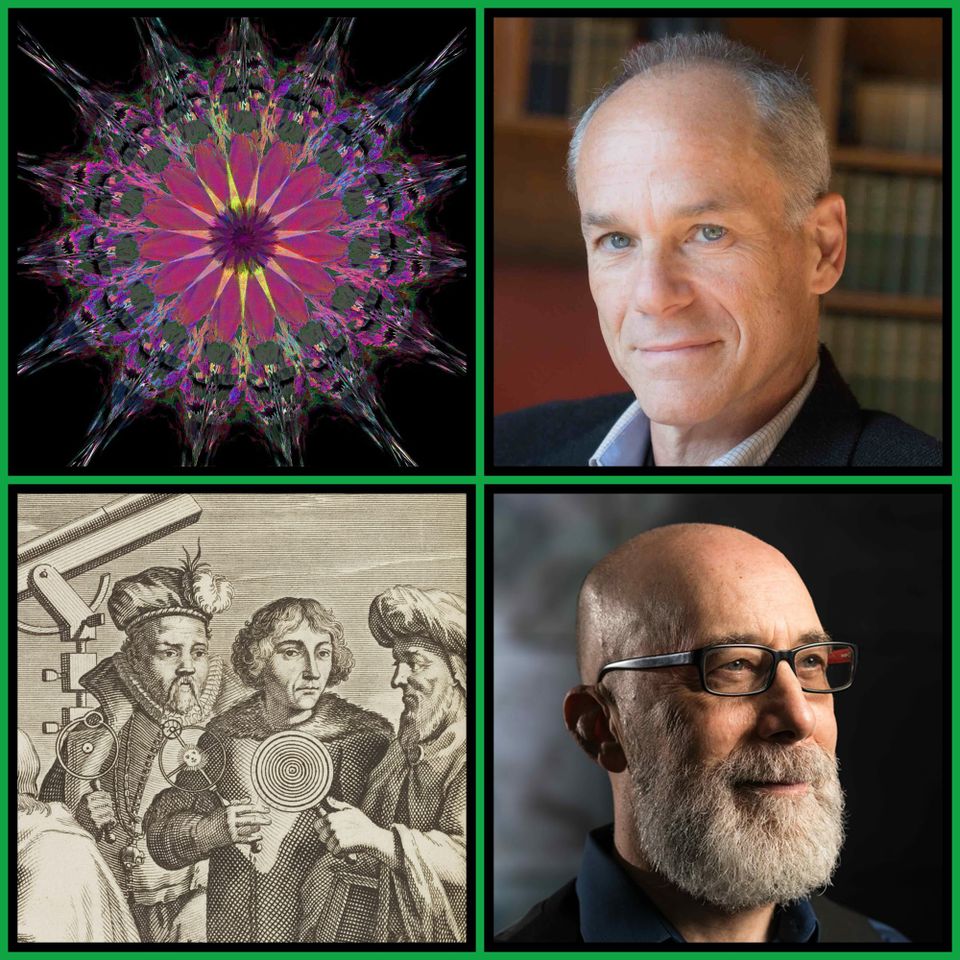
In the hills near Siena, at a small think tank called the Island of Knowledge, Anne Strainchamps sits down with two physicists who believe modern science needs to remember its roots. Marcelo Gleiser, theoretical physicist at Dartmouth and winner of the 2019 Templeton Prize, and Adam Frank, astrophysicist at the University of Rochester, argue that Kepler, Newton and Einstein saw their equations as something close to prayer. Somewhere along the way, science came to treat nature as dead matter to be poked, extracted and burned. Marcelo and Adam call the remedy “resacralizing” the world.
Their conversation moves from Galileo’s beautifully crafted instruments to Frankenstein and transhumanism, from the mystic physicists who invented quantum mechanics to the postwar American push to “just calculate.” They talk about hierophany, the moment when the sacred breaks into ordinary life, and how it can arrive in the middle of a calculation. Marcelo recalls the thrill of discovering the oscillon, a bubble of energy that doesn’t want to die. Adam describes Zen kensho and the poetry hiding inside mathematics.
They also speak about the losses they carried from childhood, and how the stars and the big questions of physics offered direction and perspective. Finally, they look beyond the Western canon, to Brazil’s indigenous traditions and to philosophers like Nagarjuna, for the ideas that could help build a new kind of science.
- More from the "Island of Knowledge" series
- Book: "The Blind Spot: Why Science Cannot Ignore Human Experience"
- Book: "Frankenstein"
- Book: "The Constant Fire: Beyond the Science and Religion Debate"
- Book: "The Dancing Universe: From Creation Myths to the Big Bang"
- The Island of Knowledge
Transcript
Anne Strainchamps: Welcome to Wonder Cabinet. I'm Anne Strainchamps.
Steve Paulson: And I'm Steve Paulson. In the hills of Tuscany, a small group of scientists and philosophers is trying to bring modern science back into alignment with its nearly forgotten roots.
Anne Strainchamps: With a vision of the universe as sacred and science as a practice of communion with it.
Marcelo Gleiser: The story is that I've always been fascinated with the mystery of existence. You know, who are we? Why are we here? Why are we thinking these things and my goldfish isn't?
Steve Paulson: This is the theoretical physicist Marcelo Gleiser.
Marcelo Gleiser: Then I started to look at the history of philosophy and of science, and I realized that all these other people before me, Copernicus, Kepler, Newton, all of these guys, to them, the motivation to do this kind of science was to be in communion with a wholeness. So the science was almost like a prayer. And the equations were like this kind of hermetic language that would create a connection with this transcendent existence.
And Einstein comes along, and then Pauli and Schrodinger, and these guys are all quantum physics, but yet all of them, in a sense, mystics as well.
Steve Paulson: We're at a small think tank near Siena called the Island of Knowledge. Marcelo Gleiser and his wife, clinical psychologist Kari Gleiser, started it as a place to hold conversations about how to get beyond reductionist models of science into a more holistic view of life. Marcelo calls it resacralizing the earth.
Anne Strainchamps: There's a 16th century chapel here, retrofitted with cozy chairs and an espresso machine outside. And those are the original bells.
Steve Paulson: We have been recording interviews here for the past couple of years. You've probably heard some of them. But this week, Anne's doing something a little different.
Anne Strainchamps: We're going to hear a conversation I had with Marcelo and his close friend and collaborator, Adam Frank, about what exactly they mean when they talk about bringing science and the sacred together. Adam is a leading astrophysicist at the University of Rochester. He works on the evolution of stars and signatures of alien life. And he's written a whole string of popular books. The last two were The Little Book of Aliens and The Blind Spot, the book he co-authored with Marcelo and their friend, the philosopher Evan Thompson.
Steve Paulson: And Marcelo's also written a lot of popular books, including The Dawn of a Mindful Universe and The Simple Beauty of the Unexpected. He's a physicist and astronomer at Dartmouth College and the winner of the 2019 Templeton Prize. So take us into this interview. Where did you begin?
Anne Strainchamps: Well, we were sitting in the home of the Italian Renaissance, not far from where Galileo clashed with the church and jump-started Western astronomy. So I figured we'd start there.
Anne Strainchamps: Okay, you guys. Here we are in a place where several hundred years ago, another scientific revolution began. Adam, you made a bit of a pilgrimage to Galileo's house?
Adam Frank: I did. Yeah. Arcetri, which is the astronomy institute, is just, you can see Galileo's house from there. So I both made the pilgrimage to Galileo's house and also the pilgrimage to the Galileo Museum multiple times. And my daughter came with me once.
And the first time I went, at some point she's like, dad, do you need to sit down? Because I was just overwhelmed, because the Galileo Museum is not just Galileo. It's really the birth of science. And you see these beautiful wooden instruments that these guys were building by hand that actually allowed them to see some of these deepest principles about mechanics and so on. And you think, my God, I have these super powerful computers and I couldn't have come up with what they came up with.
Marcelo Gleiser: It's funny because I met you at Galileo's house for a meeting in astrobiology. Remember this? We both spoke. So the meeting was actually where Galileo lived, which between us, for me, a guy who was condemned by the Inquisition, right?
Anne Strainchamps: Lived under house arrest.
Marcelo Gleiser: A house, but a nice house. I mean, it could be worse! So this thing that Adam just said is that the scientific instruments were works of art.
Anne Strainchamps: Oh, they're so beautiful. Steve and I went to the Galileo Museum. And for one thing, not only are they beautiful, they're made of silver and gold. Some of those armillary spheres, they're just...
Adam Frank: And the engravings on them. I mean, it's clear there was love put into these.
Anne Strainchamps: Well, and then you think about the riches and the artistry lavished on objects that felt sacred.
Adam Frank: Yeah. It's an interesting thing to think about because both of us have a sense of the sacred. We're people who're like, oh, religion is stupid. The idea that human beings have the experience of the spiritual, for lack of a better word, of the sacred. I think we both also really like the word sacred.
In some sense, one of the things we're arguing is that when early science, like Kepler, they felt that clearly there was a unity between what they were doing scientifically and the sense of the sacred. And then for whatever reason, and we can talk about how that got pushed out, to have that view was now heresy within science. And one of the things I think we're arguing is that you need to have that back. Because if we don't, it's clear that we're pushing the planet off.
Marcelo Gleiser: That's it, because this worldview of separating science and nature from the sacred, so to speak, it happened because of the objectification of nature. So in order to study nature from the outside in, you had to push yourself out, and have this objectivity. So now nature is this thing that is outside of us. And so you can poke it, you can study it, it becomes an object.
And because of that, the whole Industrial Revolution didn't have any qualms about poking, extracting, burning material resources, because nature wasn't sacred anymore.
Adam Frank: There was a philosophy, which was really a bias, that many people claimed is what science says. Science is a way of entering into a dialogue with nature. But the killing, making it seem like, oh, it's a dead universe. That's a philosophical bias. You could still have science without that.
But the interesting thing to see is that when the Royal Society was founded, one of the first scientific institutions, a third of its members were members of Parliament. The methodology that was emerging in science was recognized as being powerful, that it would lead to advances in your political economy and your military strength. And the political economy that emerged out of that had the same supposed scientific views. So then a mountain, there's nothing sacred about the mountain. The life on the mountain is like, yeah, whatever. You can only see the amount of board feet of lumber on the mountain.
And so we ended up with a political economy that reflected not science, but these metaphysical biases that people were gluing, like pin the tail on the donkey, onto science, saying, oh, this speaks for science. And it worked for a while, but now it's clearly not working.
Anne Strainchamps: But then you could say the fault is not the fault of the scientific worldview. I mean, you're talking about the fault being industrialization and the creation of global capitalism.
Adam Frank: The desacralization of the world, sort of the world becoming dead, right? So there's a famous quote by a famous physicist, who I will not name, who says, the more we learn about the world, the more we learn it's meaningless. Kepler would not have said that.
Marcelo Gleiser: Steven Weinberg said that.
Adam Frank: But that viewpoint, of a dead world, that the universe is just made of dead matter bouncing randomly in the universe. That is something that slowly emerged, certainly by the 17th century, by the time you get to Laplace and his idea that if you knew where every atom was and the velocity of every atom, you could predict the entire future, right? That is something which emerges in the 17th and 18th century, and it's a kind of certainty. It's because the power of the church is passing, the power of science is rising, and this was almost a replacement for God.
It's like, oh, we have certainty because science gives us certainty, which was what the Enlightenment wanted. The Enlightenment was looking to get past the superstitious nature of religious thought. But it threw the baby out with the bathwater in some sense. And then you ended up with a dead universe, and so there was no place for sacredness anymore.
And then as the economies of scientific power or technological power grow, I think that's when you really find the sacredness being beaten out of the intelligentsia, of the culture creators. You're considered kind of stupid if you wanted to talk about it, unless you were a romantic painter. But anybody else, anybody wanting to do science? Don't talk about the sacred.
Anne Strainchamps: Well, that gets to another point I was going to make, which is when we talk about the scientific worldview, that worldview is the culture we swim in, right? It touches so much of our lives and structures so much of our thought in ways that we don't even recognize. You probably have favorite examples.
Marcelo Gleiser: Well, you know, I love Frankenstein because Frankenstein, to me, is the best metaphor of science going nuts, right? Because the biggest, in quotes, enemy of life is death. So if science is truly powerful, godlike powerful, it will control dying. So Frankenstein, written, you know, 1817, if I'm not mistaken, by a 19-year-old lady, a teenager.
So she writes this book, which few people read now because everybody goes to the movies. And the movies are completely different from the book. In the movie, the creature is like a kind of guy, like Boris Karloff going “aahhhrrrgh.” In the book, the creature is a genius. And the creature asks the creator, Dr. Frankenstein, to create a partner, a woman creature. If he did that, they would move away and disappear into the Arctic or something like that.
So Dr. Frankenstein realizes that if he does that, because this creature is much smarter and much stronger than the humans, their progeny would make humanity useless. And so it's like, I'm not going to do this because otherwise I'm going to destroy humanity. So here we go. AI. AI is going to dominate the world.
Transhumanism. What is transhumanism? It's using the science of today, which is all about information theory, so that you, Anne, you're an information structure that can be decoded. This is the hypothesis, right? Or the doctrine. It's more like a religious doctrine.
You can be decoded, and then you can be put into a hard drive, and you don't need this carbon-based useless body of yours because your information will be perpetuated in a machine. It doesn't matter that you never feel the touch of somebody or kissing somebody. That's irrelevant because you, according to this doctrine, will live forever. And what is the fear? Well, that these machines are going to control the world. So it is very much the same metaphor, that when science tries to imitate godlike powers, it backfires. It's the Prometheus. In fact, the subtitle of Frankenstein is The Modern Prometheus.
Anne Strainchamps: I really love the German sociologist Weber's idea of the disenchantment of the modern world. And it sounds to me like you're saying, science not only contributed to the disenchantment of the modern world, but science became disenchanted. I mean, maybe you could phrase the project of beginning to think your way toward a new kind of science as the re-enchantment of science.
Marcelo Gleiser: That's beautiful. That's exactly what we're trying to do. Re-enchant the world.
Anne Strainchamps: There was a thing you wrote, I wrote it down because I liked it so much. The founders of science, you said, “were all deeply spiritual, religious men and women who saw what they were doing as a way of honoring their own sense of the sacred.” So that science was a gateway to those experiences.
Marcelo Gleiser: Yeah, because, you know, people think of science as a way to the truth. And I say, uh-uh, science is a flirt with the unknown. Because it's all about what we don't know. And that is what Einstein said, that we are embedded in the mysterious.
And he has this beautiful quote, that if you're not moved by the mysterious, you're as dead as a snuffed-out candle. This mystery is the cradle of all arts and sciences. So he puts together these two things, right, that we need to create in order to engage with the mysterious. And science is another way of being creative. How do you do that? By diving into the mystery of existence. If that's not enchanting, what is, right? That's the way I look at it.
Adam Frank: And one other thing I think is important here, we somehow got this weird idea that science can explain everything, that it's science's job to explain everything. So, you know, you just saw a great production of Shakespeare and you were really moved by one of the soliloquies. Well, that's really nothing but your neurons. Ultimately, it's really nothing but your neurons. And then I'm going to tell you some evolutionary biology story about why evolution primed you to like sonnets, why you're hardwired for stories. And so it's just like, no way!
There are multiple ways as human beings that we have to know. And so one of the most important things for us is understanding that art has its own truth. The truth that you get with art does not reduce down to some property of your neurons. The truth of spiritual practice, of contemplative practice, does not reduce down to neurons or evolutionary psychology.
Anne Strainchamps: There's a word I've heard you use, Adam, to describe some of these moments of sudden enlargement. Hierophany?
Adam Frank: Hierophany, yeah.
Anne Strainchamps: What is it?
Adam Frank: Hierophany is from religious studies, actually. Hierophany is the idea when the sacred busts through. Everybody has these in their life. It could be at the birth of your child or you're just doing your dishes. All of a sudden it's like, whoa, what's going on?
I’ve had these moments like waiting on the bus in New York City, where suddenly you just feel the presence of the world. I always describe it as the presence of more. There's just more here. And so it was Mircea Eliade who coined that term. It's the eruption of the sacred into daily life, and the power of the sacred. He saw it as something that motivated and drove much of human culture. And my argument in that book was that even if we don't acknowledge it, scientific exploration, scientific creativity, as Marcelo was saying, is a place where a hierophany can occur.
Anne Strainchamps: Okay. Hold that thought. We are about to get more personal and talk about Adam and Marcelo's interior spiritual lives.
Steve Paulson: Hey, it's Steve. I want to invite you to visit our Wonder Cabinet website, where you will find more information about the show and Anne and me. And I really hope you'll subscribe to our newsletter. We'll tell you the story behind the name of this podcast and some of the amazing guests we'll be talking with in future episodes.
You can find us at wondercabinetproductions.com. And please tell your friends about Wonder Cabinet. This is a brand new podcast, and we'd love your help in getting the word out.
Anne Strainchamps: I'm Anne Strainchamps, and I'm talking with two leading physicists and friends, Adam Frank and Marcelo Gleiser, about their dream of bringing science and the sacred back together. Does that happen for you, Marcelo, in the middle of doing science?
Marcelo Gleiser: Yes, definitely. I mean, it has happened. There are moments, they're rare. A lot of it is just grinding. It's not very glamorous, but there are moments, a few in my career, not many, where I really felt that I was in touch with something which was, first of all, surprising and revealing. It was revelatory, right?
Anne Strainchamps: For example?
Marcelo Gleiser: Well, when I discovered a new structure that is now called an oscillon, which is basically a bubble of energy that doesn't want to die, that appears in certain kinds of physical systems. People doubted me when I first proposed the idea. And then I proved that it was right. And it was a visceral feeling of transcendence I felt there. It was really physical. It wasn't just intellectual. It was like, wow.
Because I actually saw – it's beautiful, on computers – you plot the energy as a function of time. And if they were right, the energy would just go to zero real quick. If I were right, the energy would stay constant for a very long time and then drop. And I saw that plateau and I'm like, damn, this bubble doesn't want to die. And it's exactly what we expected. And it was really profound.
So that was one very impactful one. And then it became a whole... How to call it, like there's hundreds of papers written about this kind of structure now in physics. So that was one example, and there are many, but also even smaller things.
Adam Frank: It’s funny, in Zen – I'm a contemplative in the Zen tradition – they talk about kensho. So kensho is this moment of realization. And there's really big ones and then there's sort of more ordinary ones. My teacher describes it as like there's a screen separating you and the sacred. And each time you do it, you kind of poke a little hole in the screen, and a little bit of light comes through.
Anne Strainchamps: So does it get easier over time?
Adam Frank: You get a little bit more familiar with it. Well, because it's a practice, right? They don't call it contemplative practice for nothing. Just like tennis, I'm going to hit 10,000 backhands until I get better at it. It does actually, yeah.
Anne Strainchamps: You know, science and contemplative practice don't seem unalike in the sense that they're also both about attention, right?
Adam Frank: You're aligning yourself. You're setting an intention. You're setting yourself into a direction. So the example I always used that I loved was the sacred and the profane. Even the word sacred comes from Roman temple architecture. There was the sacer. The sacer was when you went in there, that was the actual temple. When you went in there, you had to attend to the gods. This was a place for the gods, right? The profanum was outside where people were selling walnuts and Grateful Dead tapes, and you could do whatever you wanted in the profanum. But once you entered the sacer, you were aligning yourself. You were paying attention to the realm of the gods.
And just like with science, when you start, you sit down, we're both theorists. So that idea of sitting down at a table with a book or with a pencil and paper, and you start. And you put your head down and you're doing stuff and then you look up and it's five hours later.
Marcelo Gleiser: That's right. This sense of flow, timelessness. You're just gone. And it's a code, right? Because you're writing these equations. It's a different language, right? It's a representative language of how we come to symbolize our engagement with nature. You could probably do a little translation of what the mathematics and the equations and the rules of engagement with that kind of symbolism and sacred symbolism.
Anne Strainchamps: That's really interesting. I hadn't thought about that, that you're thinking with equations. Is it more image-based? I mean, we’re talking about these ineffable experiences, which literally means they cannot be put into words. When you're working deeply in equations, are you working in a wordless way?
Adam Frank: I think it's a poetic language. The first popular article I ever wrote was about math as a poetic language. So one of my favorite poets, John Ashbery, has a line, “rather than words comes the thought of high windows, the sun comprehending glass, and beyond it, the stillness which is nowhere and nothing.”
And to me, we've all seen sunbeams falling through a window, right? And I could go around and I could describe to you all the sunbeams on all the windows I've ever seen, but there in that one image is every sunbeam, right? And so just like these mathematical equations, like the equation for the ellipse that Kepler found for planetary orbits. In that one equation, one line, is every ellipse you could possibly imagine. So I think it's a poetic language.
Marcelo Gleiser: Right, it definitely is. And it's also an engagement of intuition and rationality together. Whenever I'm doing this, the math is coming, but it's more about images than, you know, wordly thoughts. And I don't know about you, but I would always have the intuition of the answer. And my problem was solving the mathematics to get to the answer, because this thing has to work.
But the math was complicated and we’d get stuck, right? And you're like, I can't do this anymore. So you let go. And then two weeks later, you come back and you're like, “of course, I missed this factor of two!” And then everything flows. There is something quite beautiful about that.
Anne Strainchamps: How did we ever get to the trope of the soulless, passionless scientist? I mean, listening to you both, there is so much passion, so much feeling.
Adam Frank: Like the Big Bang Theory, with the sort of super nerdy, not very human scientist. I've always been like, what? Who does this serve? This idea that scientists are these disembodied, you know.
Marcelo Gleiser: American pragmatism made a difference, honestly. I think there was a transition, because if you go back to Europe in the 1920s and 30s, when all these guys were figuring out quantum mechanics and relativity…
Anne Strainchamps: They were wild, crazy people!
Marcelo Gleiser: Right? And they knew a ton of philosophy, most of them.
Anne Strainchamps: And they were mystical. Think of Wolfgang Pauli.
Adam Frank: And his interaction with Jung.
Marcelo Gleiser: Yeah. I mean, synchronicity! I mean, when Niels Bohr was knighted by the King of Denmark, his coat of arms was the yin-yang symbol. Did you know that? He became a knight of the Order of the Elephant or something like this, and it's the Indian symbol. And the Latin says, contraria sunt complementa, which means opposites complement each other, which is the essence of why he was talking about particle-wave duality.
But the point is that these guys were inspired by spirituality in different ways and by metaphysics in different ways. And then when you go to the United States, I think there was a transition into practicality, and machine-like metaphors became dominant, especially because of the Second World War.
Adam Frank: Yeah. The center of gravity of physics moves from Europe to America after the Second World War, because before that America was not a center of physics or science, really. We were great inventors. One of the lovely things about Americans was, “hey, don't give me any of that namby-pamby philosophy. I just want to make me a tractor.”
Marcelo Gleiser: Exactly.
Adam Frank: And so then you get guys like Feynman, with that great Brooklyn accent, like “listen, pal, I don't want to hear about Heidegger. Just tell me how this thing works.” But it had a real negative consequence. And you see this with quantum mechanics: the founders of quantum mechanics really saw, “whoa, this resacralizes the world! This puts us right back into the picture.”
But then, quantum mechanics, the center of gravity moves to the United States. And people are like, “don't even talk about that. I just want to make a quantum toaster. Don't talk to me about the meaning of quantum mechanics.” So there's like 60 years where it was a career killer to actually ask, what do these equations mean? Like, “don't do that, kid.”
Anne Strainchamps: Was that hard for you guys?
Adam Frank: For me, very.
Anne Strainchamps: Were there points when you thought, “I cannot say anything remotely mystical or sacred in front of anybody?”
Adam Frank: Yeah, you definitely learned to edit.
Marcelo Gleiser: I actually tried. I tried to work with David Bohm, who was this legendary physicist that had this interpretation of quantum mechanics that had to do with wholeness. So the whole universe was implicated in things that happened. And he's like, I'm too old. I'm not taking any more grad students.
Then I went to talk to John Bell, who was this other guy who is super legendary, you know, on quantum mechanics. And I said, you know, I really want to work – this is PhD level – I really want to work on interpretation of quantum physics. And this is 1983 or '84. And his answer was, that will destroy your career. Don't do it. Do you know what he says? Make a name in a solid field of physics, of research, and then maybe people will pay attention to you later.
Anne Strainchamps: Later when you have tenure and you're safe. Then you can come out.
Adam Frank: I was lucky. As my graduate quantum mechanics teacher I had Phil Peters, the pear-shaped professor. He was kind of pear shaped, but he was such a sweet guy. And he really cared. Unlike every other quantum class I'd ever taken where you're like, “Excuse me, what do you mean? What do you mean the cat's dead and alive?” And it's like, “shut up, kid, just calculate.”
Phil Peters went through the whole thing, and he became a mentor. My friend and I, we'd both go and talk to him and ask him questions about quantum mechanics, and he was deeply interested in it. I wasn't going to go into quantum mechanics because I was doing astronomy. But it was really nice to find someone like him. But I think where we found a place to begin to explore these other ideas was in our popular, quote unquote, popular writings.
Marcelo Gleiser: Which I started after I was tenured, by the way. And I have to say, coming from Brazil, I have to thank the American educational system, because liberal arts education is just a brilliant thing. It actually gave me back my identity, because I was teaching quantum mechanics at the graduate level, crank, crank, crank, crank. And I would try to interject a little bit of philosophy there. But then they needed a course, a physics course for non-science majors.
Anne Strainchamps: Physics for Poets, I remember those courses!
Marcelo Gleiser: And there was no textbook. And I'm like, I'm going to write a textbook for them. That was my first book. The Dancing Universe was the textbook that is still used today, 30 years later. And how do I start? With creation myths of different cultures. Because they were the first answers to the hardest question we can ask, which is where does everything come from? So what did the Maori from New Zealand think? What did the Hindus and the Buddhists think? I said, those are equally valid – though not from a scientific perspective – narratives of where do we come from and why are we here. It's always about the search for meaning, really.
Anne Strainchamps: So we've circled around, talking about the ways in which science historically offered people something that's similar to what religion and spiritual teachings have offered people. Like explanations of where we came from, those big existential things. But another thing is solace in the face of suffering. In every religion, every spiritual teaching, that's one of its primary values.
And I know that each of you, when you were very young, lost family members. And I think that both of you found solace in science, that the pain and suffering and questioning that began when you were really young led to science. Am I right?
Marcelo Gleiser: In my case, for sure, because, yeah, my mother died when I was six. And so then you have this encounter with death and loss so early, which immediately makes you start thinking about time. And that's where I came from. And so as a teenager, I wasn't sure about physics yet, but I knew I had to do something related to time.
And I actually went on to study Jung a lot, because he was kind of like this – he’s a psychologist, but he has a lot of mysticism and these archetypal connections, right? Which I thought was like transcendence from everyday life here, which was what I was trying to do. But then when I found out about relativity and quantum mechanics, I said, hey, wait a second. I can think about these big questions of “what is space? What is time? What is energy? What is beginning?” How do you even begin to think about what is the beginning of everything? Being a scientist.
And that gave me, I wouldn't say it gave me solace, but it gave me a direction. A place to put that question. And engaging with the search is the process of healing.
Adam Frank: Yeah. What happened with me was, I was one of these people for whom astronomy happened when I was five. I was in my father's library and I found his pulp science fiction magazines that always had those lurid covers of either hot babes on planets or people jumping around in spacesuits. I fell in love immediately with the idea of space. And then my brother was killed in a car accident when I was nine, he was 16.
And I had a lot of astronomy books, and I'd open the books with these beautiful mosaic images of nebula and stars. And I would just look at one star and I'd be like, “what's happening there?” That's a place. And it's got its own stories. And then I'd move to another story. I'm like, “oh, what's happening on that one?”
So many people, say “oh, doesn't the size of the universe freak you out?” But it’s the other way around. Whatever I'm going through, my story is just one page in a vast book of stories. And so it was kind of a compassion for the whole universe. I mean, there's suffering everywhere – which eventually led into Buddhism as well, but decades later.
Anne Strainchamps: That vastness can be a comfort, can make your own pain smaller?
Adam Frank: Yeah, because – and this is also one of the things I learned from contemplative practice – no matter what, you're going to go through suffering. You’re going to have your hard times. And it can either be in a closet or in a stadium. The stadium is just a much better place because you can look around and there's the sky. You see that there's more going on than just you, and that's part of, I think, healing and transcendence, literally transcendence. You're transcending your own narrative.
Anne Strainchamps: So going back to where to find the new metaphors, the new metaphysics that might open up new directions in science, where are you looking? Are there world spiritual or religious traditions that might offer a counterbalance to the underlying flavor of monotheism in Western science?
Marcelo Gleiser: Well, from my perspective, I have to say that because I'm from Brazil, I'm becoming very much engaged with the indigenous traditions of Brazil now, big time. And I am blown away by the sophistication of their culture and knowledge of the forest. It is a technology, it is science. They heal people in completely different ways than traditional medicine does.
And to them, the whole engagement with nature is an exercise of the sacred. It is being part of a world that is magical. I think we have to learn from that. We have to honor these practices. These guys, they are literally the guardians of the forest. And that forest happens to be the big forest that we all should be taking care of, right? I'm very moved by that.
You know, in our movement, we've been talking a lot about this – I call it the re-sacralization of the planet. Bringing the sacred back into our relationship with the planet. And one way that I've been trying to do that is by looking at what we have learned so far of other worlds. I mean, in our solar system, and in other stellar systems. Maybe there is life out there – Adam is the expert on this stuff – maybe there are advanced civilizations really far away from us.
But for all practical reasons, this is our home. This planet is absolutely spectacular and rare in its biodiversity. Because if you go to Mars or Venus, they suck. I mean, only Elon Musk wants to go to Mars.
Anne Strainchamps: I'd be delighted to send Elon there.
Marcelo Gleiser: He can go and stay. But the point is that once you start looking at the planet in this way, to me it becomes sacred because it becomes rare, and rare is precious, precious is sacred. And more than that, we owe our existence to this planet. And so how could we not? I mean, I don't get it. How can we not take care of it, given what we know nowadays?
So my mission has been this one for the last few years, to bring out this knowledge to as many people as I can, to slowly but surely maybe contribute to a new ethos where we are relating to the planet in the ways in which these ancient traditions have related to it for thousands of years, because they know that if you kill nature, you die with it.
Adam Frank: Yeah. And for me, I came to Buddhist practice for other reasons. I didn't come to it for scientific reasons. But over 30 years of contemplative practice, of staring at the wall, I've become very acquainted with what people call Eastern philosophy – a bad word, it's the classical philosophy of India and Asia. And there's a line of profound philosophical dialogue happening in first century, third century, ninth century, starting in India, then moving over to China. Tibet is also participating in it.
And they are taking on the same questions that Descartes and Spinoza, et cetera, all the people in the Western canon, were taking on. But if you look at philosophy in the West, it's as if these other philosophers, these other civilizations didn't exist.
Anne Strainchamps: We think of them as having mythologies, not philosophy.
Adam Frank: Yeah, exactly, right? Whereas actually, Nagarjuna is a very important philosopher, 2nd century AD in India. He is comparable to Aristotle in terms of the logical analysis that he does of questions of experience and existence. But go to a philosophy of science conference and good luck finding anyone talking about Nagarjuna or Vasubandhu.
Science is a worldwide phenomenon. Before the West, before the Renaissance, there was science happening everywhere, on every continent.
Anne Strainchamps: Of course. The Ottoman Empire.
Adam Frank: …The Tang Dynasty. There would not be Western science without what the Tang Dynasty in China was doing. Or Indigenous cultures. Now we can see all the ways that the West went and got the knowledge of plants from Indigenous science.
Anne Strainchamps: And there was African cosmology…
Adam Frank: Right, right. So it's time to begin to take these other civilizations and their philosophical traditions seriously, to help us build a different kind of science, or a different kind of framework under which we'll use what we know about science to take science in a direction that can resacralize.
Marcelo Gleiser: And this is very different from what Fritjof Capra and Gary Zukav did with The Tao of Physics and The Dancing Wu Li Masters, which are saying, “look, modern physics is rediscovering ancient knowledge.” No, this actually much more important and profound: we need this ancient knowledge to reinvent a new physics. So that's how we are starting.
Anne Strainchamps: Thank you both so much for talking. It's so exciting.
Marcelo Gleiser: Super fun. Thanks.
Anne Strainchamps: Adam Frank is a leading astrophysicist. He works on the evolution of stars and signatures of alien life. His most popular recent books are The Little Book of Aliens and The Blind Spot, the last one co-authored with philosopher Evan Thompson and Marcelo Gleiser, who is a theoretical physicist, the 2019 Templeton Prize Laureate, author of many popular books, and the co-founder of the Island of Knowledge, where this interview was recorded.
Steve Paulson: Support for Wonder Cabinet's Island of Knowledge episodes comes from Dartmouth College and the John Templeton Foundation. And thanks, as always, to our audio engineer Steve Gotcher and digital producer Mark Riechers.
Anne Strainchamps: We're going to have family visiting for Thanksgiving, so we'll be taking next week off. But in the spirit of gratitude, I just want to say a huge thank you to you for helping us launch Wonder Cabinet, for recommending it to your friends and followers, and for being here with us every week.
Steve Paulson: We'll be back with you in early December with the true story of St. Nicholas and the remarkable tale of how his bones were stolen nearly 800 years after he died. It's one of the all-time great heist stories.
Anne Strainchamps: Be well. See you next time.
Subscribe to make sure you never miss an episode.