

25 Apr 2026
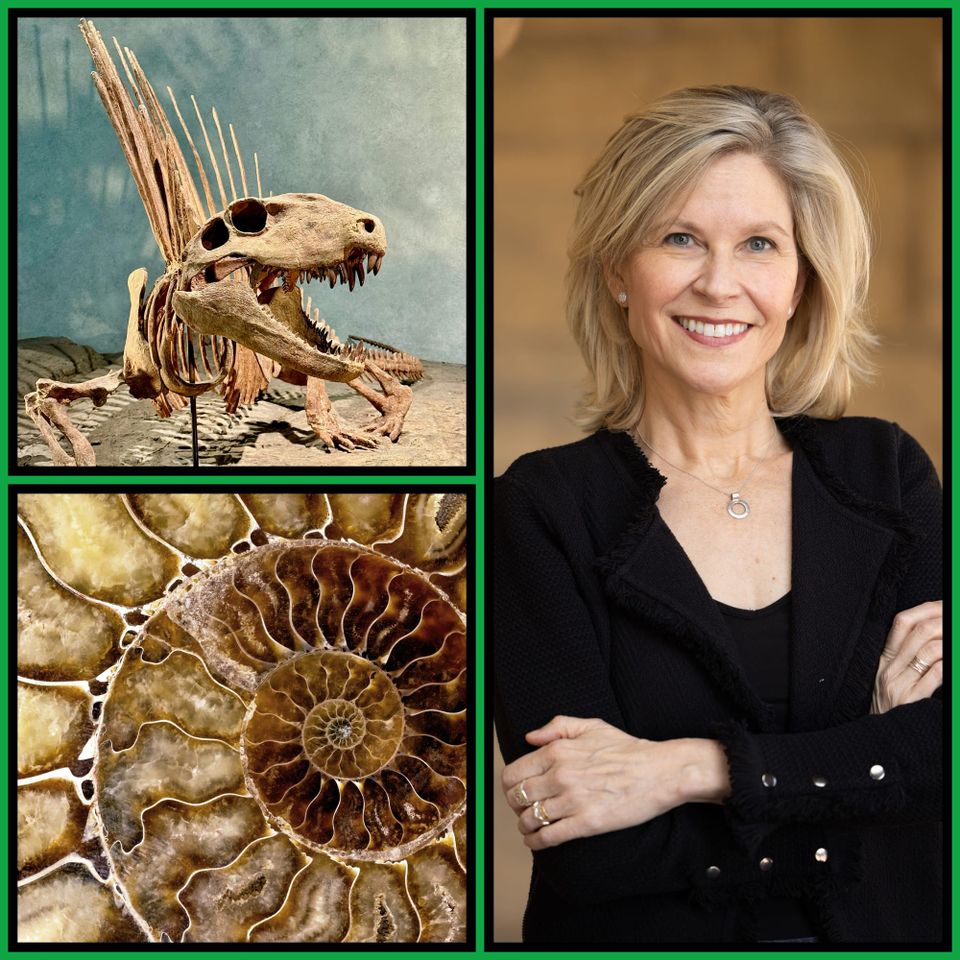
Caroline Winterer: Dinosaurs, Deep Time and the American Soul
Dinosaur bones reshaped how Americans see themselves — and their continent. Historian Caroline Winterer traces the deep time revolution and its darker consequences.
0:00 / 0:00
25 Apr 2026
Caroline Winterer: Dinosaurs, Deep Time and the American Soul
Dinosaur bones reshaped how Americans see themselves — and their continent. Historian Caroline Winterer traces the deep time revolution and its darker consequences.
ShareEpisode Notes
T-Rex. Brontosaurus. Diplodocus. Just the names conjure something enormous — a sense of scale that dwarfs human history. Standing before dinosaur tracks in the Utah desert, or gazing up at a towering skeleton in a natural history museum, you feel it: the vertigo of deep time. Millions of years of life and death, compressed into bone and stone.
Two hundred years ago, Americans began unearthing mysterious fossils and giant bones they didn't even have names for yet. Almost overnight, something remarkable happened: the New World became old. The United States went from infant start-up nation to the blueprint for all of creation.
Stanford historian Caroline Winterer traces this deep time revolution in her book How the New World Became Old — and she shows us how profoundly it shaped American identity. We still think of dinosaurs as fun, as children's toys and museum spectacles. Few of us realize how deeply they underwrote a national mythology — one that fueled American exceptionalism, manifest destiny, Christian nationalism and genocide.
This is a story about wonder and awe. And it teaches us that those emotions are neither simple nor neutral.
- Caroline’s website
- Caroline’s book "How the New World Became Old: The Deep Time Revolution in America"
Transcript
Anne Strainchamps: Welcome to Wonder Cabinet. I'm Anne Strainchamps.
Steve Paulson: And I'm Steve Paulson.
Anne Strainchamps: Imagine hiking in one of those red rock deserts in Utah on a scorching afternoon — so hot and dry, there's nothing moving for miles.
Steve Paulson: Once this was lush green land, flowing with water, and once a giant sauropod walked right here.
Anne Strainchamps: Its feet sank into the mud, its footprints dried and baked into rocks. And today, 150 million years later, they're still here.
Caroline Winterer: Yeah, they're huge. You can go off into the scrubby desert, and for literally millions of years, the tracks of not just one dinosaur, but multiple dinosaurs have been kept intact. And those footprints are really, really, really big.
Anne Strainchamps: Caroline Winterer is one of millions of people who've made the trek to marvel at dinosaur tracks in places like Utah and Texas and Wyoming and Colorado — places where you can feel the wonder of deep time.
Steve Paulson: Which is such an American experience. I mean, we've stood and looked out at the Grand Canyon and Yosemite Valley, and you're looking at hundreds of millions of years of geology. But Caroline Winterer has a special perspective on all that wonder.
Anne Strainchamps: She's a historian at Stanford, and she wrote a book that is one of the best things I read this year. It's called How the New World Became Old: The Deep Time Revolution in America. So it links dinosaurs and the geological strata and time itself to American identity.
Steve Paulson: The story begins in the late 1800s, when people in the U.S. first began digging up dinosaur bones. They didn't even have names for them yet, but they fell in love with them.
Anne Strainchamps: And we're still in love with them, right?
Steve Paulson: Absolutely.
Anne Strainchamps: Dinosaurs are like our national mascots. We give them nicknames and cartoon identities. We make theme parks out of them and put them on lunchboxes. But to understand where Caroline is going to take us, you have to know that when people first began digging up all those fossilized bones, they didn't realize how old they were.
Steve Paulson: Right, because people still thought the Earth was only 6,000 years old.
Anne Strainchamps: Yeah, and they also thought this continent was the last one to emerge after God drowned the Earth in an epic flood.
Steve Paulson: The one Noah survived.
Anne Strainchamps: So this new world was just a baby on the world stage — a bratty, inferior, younger sibling compared to the older civilizations in Europe and Asia.
Steve Paulson: But then, looking at that geological strata, they began to realize that this continent was actually billions of years old. That's the deep time revolution Caroline refers to, and it becomes a real source of national pride.
Anne Strainchamps: Yeah, but here's what I think is key. The way Caroline tells it, this deep time revolution is like the missing piece in the story of American exceptionalism — because it was used not just to bolster America's standing in the world, but also to justify manifest destiny, Christian nationalism, even genocide. And so the lesson here is that we need to examine wonder and awe, to think about where those emotions take us and the uses to which they're put.
Steve Paulson: And in America, it all begins with dinosaurs.
Anne Strainchamps: So I wanted to start by talking about dinosaurs. You wrote that this book began with dinosaurs, that you've loved them ever since you were little.
Caroline Winterer: Yeah, in part because I grew up in the West, in the United States, where unlike the East, whatever dinosaurs there are, are often very visible on the surface — in places like Utah and Colorado. But I also was lucky to grow up in a house with parents who seemed to like picture books, and they had a wonderful two-volume edition of dinosaur paintings from the 1950s. And my favorite was Pachycephalosaurus, which has this crazy big bulbous head with lots of knobs on it. So to a four-year-old, this seemed like the best kind of dinosaur to be — the really weird-looking one. But yeah, it catapults you into this world of imagination. And unlike many people, I did not outgrow my childhood adoration.
Anne Strainchamps: It's funny how dinosaurs and childhood go together, right? Like you, I loved those picture books about dinosaurs. I loved going to natural history museums, seeing dinosaur skeletons. But there were probably 20, 30 years there as an adult when I didn't have dinosaurs in my life. And then I had kids, and there were the dinosaurs again.
Reading your book got me to think about how that is a bedrock American experience — how dinosaurs are embedded in our personal childhoods, but also in the childhood of the nation. So why and how did dinosaurs become part of our national identity?
Caroline Winterer: Yeah, so it turns out that this idea of deep time, which is the container for the dinosaurs, unfolds over the course of a single century. So that's why I dare to call this a revolution — a deep time revolution — because by historical standards, this is a very rapid changing of people's minds.
Anne Strainchamps: 100 years is nothing.
Caroline Winterer: It's nothing in the drop of time. And so if you had interviewed, let's say, the founding fathers in the American Revolution, all of them would have given you a version of this answer to the question, how old is the Earth? They would have said, well, it's about 6,000 years old. How do we know this? Because if you run the numbers in the Bible, that's kind of what you roughly come up with — a creation date of around 4,000 BC. And somehow over the course of the next century, the bottom drops out of that chronology.
And through a variety of new projects — for example, the desire to find what are called fossil fuels to power the Industrial Revolution, the desire for white people to expand into Western lands beyond the Mississippi — projects that we have simply thought of as the building of the national infrastructure in fact required the building of a new national chronology. They were digging into strata, for example, in upstate New York, where they found really weird early life forms like the famous trilobites, which are about as big as — if you were to wear a pendant on a necklace, it's about that big, like a big silver dollar-sized little creature that crawls around.
And this was very haunting to Americans. There were layers of rocks, and then suddenly there were trilobites. And how had this happened? They started to wrestle with this in the 1820s, during the John Quincy Adams administration.
Anne Strainchamps: I love this image of ordinary Americans out there digging for the transcontinental railroads and pulling up not just trilobites, but also dinosaur bones — these things that are larger than any living creature today. I'm trying to think my way back into how incredibly knocked out people must have been, and just disbelieving.
Caroline Winterer: Yeah, these things are huge, and they like to pose with them. Like, look at this giant femur — it's as tall as an adult human. And they love especially to ship these things to Europe, to show that Europe might have Roman ruins, but Americans have something not only older, but bigger. And that's really striking, because Pompeii had just been uncovered the previous century. The reason Pompeii was so exciting was because there were actual human bodies there. But Brontosaurus is way bigger than that. So we too have bodies in America, and our bodies are bigger than your bodies. This is very much about the creation of American nationalism.
Anne Strainchamps: You said that you started writing a book about dinosaurs, and then eventually realized that you were writing a book about God. And you've got this lovely line — "deep time caresses the divine." Can you try to bring that alive a little bit, in terms of how it must have felt to people?
Caroline Winterer: The reason that normal people could get on board with this is because the deep chronology of time makes God even more amazing, because it says he operated over much larger spans of time than we had thought. The mere six days of Genesis is just child's play in comparison to the billions of years over which God continually lavished the greatest expression of his love, which is his creative energies. And they talk about that constantly. Look at God, look at him — he's implanting the trilobites, and then he's implanting the coal forests that are now giving illuminating energies to us. And then he goes again. He gives us these enormous brontosauruses that we are now uncovering. And then he does it again and brings us the animals of the Ice Age. And then finally, his crowning creation — man, again using the Victorian terminology, man. And this enables an even more majestic conception of God.
And so a lot of people say, yes, the dinosaurs are for me. They are a sign of God's love.
Anne Strainchamps: God gave us Adam and Eve and also the dinosaurs! But surely there were debates about how the hell do you put these things together. Were there dinosaurs in the Garden of Eden or not?
Caroline Winterer: Yeah. The problems really don't start until the publication of Darwin's Origin of Species in 1859. And the reason that problems begin is because Darwin posits a way to imagine the changing of the guard in the life forms — you know, from trilobites to dinosaurs and all that — without any godly agency. He says that it's not God, necessarily. It is nature, natural selection, that weeds out life forms that aren't working. So something must have been wrong with the trilobites because eventually they went away.
But that wasn't God deciding one day, "Oh, I can't stand these trilobites. They were fine, but now enough with them! No more trilobites." Like someone cleaning out their closet, you know, spring cleaning: "And now we shall have the Brontosaurus." And that was how the most famous scientist in America, Louis Agassiz, promoted things. He was the great rival to Charles Darwin, and he went out on the lecture circuit and said God had these repeated creations and destructions, creations and destructions. And this is very exciting as a story of the United States!
Darwin requires natural selection over long periods of time and very few exciting, destructive moments.
Anne Strainchamps: In fact, it's a whole series of tiny little moments — minute changes in, I don't know, the shape of a trilobite tail that might lead to them dying out.
Caroline Winterer: Yeah, it's almost like he's the policeman on the side of the road saying, "Nothing to see here folks, nothing to see here." So boring. And it is also non-teleological. It is not necessarily leading to anywhere.
Anne Strainchamps: And you don't need a God.
Caroline Winterer: You don't need a God. And Darwin worries very much about this because he's a believer. It's sort of like a Frankenstein's monster thing — like, "what did I do?" But the combination of not needing a God and non-teleology is extremely problematic for many people. And in response to that, a new branch of Protestantism unfolds in the wake of the Civil War, which we know today as fundamentalism. They return to the comforts of the short chronology in order to rescue a teleological, active God in the story of life on Earth and in the story of the United States.
They really get going in the early 20th century as the young Earth creationists, and their numbers continue to grow today — precisely for the reasons I have mentioned, that there is something existentially terrifying about the scenario that Darwin presents to us: God is unnecessary, and whatever force is operating out there, it is not necessarily leading to us. We are incidental.
Anne Strainchamps: Yeah, and for a lot of Americans who grew up secular and completely adopted a scientific viewpoint, the Creationist argument can seem just arcane. But I think, in fact, this argument about whether or not we live in a landscape that's saturated with meaning — do we have a place here or not? Is this planet special, or are we just adrift in an ocean of dark space? — these are questions that still occupy us.
Caroline Winterer: They certainly are. They are the most profound questions of our existence as humans, and they are simultaneously inspiring and also deeply disturbing. Who are we? Why are we here? Where are we going? What does it all mean? This is why we create philosophy, and it is why we create gods — to try to wrestle with those questions. Where do people go when they die? It's all very troubling and inspiring at the same time. And I was very excited to realize that dinosaurs were helpful for thinking about that.
Anne Strainchamps: Helpful — and also dangerous. America's discovery of dinosaurs and deep time would also lay the groundwork for Christian nationalism, manifest destiny, and genocide. More in a sec.
Steve Paulson: Hey, it's Steve. I want to invite you to visit our Wonder Cabinet website, where you will find more information about the show and Anne and me. And I really hope you'll subscribe to our newsletter. We'll tell you the story behind the name of this podcast and some of the amazing guests we'll be talking with in future episodes. You can find us at wondercabinetproductions.com. And please, tell your friends about Wonder Cabinet. This is a brand new podcast, and we'd love your help in getting the word out. Thank you.
Anne Strainchamps: This is Wonder Cabinet, and I'm talking with Stanford historian Caroline Winterer about her book, How the New World Became Old: The Deep Time Revolution in America. So let's get into the shadow side of wonder and awe.
Anne Strainchamps: Going back to the theological implications of deep time, America's national identity gets linked to this idea of God's divine favor — that this is the most favored land. Not only do we get all these amazing fossils, we get the fossil fuels! We're standing atop a treasure trove of wealth that God has created and given to us, Americans, to use! You can just watch Manifest Destiny and Christian nationalism hold hands, and terrible things came from that.
Caroline Winterer: Indeed. And to the people who were finding deep time, they did not realize that. They did not realize what they were doing. A few of them did — a few of them commented on what it meant to extirpate the Native peoples from the Cotton South, to make room for the slave-worked cotton fields that were packaged as good because God had given us the Cretaceous, which creates very rich limestone soils.
Anne Strainchamps: What were they saying?
Caroline Winterer: I mean, it's sort of like AI today, right? There are a few naysayers in the corner — or I guess I would say the tech revolution in general — and there's a kind of techno-utopianism at work. And there's a deep time utopianism in the 19th century. It's new. It's exciting. Who knows where it will lead? And we can't stop the forces of God's progress. God is taking us forward.
I mean, this is a feature of deep time that maybe is worth mentioning: it moves forward in a linear way. And it displaces the ways that Americans and others in the 18th century thought about time, which is that it's often cyclical — we will return to events. But deep time requires a forward movement of time from the past to the present. You don't repeat. Strata don't repeat themselves. This is seen to be an objective fact of nature. Time moves forward.
So they say, well, how could I stop that? We have to replace the Choctaw forests of Georgia with cotton fields, because that's what the strata tell us to do. They think that they are doing God's work, as so many people always think they're doing, right? We are the heroes of our own narratives.
Anne Strainchamps: Did deep time provide a rationale for the removal of Native Americans? Because I thought, well, here they're falling in love with this ancient land — why aren't they also falling in love with the original inhabitants, the Native Americans who are here? Was there any part of deep time that provided a rationale or underpinning for that movement?
Caroline Winterer: Absolutely. With the building of the railroads after the Civil War, a lot of the railroads are being built in what was then, and is today, Lakota Sioux land in the Nebraska territory. And essentially what they decide, upon digging down into the fossil remains first — into the 50-million-year-old extinct mammals like the paleocamels, et cetera, and then below them, the dinosaurs themselves — they say, "Oh, no, these were the first Americans. Native peoples, they came late. They're immigrants like we are – but God is not behind them."
So the first Americans are dinosaurs and then furry rhinoceroses. And moreover, the horse and the camel, which are native to the Americas, went and populated the rest of the world. So you're welcome, rest of world. We gave you the horse, starting with little Eohippus, the dawn horse. It grew and became the great engine of civilization for Asia and Europe, and then was returned to its rightful home of America by the Spaniards during their God-defended invasion of America in the late 15th and early 16th centuries. So that was the new narrative that they locked into place.
Anne Strainchamps: That 50-million-year-old mammals were the first Americans, not the Native Americans.
Caroline Winterer: That's right. Yeah, the Native Americans are not the Native Americans.
And furthermore, they go one step further because they love to talk about psychology. So what was more, they said Native peoples are incapable of comprehending deep time. This is them talking, right? Not me.
Anne Strainchamps: Of course.
Caroline Winterer: And so they start actually sending anthropologists into the field in the 1870s, and they collect what are called Indian calendars, which today are called winter counts. These are records every year of, let's say, this was the year the stars fell — there was a meteor shower — and this would be recorded on a cowhide, for example. These only went back about 100 years. And so the anthropologists returned to the Smithsonian and Yale and other places and said, look, we have evidence that the Native peoples cannot comprehend deep time because, look, they're just creating these 100-year-old records. So this is all justification for Native removal or extinction.
And then the kind of pièce de résistance of this way of thinking is when they realized that a lot of the Ice Age megafauna — the Ice Age in North America ended around 10,000 or 11,000 years ago, when there were already Native peoples in the Americas — and the woolly mammoth, the mastodon, the woolly rhinoceros, the giant sloth: they were finding the bones, but they were not finding living examples of those creatures. And so they said, these scientists, "Ah, the Native Americans committed a massive genocide of the Pleistocene megafauna, the Ice Age megafauna." And so having been genocidal themselves, our own genocide against the Native peoples is justified.
Anne Strainchamps: It's hard to hear this stuff.
Caroline Winterer: It is. The train of thinking is extremely disturbing, but it's a reminder that the stakes of deep time are massive. They were massive in the 19th century, and they are massive today. We locate in deep time some of the questions that are most important to us. Who deserves to be here? Who gets to be here? And on what basis do they get to be here? On what grounds do they participate in the civic polity?
Anne Strainchamps: And that is obviously still with us. The Civil War happens in the middle of all of this, and I'm wondering how the deep time narrative shifts with it. You would think it might interrupt this triumphalist narrative, because America suddenly does not look like this glorious nation. It looks like blood-soaked battlefields.
Caroline Winterer: Yes. The Civil War coincides with the publication of The Origin of Species. It arrives in the United States in November of 1859, and it hits the national press where it's reviewed during the Civil War. The mechanism of natural selection is mass death — not the death of you or the death of me. And the Civil War is the death of hundreds of thousands of people, roughly 750,000 people dying as a direct cause of battle.
Anne Strainchamps: That has to dwarf any other American war.
Caroline Winterer: It did at the time, and it does still today. This is a doorway to modernity in the sense that we begin as humans to cope with mass death. Mass everything, really — mass society, mass transportation, mass war, mass death. And if anything, the mass death of the Civil War sort of helps to jolly along the idea of deep time, because people can imagine that underneath their fallen son in an Antietam grave, there lies another noble being who also gave its life to God's cause. The trilobites they're sending around are dead trilobites. The Brontosaurus bones they're shipping to the King of England, saying "ours are bigger than yours" — literally, they are saying that – these are dead dinosaurs.
So there is a renewed presence of death in everyday life because the Civil War puts it there, but it also breathes meaning, majesty, and martyrdom — all kinds of Christian qualities — into this death. And also, because afterward there's a need for a national reconciliation, a re-sewing of the Confederacy into the rest of the nation. So you can think of the transcontinental railroad as a giant zipper, zipping up the United States and ending over here at Stanford. That's what then leads to the discoveries in Nebraska, and Utah etcetera, of these very, very ancient animals. So it's all bound up together.
Anne Strainchamps: What happens much later as we move into the 20th century and post-World War II? I know this isn't what you wrote about in the book, but we've been talking about mass death. All of the time-related sciences take off in the atomic age and are connected intimately to mass death and to the nuclear project. How do deep time and dinosaurs get woven together in the atomic age?
Caroline Winterer: Well, something interesting happens is in 1980. By now the general public has been habituated to the idea that apocalypse comes from the skies, we've had the nuclear bombing of Hiroshima and Nagasaki — and the asteroid theory of dinosaur extinction is first proposed in an article in 1981 by Luis Alvarez and his son Walter Alvarez at UC Berkeley. They say that the dinosaurs didn't die out gradually, as people had been learning in high school for the last century. But instead, Armageddon came from the sky.
Anne Strainchamps: The asteroid! Precipitating a kind of nuclear winter – just the thing that in the Cold War we were all so terrified of.
Caroline Winterer: So we were ready to accept it. And this is not to say that the scientific theory is wrong. It's just to say that the public is primed to accept certain things. It was primed to accept deep time in the 19th century because of the Civil War. It was primed to accept the asteroid theory of what is essentially neo-catastrophism. The problem with Darwin was always that gradualism is boring. But look — an asteroid! Super exciting. And furthermore, it is discovered, about 10 years later, that the asteroid fell in the New World — off the coast of Mexico. And its most exquisite and detailed and amazing remains can be found in… the United States! In the dinosaur lands of Nebraska, in the Badlands.
Anne Strainchamps: I keep hearing echoes of Donald Trump. You know: we have the best and the biggest dinosaurs, the biggest coal seams, the biggest asteroids.
Caroline Winterer: Yeah, it can go there, right? "We have the deepest time. We have the biggest asteroid. Come to Nebraska!"
Anne Strainchamps: Well, so let's take this story up to the present. If those 19th and 20th century Americans saw this land as a God-given Garden of Eden, here in the 21st century we have a very different narrative, of a post-lapsarian America in which all that fossil fuel consumption turned out to be the original environmental sin. And so in the span of 100 years — and we began by talking about what a short period of time that is — we have irrevocably altered what took eons of time to build. So going back to that existential terror of deep time, now we're living with a nightmare version of it.
Caroline Winterer: Deep time is the gift that keeps on giving! But you don't know if it's the gift you didn't want or the gift you did want. In the 19th century, yeah, it has this lovely "God gave us this and that" aspect. But now the idea of the Anthropocene is a way of, once again, deploying deep time to come to terms with our greatest existential questions. In this case: what have we done? Which is very biblical in some ways — you know, "what have I done here? I did not know." Or maybe it's a Greek tragedy.
But the idea of the Anthropocene is the ultimate projection of humanity into the space of deep time. And it gives us a way to frame and to cope with what to us seems extremely frightening. That said, there are a number of people who say, yeah, but don't worry — because deep time has a kind of soothing gift, which is that we may knock ourselves off the earth in, let's say, a thousand years. We'll fill the skies with garbage and most of the current animals will die off. But the earth will keep going. We'll be gone, but let's stop being so self-centered; there will be new life forms. And like some sort of weird gods, we will be the midwives of life forms that would not have appeared had it not been for our massive destruction of the Earth. So that's how deep time can really cut both ways — as a tragedy and as a weird sort of benevolence.
Anne Strainchamps: Do you think there's any way deep time could offer a different, more hopeful narrative? Could we revive any of that sense of wonder and awe that folks had back in the 19th and 20th centuries — perhaps re-sacralize the natural world?
Caroline Winterer: It certainly did in the 19th century — the realization that what you're looking at is just the most recent representation of a never-ending story.
Anne Strainchamps: Well, that's when we got the national parks. The way they were created is a scar on our past, but they are still one of the greatest things to have come out of America.
Caroline Winterer: Yeah, they are the national cathedrals, the secular cathedrals of the United States. No other nation had them at the time. And you're right, there was a violence to their creation — the eradication of the Native peoples who lived there. But they also are born of deep time. Those first national parks — Yellowstone, Yosemite, the Grand Canyon — are born of this idea that in the strata is God. And that we need to allow people into this national cathedral to see the face of a past so deep that it brings you in contact with your maker, and that the only appropriate response is silence and wonder. You know, that sounds like a Puritan sermon from 1630! There's a captivity narrative from the 17th century that ends, "Stand still and see the wonder of the Lord." That is absolutely the national parks.
Anne Strainchamps: So can we create a wonder at the natural world that also incorporates the wonder of all peoples who inhabit the earth?
Caroline Winterer: We're getting there, but we're not there yet.
Anne Strainchamps: So I have a couple of questions about time itself. Today, it seems to me, we have the opposite problem of deep time: our modern time frames are too short. We're inundated on a daily, hourly basis with news of the now. I'm curious about how different our sense of time today is from that earlier generation you've been describing.
Caroline Winterer: Not much, actually.
Anne Strainchamps: Really?
Caroline Winterer: Yeah, deep time emerges at the same time as rushing. There's actually a wonderful book called The Railway Journey by a guy named Wolfgang Schivelbusch. And he talks about how when the first railway journeys were undertaken in the 1840s and 1850s, people felt like we do now with our smartphones — "ping, ping, ping," everything is happening too fast! Because they were going 30 miles an hour, which is faster than anything but a ship would have gone at the time, but this is over land. And they have a sense of sensorily overwhelming qualities — "here's an image, here's an image, here's a village, here's a village, oh, it's all going so fast." They even had diseases, like "railway spine" from the acceleration and the deceleration of the train. And deep time emerges as the opposite of that.
So the faster we go, the deeper the time. Now we're back to the Big Bang — the universe is 13, 14 billion years old – and it's absolutely no coincidence that that goes along with our sense that we're all going too quickly. I think our brains love to play with this, that it is in some ways manufactured — not in the sense that corporations are sinisterly giving this to us, but that we delight in rolling these things around in our minds and coping with, on the one hand, deep time, and then on the other hand, my phone is pinging me again. This is delicious for us. It's entertaining.
Anne Strainchamps: I love that way of thinking about it. As opposed to my usual catastrophizing — "oh, my God, everything's going too fast, I can't breathe, this is bad for us." This is a much better way of framing it.
Caroline Winterer: I don't know if it's scientifically correct. This is the view from Caroline!
Anne Strainchamps: Caroline Winterer is the William Robertson Coe Professor of History and American Studies at Stanford University and the author of How the New World Became Old: The Deep Time Revolution in America.
Steve Paulson: Wow, I have to say, you two gave us a lot to think about there. And you know, in an odd way, this kind of dovetails with the episode that I'm working on for next week. I'm going to be talking with the economist Rebecca Henderson about how to reimagine capitalism. And she has a perspective I really haven't heard before.
Anne Strainchamps: I'm Anne Strainchamps.
Steve Paulson: And I'm Steve Paulson. Wonder Cabinet comes to you from Madison, Wisconsin, and Vershire, Vermont. Our audio engineer is Steve Gotcher. Our digital producer is Mark Riechers.
Anne Strainchamps: If you haven't yet, sign up for our newsletter so you can get updates on new episodes. You'll find it at wondercabinetproductions.com. As you may know, this is a brand new podcast, and so anything you can do to help spread the word would be truly lovely.
Steve Paulson: Thanks so much for joining us today. Until next week.

Subscribe to make sure you never miss an episode.