
08 Aug 2026
Chasing Wilderness with Cal Flyn (and Gary Snyder)
Cal Flyn journeys to some of Earth's most forbidding landscapes in search of an ancient, dangerous idea: wilderness. And Gary Snyder on inner wildness.
0:00 / 0:00
08 Aug 2026
Chasing Wilderness with Cal Flyn (and Gary Snyder)
Cal Flyn journeys to some of Earth's most forbidding landscapes in search of an ancient, dangerous idea: wilderness. And Gary Snyder on inner wildness.
ShareEpisode Notes
For thousands of years, people have dreamed of walking off the map — lighting out for the remote unknown, into landscapes untouched and untamed. The classic wilderness quest is as old as literature itself: you go into the wild, and you come out changed. It's woven into ancient spiritual texts, medieval myths, and European accounts of the so-called "New World."
But wilderness is an idea as slippery as it is powerful — and wilderness preservation is a complicated and often costly ideal.
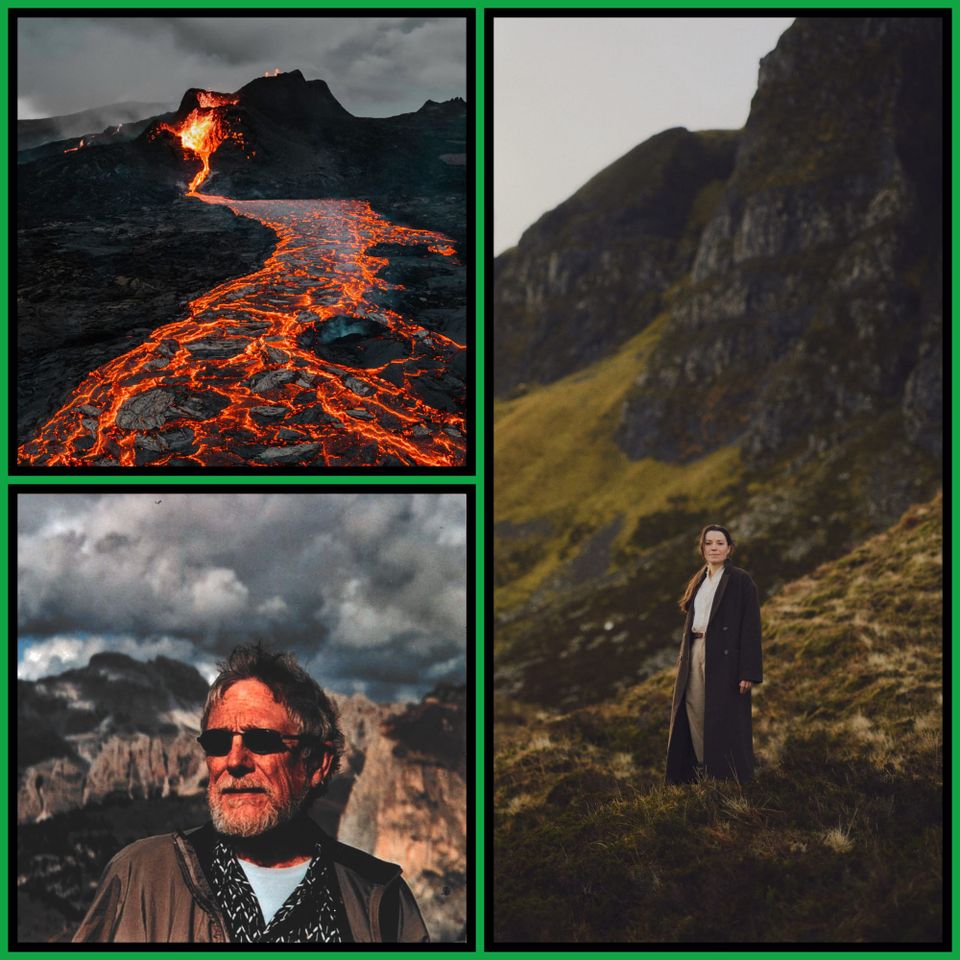
That's the territory Cal Flyn explores in her new book, The Savage Landscape: How We Made the Wilderness. An award-winning writer, Flyn has traveled — often alone — into some of the most remote and forbidding places on Earth: a desert monastery on Mount Sinai, deep into the Amazon rainforest, up a Tibetan mountain pass, and inside an erupting Icelandic volcano. She gets there by river skiff, deep-sea submersible, helicopter, and horseback, and along the way she finds moments of sheer wonder — and real danger.
We talk with Flyn about the history of this ancient idea and why humans keep chasing it. With nearly 8 billion people on the planet, almost no place is truly untouched. So what IS wilderness? Why do we keep seeking it? And who pays the price?
Plus:
Steve talks with legendary poet and environmental writer Gary Snyder — now 96, once a friend of the Beats and a Zen apprentice in 1950s Japan — about his classic book The Practice of the Wild. Snyder also reads two poems. This is an excerpt from an archival conversation.
The original aired on Wisconsin Public Radio’s To The Best Of Our Knowledge. This Wonder Cabinet episode was not funded, endorsed or affiliated with Wisconsin Public Media or the University of Wisconsin-Madison.
- Cal Flyn’s website
- Cal Flyn on Insta
- Book: “The Savage Landscape: How We Made the Wilderness”
- Book: “Islands of Abandonment”
- Read more about Gary Snyder at The Poetry Foundation
- Read “Piute Creek” by Gary Snyder
- Read “Ripples on the Surface” by Gary Snyder
- Uncut Gary Snyder interview from TTBOOK
Transcript
Anne Strainchamps: Welcome to Wonder Cabinet. I'm Anne Strainchamps.
Steve Paulson: And I'm Steve Paulson.
Anne Strainchamps: How far would you go to get a glimpse of wilderness? And how would you even know when you got there?
Cal Flyn: A few years ago, in the summer of 2017, my partner and I rode the Colorado Trail from end to end, almost 500 miles through the Rockies. It was just me and him and three horses.
Steve Paulson: This is Cal Flyn, a writer and journalist who has spent a lot of her life looking for wilderness.
Cal Flyn: Having ridden for days and gone through many physical trials to get there, we came across this signpost in the woods, in the mountains. It said, “Welcome to the Holy Cross Wilderness.” It looked to me like a street sign and it had a drawer in the base, and the drawer held a register and asked us to sign in. This whole bureaucratic situation really caught me by surprise: you arrive in a wilderness, and the wilderness has a street sign telling you where you are.
Anne Strainchamps: For as long as we've had maps, people have been trying to get off them, looking for places that are uncharted and untamed.
Steve Paulson: Wilderness is an ancient and powerful idea, and people have been chasing it for thousands of years, but often with devastating results. Because what one person calls wilderness, someone else may call home.
Anne Strainchamps: Truly untouched lands probably don't exist. So then what is wilderness? A beautiful dream or a dangerous fantasy?
Steve Paulson: That's what Cal Flyn explores in her new book, The Savage Landscape: How We Made the Wilderness – a book you couldn't put down!
Anne Strainchamps: It is just so beautifully written — part adventure story and part intellectual quest. Cal Flyn is an investigative journalist, a nature writer, and an intrepid explorer. People might have heard of her first book, Islands of Abandonment, which was about traveling into post-human landscapes. For that one, she was crawling on her belly, breaking into forbidden no-man's-lands, demilitarized zones, places like that.
But then she had that experience we just heard, of being six days into a wilderness trek in the American Rockies and stumbling onto an official signpost that had a logbook and a list of rules attached. And she couldn't stop thinking about the contradictions that are built into this idea we call wilderness.
Steve Paulson: You were really drawn to the history she explores — the desert ascetics, the primeval forest, European accounts of the so-called New World. But it's also an adventure story.
Anne Strainchamps: Well, you can't have a wilderness quest without adventures – so Cal canoes deep into the Amazon rainforest. She climbs high mountain passes in Tibet. She flies a helicopter inside an Icelandic volcano while it's erupting!
Steve Paulson: Places we might dream about going, but would actually rather read about. So where did you reach her?
Anne Strainchamps: In Glasgow, Scotland, where she lives.
Cal, Have you always lived in Glasgow? Did you grow up in Scotland?
Cal Flyn: I grew up in Scotland — I'm from the Highlands originally, quite near Inverness, and until quite recently, my partner and I were living in the Orkney Islands in the far north.
Anne Strainchamps: So you’ve been drawn to remote places for a long time! What are the Orkney Islands like?
Cal Flyn: They're low and green and mainly treeless, and often you see weather formations coming in from a really, really long way away. So it's got this sort of almost romantic sense of drama and you really feel sort of at the mercy of a lot of the elements up there. And having moved away, a big question that I'm asking myself at the moment is how do I keep my connection to what's happening outside the window alive in the same way?
Anne Strainchamps: I think that's a question many people resonate with, no matter where they live. Over the course of your life, you’ve spent a lot of time in wild places. You've done a lot of adventuring outdoors, often in difficult, dangerous conditions. And people have a lot of different reasons for spending time in wild places. How would you describe yours? What's the draw for you?
Cal Flyn: Well, psychoanalyzing the self is often difficult, right? But I do think in my own psychology, I'm very hung up on proving myself not to be a coward. I think this is my big preoccupation, that I sort of believe myself to be easily scared, and so I spend my adult life pushing the boundaries, and going to places that scare me. In my previous book, I wrote about abandoned places, and that was very much a mental battle for me a lot of the time.
Anne Strainchamps: You went to places like Chernobyl – talk about scary!
Cal Flyn: Actually, Chernobyl was mentally easier because I had a piece of paper that said I was allowed to go there. A lot of the places that I found hardest to go might not sound like much, but because I'm crawling through a hole in a fence or going through a window to get there, that puts it in a special, frightening place in my own mind. And I think wildernesses are part of that. That feeling I get of being right on the edge of something – that's what the wilderness is to me.
Anne Strainchamps: Right on the edge of something. The edge of what?
Cal Flyn: The border with all that is other. The question of what is a wilderness — often people are like, well, I know it when I see it, or I know it when I feel it. But actually, history is full of situations in which people see and feel wilderness but are later disproven, because lots of people will come out of the woods and say, “hey, we camp here once a year, and we have done for the last 10,000 years.” So this happens over and over again — this mismatch in the way we understand the natural world around us, the way we misread or miscomprehend it.
Anne Strainchamps: Well, it's a concept with such deep roots for us — as you say, it goes back thousands of years in human psychology and spiritual life. So this journey you took, looking for un-signposted wildernesses, you also set up — and I love this — as a trip in time, exploring the evolution of the idea of wilderness. Your first stop was Mount Sinai. Why there?
Cal Flyn: I wanted the book to have an arc, to tell a bigger story than just the ten adventures I would go on. So the first chapter is set up as a discussion of the history of wilderness as a spiritual concept — as a biblical and pre-biblical concept in many cultures. Sinai seemed like a brilliant place to start because it's at the heart of many epiphanies and revelations in the Abrahamic religions generally.
And secondly, because there's this micro-industry of people who go there on pilgrimage, to try to have a revelation themselves, or to pay respect to the past revelations. And I could go there myself, half as a narrative device and half in search of my own revelation, because I think that's always at the heart of it, right? You can hope.
Anne Strainchamps: I never thought before of the Bible as a series of wilderness quests, but it's one of those things where once somebody points it out, you can't unsee it. And my gosh, the entire thing is people going into or out of the wilderness! But I'm not sure wilderness meant to them what it does to us. What did going in and out of the wilderness signify, if you go back to Moses, Jesus, the desert fathers and mothers?
Cal Flyn: Well, when you dig down into translations of the Old Testament, they use a number of different words that do and don't translate to wilderness. Many of the words used repeatedly throughout the Old Testament can mean wilderness, but they can also mean things like “the area where you graze your goats,”, or an area where no crops will grow, or an area of desolation — the words themselves are a little bit slippery. We’re talking about areas that felt outside of normal reality or normal society, somewhere people might drift through or drift out to. And if you went and set yourself up there, as the desert fathers did — these ascetics from around the second or third century onwards — you could be completely outside of your normal set of rules for living.
It's also a kind of stripped-back landscape — a place of thorns, maybe some berries, maybe some desert springs bubbling up. But it's a desolate, bleakly beautiful landscape and a challenging place to live. Physical trial is built into this idea of wilderness — the idea that you go on some kind of physical journey that will force you into a mental or spiritual or metaphysical journey as well. That's all tied together in these early examples of wilderness trials.
And then as monasticism moves through Europe, they start using the word "desert" in slightly different ways. It can mean a deserted place, but it also has this larger, more mystical meaning — a place where you might be alone with your thoughts, or in a stripped-back situation of some kind. It could be in a forest, but you're living there very simply.
Anne Strainchamps: I was traveling recently in the Republic of Georgia, and right on the edge between Georgia and Azerbaijan, there’s a very ancient monastery carved into rock [David Gareji], where a very early church father lived with a tiny band of monks. It's in the middle of nowhere. You can visit places like this, not only in Georgia, but throughout the Middle East and Europe. It's almost as though wilderness and remote places had become a kind of spiritual technology.
Cal Flyn: I think that's a really perceptive way of putting it, as a technology. Something you can use to create the conditions that will allow for a certain kind of mystical experience. I think that's often what this kind of monk was looking for.
Anne Strainchamps: Did they write much about land-based spiritual practice? About ways to pray? Or did they just go there and expect the land itself to have this effect on them?
Cal Flyn: Well it’s quite difficult to write a history of hermits, because many of them go unrecorded! Most of their findings have vanished with them, and were always intended to. But in the writings we do have, you almost always get the sense that the true revelation, the sense of epiphany, is only moments in the day. Most of it is taken up with survival. And I think that's what's so fascinating — the frustration of the hermit, of the ascetic.
Anne Strainchamps: And maybe that's part of it — wasn't the idea that this encounter with nature was supposed to strip you down, that the difficulty of living in these places was supposed to be painful and challenging, but purifying?
Cal Flyn: Purifying is absolutely it! Because you do see extreme examples of that — when people are surviving off water and crusts – they often talk about ravens bringing them crusts or dates – just the absolute bare minimum. And so there’s the wilderness itself — the place — but there are other aspects you can use as intensifiers. Fasting and physical pain are ways to intensify the experience.
Anne Strainchamps: What was it like for you, being at Mount Sinai?
Cal Flyn: Mount Sinai was this incredible landscape, really — you start from this almost flat, plain – sandy, dry, dry, dry landscape – but then these mountains rise up, red and bare. When you rise to the top of Mount Sinai, you're at eye level with a lot of the surrounding peaks and mountains, and if you're there for sundown or sunrise, these bare rocks are lit by all of these crazy desert lights — all the colors in the sky just rebounding off the rock. It's a very ethereal landscape, so I can see why one might feel it to be a place of revelation. And all the other people I meet there find this landscape to be sacred to them in some way. There's something in that too, this sort of collective air of veneration.
Anne Strainchamps: You were there at sunrise, right? And I imagine if you're there at sunrise, and there are pilgrims around you whose voices are hushed, who are clearly deeply moved by and bringing a certain feeling and tone to being there — that's part of the landscape too. Because we're part of nature. So, the landscape feels sacred because we're all together making it sacred.
Cal Flyn: Yeah, in the same way that when you enter a cathedral, you're bowled over not only by the architecture, but by the atmosphere inside, which is at least partly the behavior of all the other people there. You might not know exactly what you're seeking, but you can get swept along with this sense of the sacred place.
Anne Strainchamps: After Mount Sinai, you headed to Transylvania, to some of Europe's oldest and most mythic forests, to explore a different kind of wilderness archetype — the wild wood. Tell me about that.
Cal Flyn: Absolutely. I mentioned this idea of the wilderness as being home to wild beasts — animals that are not domesticated, not easy to comprehend and perhaps inherently threatening. And so I was interested in the experience of present-day Transylvanian people in their conflict with carnivores there. They've been seeing a big boom in the population of brown bears and wolves, as actually has most of mainland Europe. But Romania is really ahead of the curve, because bears have been under special protections there since the communist regime, and their numbers are enormous in comparison to other parts of Europe.
And as Romania has been growing in wealth and population, they've been building these beautiful storybook towns, expanding into the forest — and this is where the conflicts tend to arise. The bears still think of it as their territory, and so they will wander the streets. You problems with bears breaking into schools and raiding the canteen, bears breaking into churches and drinking the communion wine and eating the wafers the beeswax candles, and so on.
And then, because it's Transylvania, it also has this great backdrop of stories about vampires, and werewolf legends – a lot of uncertainty around the border between animal and human. And that's a big element of what we're talking about when we talk about the wilderness. It's like: where do we stop, and it begins? It's all threshold.
Anne Strainchamps: I think it was in the early Middle Ages, maybe as the Roman Empire broke apart and villages were being abandoned, forests began moving in. And it becomes a kind of supernatural zone — the fairy tales and folk tales that come to us from Europe all have their basis in this feeling that the wildwood is where scary and enchanted beings live.
Cal Flyn: Yeah, fear of the forest and fear of foreign forces – they’re are all tied up in the etymology. “Forest” and “foreign” are derived from the same words. And I think that reflects this idea of “the enemy’s at the gate,” almost. And suspicion of nature also rises as populations rise. As people develop more pretensions about being civilized, they also start being more afraid of the forest — they understand it less well. It becomes someone else's, or some other animal's, territory in a way that perhaps it hadn't been for a while. So this unsettling feeling about the forest becomes a dominant strand of the culture.
Anne Strainchamps: I was thinking about the spiritual connotations of wild landscapes, which foreshadows a much later historical melding of religion and wilderness: the creation of America's national parks. Places like Yosemite and Yellowstone — the early conservationists called them “God's cathedrals,” which is a beautiful idea, but underpinned by violent dispossession. Beause these were not untouched lands; they were inhabited by people who were then driven off them.
So these two things, wilderness conservation and atrocity, have gone hand in hand for a very long time. How far back do you trace that history?
Cal Flyn: This idea of wilderness as being unpeopled has a sort of patchy history. A good parallel might be the hunting reserve, where regions are laid aside essentially for the recreation of the rich over the ages, so that kings, for example, might go and have an emotional or transcendent experience — feel that they've left the royal courts — and that is protected through a series of exclusionary laws. Essentially, the local peasantry who are almost inevitably living there, who have houses or cottages in these hunting forests or deer forests, are not allowed to gather firewood or do their own hunting. And the penalties are quite harsh — sometimes it's death.
Anne Strainchamps: You go onto the king's land and kill a rabbit, and the king's stewards come and they're going to put you to death!
Cal Flyn: Right, and I'm sure a lot of people were hunting rabbits, but it all had to be secret — underneath the radar. These exclusionary policies were a big thing in medieval Europe,
but then when you look to America, you start seeing this wholly unpeopled aspect being revered in a new way — a colonial way of looking at the land, which is: you mentally erase the effect of the people who are also living there, who've been there for a long time, and who have, in fact, co-created the landscape. So the colonists arrive and say, wow, this is an incredible creation — we need to protect this, and essentially get rid of the people who are cluttering it up.
You know — they've got a village at the bottom of this incredibly picturesque hill, or they’re charging around killing the buffalo, and it can't be had, because it's too perfect otherwise.
The United States is doing a lot of self-reflection on the creation of the national parks, and I've been impressed by how these difficult histories are now reflected in the national parks themselves — you can learn quite a lot by visiting them. But what I think is less discussed is how these patterns are still playing out across the world, and are very American-influenced and sometimes American-financed — the setting up of other national parks in other places, all based on a similar or the same model, which involves driving indigenous groups from their homelands.
We see this a lot in the Congo Basin. Forest peoples, the Batwa, the Baka, are being forced out of their homelands very violently and made to reinvent themselves on the edges of the national park. And so conservation, which is an obvious moral good, can also be oppressive — this has been a big problem in the creation of fortress conservation, in which we set aside pieces of land and police them in a militaristic fashion. This mode of thinking about the wilderness as being unpeopled becomes a real social harm that is enacted again and again as the idea of wilderness preservation spreads out across the world.
Anne Strainchamps: And as you say, often funded by American-based conservation groups. Very well-meaning, I suppose — but the people who set up America's national parks were well-meaning too.
Cal Flyn: Yeah, absolutely. And these larger groups and government bodies are not necessarily setting out to create the conditions of eviction and expulsion, but nevertheless, the money trails are right there. Depending on how you define the term, there are about ten million conservation refugees in the world today.
Anne Strainchamps: Ten million?
Cal Flyn: Ten million people who have been displaced in the name of saving nature. So when we say we want to protect the wilderness, the answer is invariably: whose wilderness? Because there's always somebody there.
Anne Strainchamps: You write about a very specific little moment of moral choice for you — when you were in the Amazon.
Cal Flyn: Yeah, when I went to Brazil, I wanted to visit the Yanomami Indigenous Reserve — an enormous region, as large as many European countries. The Yanomami people, an indigenous group, live within the forest, often in villages of between, say, 50 and 200 people, some of them living very traditional lifestyles. They're not in much contact with what you might call the outside world, or the Brazilian government — they might not recognize the Brazilian government at all. And the Yanomami have essentially been at war for decades with wildcat miners, gold miners, and illegal loggers. Drug runners often go across borders through Yanomami territory, so it can be a dangerous place.
And when I went to visit the Yanomami, part of the process of getting permission to speak with people involved a meeting with all of the village elders. And they talked back and forth about what we should pay to be allowed to stay with them. They didn't want dollars or other currency — it wouldn't be helpful for them. So they were chatting back and forth for hours about what we should give them, and first they asked, can you give us a speedboat? — which was beyond my means. And then at some stage, they alighted on the idea that we should give them a chainsaw because it would be a really helpful tool, day to day. And of course it would — if your main transport hub is the river, and the river is constantly moving and rerouting, and trees fall across it and you get stuck, it's very difficult and time-consuming to clear enormous trees with hand saws. So this is what they had in mind. But the idea of bringing a chainsaw to this place which is so valued for its lack of chainsaws really didn’t sit well with me. The Yanomami people have become famous for their refusal to deal with people who want to use chainsaws — they repulse illegal loggers, fight them off, which is incredible — so the idea of me then bringing a chainsaw and gifting it to the group made me very uncomfortable. But it also forced me to ask myself, what am I trying to achieve by refusing them a chainsaw if they ask for it? In the end, thankfully, they changed their minds, so I didn't have to decide.
Anne Strainchamps: Thinking about the nature of a landscape, we haven't really talked much about how one writes about and describes wilderness — that's such a long literary tradition. One of the things I really admire about your work is the way you blend beauty and fear together. You describe the Amazon, for example, as a dark green, ominous Garden of Eden — plants climbing over other plants, wood winding like rope around other wood. You call it “a terrible density of life.” And then you go on to list all the ways you can die in the Amazon!
So tell me what you were thinking.
Cal Flyn: I think at least some of it is to reflect my fish-out-of-water status. Visiting the Yanomami Special Reserve was like a real culture shock to me — I'm going in as someone who has traveled a lot, spent a lot of time in other cultures, but nevertheless the intensity of the experience, not only of traveling there for multiple days in a boat, having to get in and out of the water, felt like a trial. And then, on arrival, there is so much difficulty in making oneself understood — I had a guide whose first language is Portuguese and he can speak some English, but we didn't fully understand each other a lot of the time — and then he's also not fully understanding the Yanomami people, so there’s a sense of being caught in this net of misunderstandings. And often I’m traveling as a woman alone, sometimes without a guide, so I'm always on high alert, and that gets sewn into what I notice. Again, this is that question of what you project onto the landscapes you move through.
And there are lots of very objective reasons to be scared of moving through the Amazon — it's a very difficult place to travel through, you've got to be really careful. I try not to touch anything that might move — when I get up at night from my hammock, I'm using my torch, checking that I'm not about to put my foot inside a shoe that's full of scorpions. I see all these spiders that — well, I don't see them to begin with, and then they move — so the ground is full of things that could do me harm. And I guess I want to stitch that into the language itself, the way I talk about the place, which is partly objective but also very, very deeply first-person subjective.
Anne Strainchamps: How much of the power and wonder of the wilderness experience is fear, do you think? I'm remembering a trip I took years ago to the Grand Staircase–Escalante National Monument in Utah. It’s a stunning landscape but at a certain point, it really hit me that this landscape could easily kill me. There was no protection in it — nothing soft, nothing green, just searing heat. And this kind of unspeakable time scale: you're looking at 300 million years of exposed rock — it's dwarfing and terrifying and beautiful at the same time. Is that edge of fear partly what draws you to wilderness?
Cal Flyn: Yes. Fear is absolutely an intrinsic element of it. When I start to feel really unsettled — when I'm like, maybe I want to go home – that's what I'm looking for. That sense of a place that sets you on fire, you know? You need all of your systems to be like, “whoa, whoa, whoa! I can't handle this!”
I think that's the central aspect of a lot of wilderness travel — you set things up almost like a test you're probably going to fail. “Can I do this? It's going to be so difficult, so exhausting — I've got to keep up that level of physical exertion, or focus on navigation for days.” That's what you're doing — you're testing yourself.
Anne Strainchamps: And that included getting very up close with an erupting volcano. Hang on, and we'll hear that story in just a sec. I'm Anne Strainchamps, and this is Wonder Cabinet.
Steve Paulson: Hey, it's Steve. I'm so glad you're with us, and I have a favor to ask. This is a new podcast, and we're really hoping to reach more listeners.
So we'd love for you to tell your friends about Wonder Cabinet, and it will really help when you give us a good rating on Apple Podcasts or wherever you listen. And if you're not already subscribed to our newsletter, you can sign up at wondercabinetproductions.com.
Anne Strainchamps: Talking about wilderness and wildness, had Steve and me remembering an interview he did years ago with Gary Snyder, the American poet and philosopher who wrote the eco-classic The Practice of the Wild. We're going to hear a little bit of that interview at the end of today's show. But in the meantime, getting back to Cal Flyn —
You really pushed the edge of danger a bunch of times for this project. You write about being in a helicopter in Iceland, flying over the crater of an active volcano. What did that even look like?
Cal Flyn: It was the closest thing I've had to a religious experience, truly — the sense of your mind being overloaded. You don't know how you feel, actually, because it's too much. You're being jolted around, dropped, lifted again, twirled, and outside the window is this cauldron of molten rock. I mean, what do you do with that? Your brain can't handle it. I got out of the helicopter and I just had to sit in my car for half an hour. The adrenaline was going, and I called my husband at home and I couldn't really explain myself — I was just making a gasping sound. He's like, “are you okay?” And I was like, “it was incredible!”
Anne Strainchamps: The line that got me was your description of flying through droplets of magma the size of bathtubs!
Cal Flyn: Yeah. Often I couldn't really make sense of what I was looking at, because the physical laws you have programmed into your head, it doesn't make sense. You think “how can that drop be taking so long to go up and then so long to go down?” And then your brain slowly clicks into gear, like, “oh, it's going hundreds of meters — wow,” and you understand what you’re looking at completely afresh.
Anne Strainchamps: It sounds like an altered state. So there’s a name for that mixture of beauty and terror: the sublime. A concept that goes back to Romantic-era philosophers like Edmund Burke and Immanuel Kant. What did they say that experience of the sublime is? What are the building blocks of it?
Cal Flyn: I suppose the key definition is that it's beauty and fear all tied together — a clashing chord of emotion. Edmund Burke described it as the strongest emotion that man is capable of feeling, and I agree with that. I think that two-tone element of it means it's both incredibly positive and incredibly negative all at once — it sets you up in this intense state of something. Psychologists today call it awe, but it's the same thing.
Anne Strainchamps: The Romantics were hungry for it, right? They not only wrote stories designed to elicit it, but they also went out looking for it. It seems addictive, and I think maybe you felt that way too — because the day after that helicopter trip, you went back to the volcano and hiked into the exclusion zone, where you were not supposed to be. How close did you wind up getting?
Cal Flyn: I'd estimate I was about 200 meters from the huge crater. I was outside of the hot lava, but very close to the edge of it – definitely a lot closer than I had promised myself I was going to go. I knew this was against the rules, which intensifies the emotional experience, and there were helicopters flying overhead and they could see me disregarding the rules.. But that's part of it, right — the pursuit of peril. You want things to happen, and then if they happen, it would be terrible.
Anne Strainchamps: Going back to wanting to be on that edge — there's a point where you're standing pretty close to a field of magma, this pulsing red liquid rock, and you describe it as “a saurine eye, lidless and always awake.” I have to tell you, my immediate thought was, “oh my God, it's like Frodo in the Lord of the Rings seeing the great flaming eye of Sauron. Why is that what came up?
Cal Flyn: I think that's what I was trying to channel. If you were driving around some miles away, occasionally you'd align with this gap between the mountains, and you could see it — the leaping of the lava, this cauldron of rock. It was this sort of — not evil, but certainly awesome — spectacle with this unsettling sense of constant activity, like it was up to something.
Anne Strainchamps: Right after that, there's a little section where you attempt to explain to the reader why you would risk your life to see an active volcano up close, and you're talking about the parallels between our internal psychological climates and the outer world — between our interior and exterior landscapes. And you make this comment: “the lack of control over one's emotional weather has always been a source of great frustration to me.”
I do think for many of us, the experience of being alive is to be not infrequently at the mercy of ebbing and flowing emotional tides — moods that roll in like hot or cold fronts and color your internal atmosphere. I've never really thought about noticing parallels in physical landscapes. What does that do for you?
Cal Flyn: I think it helps me understand how we relate to the world around us. If you're in a certain state of mind and you seek out a place that somehow symbolizes it, it can be a very profound experience — your inner climate is somehow being reflected in the outer world. Of course, there's a real megalomania in that, pure ego.
Anne Strainchamps: Maybe it's also a relief, a recognition that there's something bigger than you.
Cal Flyn: Yes, that's better — a relief — because whatever is happening in this landscape right now can chime something in yourself as well.
Anne Strainchamps: Well, speaking of observing oneself, this seems like a perfect segue to the Himalayas and to Buddhist landscapes. You visted a very remote area in the Himalayas, way up high in mountain passes, tiny villages you can only get to by footpaths.
And you went there not just for the wilderness landscape, but to meet the Bonpo people, who practice an ancient form of Buddhism that's also animist. Am I getting this right?
Cal Flyn: Yeah, absolutely — it's a sort of merging of Tibetan Buddhism and local animist principles, so that they believe in many of the Buddhist figures and Buddhist philosophy, but they also believe the mountains around them might be the abode of a certain god, or that the wild animals moving through the landscape are owned by certain gods that live in a valley. This idea of ownership of the landscape was very interesting to me. This is a place so sparsely vegetated that you can only pass through in certain times of year, but it's not felt to be no-man's-land — it's the property of gods or goddesses, and these are very territorial deities, wrathful if you misuse their resources or mistreat their animals. So these figures are worth dealing with — if you'd like to build a house, for example, you need to trade for the rocks you might take from the riverbed. You'd go and approach the river god and make some kind of deal, some kind of sacrifice of your own — for example, laying aside part of the river and saying, I'll never fish there, or I'll never take water from there. And in return, I'll take some of the rocks.
Anne Strainchamps: It’s a transactional relationship with the land and the supernatural beings that animate it — there's reverence, awe, fear, admiration – expressed through taboos. Maybe it’s worth paying more attention to fear as a path toward better relationships with wild places.
Cal Flyn: Oh, absolutely — fear is a force that works in the world. Ecologists talk about the landscape of fear, meaning the change in vegetation that occurs when you reintroduce carnivores to a habitat. It's talked about a lot in the context of Yellowstone — the return of apex predators like wolves and mountain lions has changed that landscape on an ecological level. So the landscape of fear is the landscape that arises as a result of these emotional forces as much as anything else.
I think that can be a way to think about our dealings with the natural world as humans. A lot of the places that get exploited and used up are places where there's a sense that anything goes. That's often why we see it in colonial cultures: you arrive in another country, you've got less respect for it, less respect for the laws that have kept it safe for centuries. So you come in and say, anything goes — we can build this here, we can blow that up and use the rock. You see it in purely utilitarian terms, and you don't have that sense of culturally imbued fear or taboo.
You know — “we can't blow up that mountain, that mountain's been there for centuries, I buried my grandmother on that mountain.” You don't have any of those taboos, and that frees you up to act with impunity. That's when we see these sort of rabid economies.
Anne Strainchamps: I was surprised to learn that sacred landscapes are among some of the best protected on the planet — better protected in many cases than areas that are under official conservation protections. Really?
Cal Flyn: Yeah — ecologists call them sacred groves. That's a retroactive application of a concept they had in ancient Greece and ancient Rome, but you find these parallels all over the world — the idea of certain places that must be kept safe for cultural or religious reasons. India is absolutely packed full of them, hundreds and hundreds of sacred groves, and often they become real storehouses of biodiversity — sometimes the only wooded places left in the whole landscape. Sometimes they're big, like a mountain or a valley, but often they’re much smaller — tiny islands of old growth, old landscape, undisturbed ecosystems. So there are wildernesses of all different sizes.
We might understand sacred groves as a kind of multi-cultural conservation project, but most of the time, the cultures wouldn't think of them in those terms. They're thought of as the abode of spirits or gods, of a trade made in some transactional way with a god, that forces the ceding of control over this piece of land. But if you look at it through the eyes of a biologist or ecologist, they're amazing natural sanctuaries. There's a whole new field of ecology that studies these places — it's really fascinating, they're trying to draw up a list of all the sacred groves around the world to calculate the biomass of everything being protected within them. But they've also flown under the radar, and that's good — that's partly what has protected them.
Anne Strainchamps: There's a term I kept thinking about when I was reading your book — I don't know if you've come across it — wild mind. It comes up in both mindfulness and eco-psychology circles: the idea that beyond our tamed and socialized minds, there's another inner state that is pure, freer. I'm never entirely sure what I think about that, because it's also a bit of a romanticized idea, maybe mapping the wilderness onto the human psyche.
Cal Flyn: I really liked what you said there — that you don’t know how you feel about it. I think it's also so tied up in many religious and spiritual practices, that we believe and don't believe all at once. The complexity of the way we look at the landscape has helped me understand the complexity of how my own mind works, and to make a kind of peace with that. I suppose that's my response — I would like to have a wild mind. On a day-to-day basis, I don't know that the wild mind is always in play, but I like to think of it as something that's in there somewhere.
Anne Strainchamps: You did wind up feeling that wilderness is at least partly a state of mind. Have you found ways to access it more yourself?
Cal Flyn: Oh, great question. One thing I learned through the final chapter of the book — I have this interview with a lama in a remote part of Nepal, right up on the border with Tibet. His argument to me was that he went to this very remote sacred valley, and he waited for the wilderness to come to him.
The way he turned it on its head really set me to thinking about how I could chase this idea– that's very hard and slippery — all over the world. But if wilderness is actually an emotional experience of place, or a spiritual experience, or whatever it is, then maybe I have to learn how to create those conditions in my own mind. So what I've been doing as a practice recently is going somewhere locally that feels a bit wild, and sitting down and waiting for the wilderness to come to me – as something I didn’t expect. Perhaps you sit very still and a bird comes down and hops over your feet, or you hear a call you haven't heard before. So this is my new level of experimentation — trying to build that wilderness in my own head.
I think a lot of my most profound experiences in nature are in places that aren't so far away from my home — maybe a place on the map that nobody's thought to name, because it's just a kind of in-between place. Something about the lack of attention, maybe, allows it to take on this far-away aspect. And often that's what I'm looking for.
Anne Strainchamps: Cal, it's been such a pleasure talking with you. Thank you.
Cal Flyn: You too. Thank you so much. I've really enjoyed this conversation.
Anne Strainchamps: Cal Flyn is a journalist, writer, and explorer — we were talking about her terrific new book, The Savage Landscape: How We Made the Wilderness.
And as I said earlier, this book got both Steve and me remembering a conversation he had years ago, on our old show, To the Best of Our Knowledge, with a legendary writer on wilderness and wildness, Gary Snyder.
Steve Paulson: Who is now 96 years old, and has had one of the most remarkable lives of anyone I can think of. He was friends with the Beat writers — Jack Kerouac actually based one of his fictional characters on Snyder. He was a Zen apprentice in Japan back in the 1950s and then went on to become one of the great environmental writers.
So when the second edition of his book, The Practice of the Wild, came out about 15 years ago, I tracked him down and we had a great conversation. I asked him about the origins of one of his early poems, "Piute Creek."
Gary Snyder: I was working on a trail crew as a laborer in the northern section of the Yosemite National Park high country, up around 7,000 or 8,000 feet elevation, with a crew of several other men, every day for weeks on end — completely out of touch with the rest of the world. And after work, and after dinner, which was cooked over an open fire, I would practice learning how to meditate and look at the stars. This poem came to me one of those nights, and was in some way transformative for me.
READS POEM
Steve Paulson: That is wonderful. Thank you so much. Now, in the new preface you wrote for The Practice of the Wild, you describe your own spiritual path as old-time Buddhism, and you say this is connected to the ancient traditions of animism and shamanism. What does it mean to be a Buddhist animist?
Gary Snyder: Well, all of the Buddhists up to the 20th century were animists as well as Buddhists, because the whole world is animist. That is to say, it feels that there is a special kind of life in all phenomena, that there are possibly spiritual forces and spiritual powers, and that the world only asks good manners of us — so we might as well have good manners. Make a little bow here, offer a little rice or alcohol there, say thank you whenever there's any reason to say thank you, say grace for food, and pay attention to those places in the landscape that are awesome.
And then we might say, oh, there is some special spiritual presence there, and acknowledge that. That's what the ancient world did, up until the 20th century and Occidental rationalism, at which point a lot of academic and westernized, somewhat Asian, Buddhists even said, well, I guess we don't need that old-fashioned peasant shamanism.
Steve Paulson: I'm guessing that your Buddhism goes especially back to the time you lived in Japan. I know you lived there for many years, from the 1950s to the late 60s, studying Zen.
Gary Snyder: That's right.
Steve Paulson: And that must have been a very unusual thing for an American to do back in the 50s, to go off to Japan.
Gary Snyder: At that time there were not many other Americans — I knew of three or four others maybe, scattered over Japan in different Zen practice situations. It was hard then, right after the war — 1956 is when I first went to Kyoto. Japan was still recovering from World War II, there was a lot of poverty, nobody had a refrigerator, nobody had heat in the house much except burning charcoal or a little kerosene. It was a hard time for people, and the monastery was particularly severe. It still is, actually.
Steve Paulson: There's a story about how some monks dangled you over a cliff with a rope tied to your ankles. Did this really happen?
Gary Snyder: Well, that wasn't Zen — that was another school of Buddhism.
Steve Paulson: The Zen monks don't do that, but some other Buddhists do?
Gary Snyder: It would be good for them to get out in the mountains more, actually. But that was the Shugendo, or the Yamabushi — I went out with them. I was already a climber, you know, before I went over there; I'd done a lot of mountaineering in the Pacific Northwest as a teenager and into my early twenties, climbed most of those big snow peaks along the West Coast.
And so one of the elder Zen monks at the monastery I was connected with, the Daitokuji Sodo, said, well, you want to go out with the Yamabushi? And I said, yeah, I've read a little bit about them, I'd love to go out with them. He connected me up with somebody, and they took me up in the mountains, the Omine Mountain Range. Part of their way of inducting people into their particular society is actually — no rope. They hold your feet with their hands and hang you over a cliff. And then ask you questions — they say they'll drop you if you don't tell the truth.
Steve Paulson: They did this with you?
Gary Snyder: Yes, they did.
Steve Paulson: Were you scared?
Gary Snyder: Yeah, sure. But, you know, I trusted them. And I was sure they couldn't tell if I was telling the truth or not.
Steve Paulson: What kinds of questions did they ask you?
Gary Snyder: Oh, I shouldn't talk about that.
Steve Paulson: Okay. You have a wonderful phrase in one of your essays — you talk about entering into the wild areas of the mind. What are those wild areas?
Gary Snyder: Well, let's take it as parallel to the physical wildness in nature. There's the territory in your house and around your house and your neighborhood, paths and roads by which you go to work and come back every day, or go to school and come back every day, that are familiar to you. But then beyond that is the territory where a wild process is dominating, and you often go in there on your own, by yourself.
So the wild areas of the mind are the less-visited places, the less obvious places, the ones that challenge you, the ones you cannot quite figure out why they went that way. And to bring it right up close, let’s remember that we don't even know what our next thought is going to be. Our ability to manage our mind is very limited.
And this is one of the things you learn when you meditate. Meditation is like cutting off all of the outside stimuli — no music, no painting, no conversation — and seeing what your mind does when it's subject to your full attention. There are parts of it you'll find yourself going into that you've never been to before, which is like the wild.
Steve Paulson: Could we end with a poem?
Gary Snyder: Sure enough. I'll try this one called "Ripples on the Surface." The quotation at the beginning is from a Tlingit woman I was out fishing with, in Sitka Sound up in Alaska. She was saying, as we were out on the water —
“Ripples on the surface of the water are silver salmon passing under. They are different from the ripples caused by breezes.”
READS POEM
Steve Paulson: That was Gary Snyder talking to me back in 2010, after the reissue of his book, The Practice of the Wild.
Anne Strainchamps: Wonder Cabinet comes to you from Madison, Wisconsin, and Vershire, Vermont. Thanks, as always, to our audio engineer, Steve Gotcher, and our digital producer, Mark Riechers. I'm Anne Strainchamps.
Steve Paulson: And I'm Steve Paulson. We would love to hear from you — send questions or comments to us at wondercabinetproductions.com, and sign up for the newsletter while you're there.
Anne Strainchamps: Be well, and happy adventuring.
Subscribe to make sure you never miss an episode.