

16 May 2026
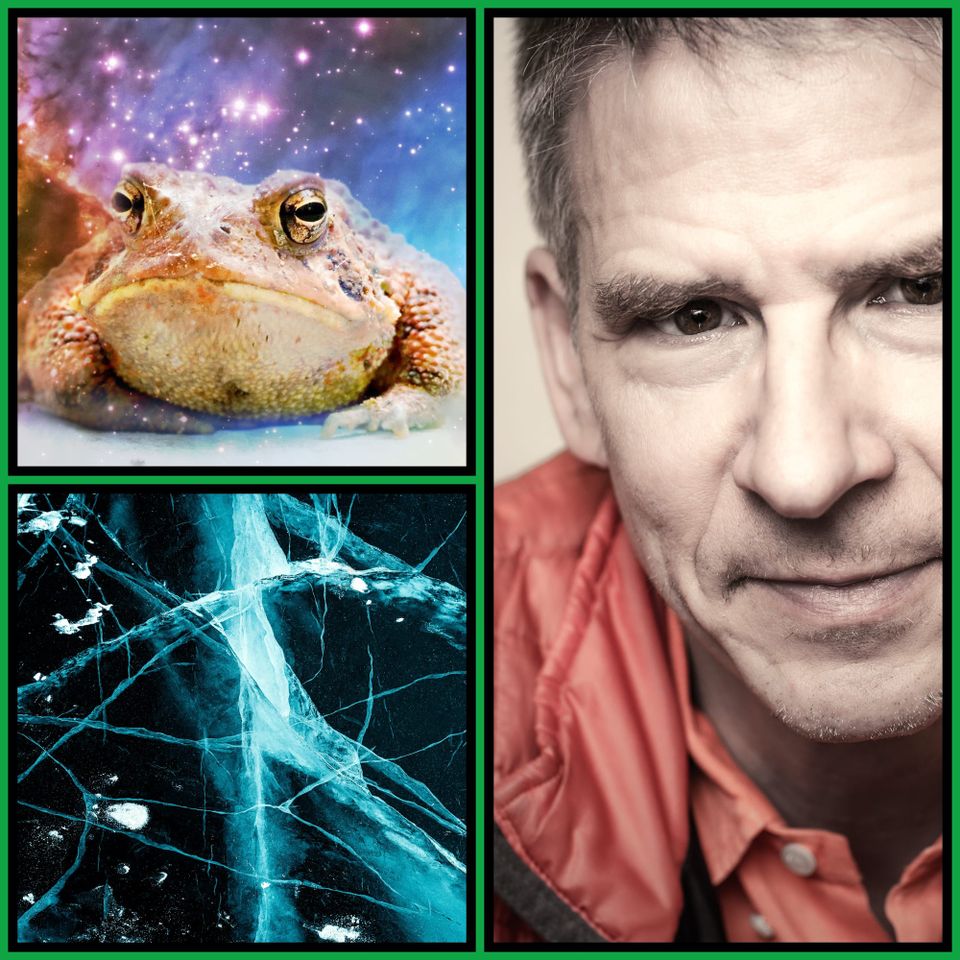
Christof Koch on the Cosmic Toad
“It was like an earthquake,” says neuroscientist Christof Koch, speaking of the mystical experiences that upended his views on consciousness and even reality.
0:00 / 0:00
16 May 2026
Christof Koch on the Cosmic Toad
“It was like an earthquake,” says neuroscientist Christof Koch, speaking of the mystical experiences that upended his views on consciousness and even reality.
ShareEpisode Notes
What happens when one of the world’s leading neuroscientists has a mystical experience that upends his understanding of reality?
In the 1990s, Christof Koch helped launch the modern science of consciousness, searching for the neural basis of subjective experience. A committed materialist, Koch believed brain science would explain how conscious experience is generated.
Then several profound psychedelic experiences changed his metaphysical beliefs. “It was like an earthquake,” he says.
In this conversation, Koch reflects on how those mind-bending experiences transformed his deepest assumptions about mind and matter, and whether the cosmos itself might have purpose. He talks about the power and the limits of science, and why he’s come to see consciousness not as a byproduct of matter, but as something far more fundamental, perhaps the fabric of reality itself.
Transcript
Anne Strainchamps: Welcome to Wonder Cabinet. I'm Anne Strainchamps.
Steve Paulson: And I'm Steve Paulson.
Anne Strainchamps: Has anything ever happened to you that fundamentally changed your understanding of what's real?
Steve Paulson: An experience that rocked your core beliefs, like maybe a spiritual awakening or a mystical breakthrough?
Anne Strainchamps: We heard a story like this recently. This was at a small gathering of scientists and philosophers at what seemed like a pretty normal kind of science talk.
Christof Koch: All right, good morning, everyone. Today we'll talk about consciousness, pure and simple. Consciousness, awareness — I take them to be identical.
Steve Paulson: This is Christof Koch, a renowned neuroscientist, beginning one of his standard lectures on the science of consciousness. And then midway through his talk, he suddenly switches gears.
Christof Koch: So I'm going to talk about two experiences and their possible implications. So one is I had an experience of this. I was breathing something.
Anne Strainchamps: The something was a powerful psychedelic.
Christof Koch: And then within six seconds, the entire world disappears. I had a psychiatrist there and the guide and my wife were there. They observed me. I was just sitting there, rigid, moaning quietly or whining, with eyes wide open. But what I experienced was just this bright light that people talk about. There was no time. There was this entire universe that I felt becoming identical to, and there was no will. There was just awareness of everything. I know it sounds woo-woo, but that's what I experienced.
Christof Koch: And it left me completely discombobulated. There wasn't anything physiologically wrong with me, but it left me profoundly shaken. At the time I was 65, so by the time you get to 65, you have a pretty firmly established metaphysical view of what exists and what doesn't exist. But it totally shifted — it was like an earthquake shifting the tectonic plates of my ontology. An experience lasting under an hour that can permanently mark you. You wake into a different reality. It's really quite remarkable. It's a distinct before and after.
Anne Strainchamps: Christof was talking at the Island of Knowledge, the small think tank in Tuscany where scientists and philosophers and writers come together to talk about big questions. We've been recording interviews there for the past couple of years.
Steve Paulson: And the topic this time is our purpose in the cosmos. And Christof had come with some answers.
Anne Strainchamps: Steve, you've followed Christof's work for years. You've interviewed him a bunch of times. What was different this time?
Steve Paulson: It was really surprising. So the thing to know about Christof is that he helped launch the modern science of consciousness. This was back in the 1990s when he and his mentor, the famous biologist Francis Crick, really made consciousness a respectable scientific discipline. They studied what are called the neural correlates of consciousness, essentially pinpointing those brain functions that correspond to specific mental activities.
Anne Strainchamps: So he was, at that time at least, what we'd call a scientific materialist, right? Meaning his assumption was that all conscious experience — thoughts, feelings, awareness — is produced by and manufactured in the brain.
Steve Paulson: And this is the standard neuroscience model today. For years, Christof was the president of the Allen Institute for Brain Science, where hundreds of scientists are doing this very fine-grained research into neural circuits. But then a few years ago, Christof had his first psychedelic experience, and then he had a few more, and his entire worldview turned upside down.
Anne Strainchamps: This must be incredibly rare.
Steve Paulson: I can't think of another major scientist today who's undergone this kind of transformation in basic beliefs. But Christof has always had this yearning to understand the fundamental nature of reality. He grew up a devout Christian in Germany and then rejected those religious beliefs, but he never lost his hunger for more meaning in his life, for what you might call ultimate truth. So I wanted to understand what happened.
Anne Strainchamps: Okay, this is a great story. Let's listen.
Steve Paulson: So Christof, for years you have been at the cutting edge of the science of consciousness. And back in the 1990s, of course, you and Francis Crick really pioneered the study of the neural correlates of consciousness. For decades, this has been your life work. And then more recently, you have become fascinated by certain life-changing, transformative experiences. I'm wondering what took you in that direction.
Christof Koch: Curiosity. I've read my entire life about people — so-called mystics, including some of the foundational figures in Western science. Pascal, for example, the French physicist in the 17th century who co-invented probability theory — people who had extraordinary experiences that were transformative. What I mean by that is there's a distinct before and after this event. And after the event, many of these people change their lives or change their goals or change their attitude in some fundamental way.
Christof Koch: We all know change is difficult, but here a brief episode of something you experience can profoundly and radically transform you. We now know this can happen during so-called near-death experiences. And of course we also know now this can happen during psychedelic experiences — that particular type of experience can also lead to these transformative events. And so I was just curious.
Steve Paulson: But why at that point in your life? I mean, we'll get to your personal experiences, but you spent decades studying the brain, studying consciousness. It seems like at a certain point you wanted to have some of these life-changing, transformative experiences yourself. And I'm wondering why. Why do this in your 60s?
Christof Koch: Well, as a student of consciousness, I'm a big believer in the motto of the Royal Society — nullius in verba, take no one's word for it. I grew up at a time when the public message was "your brain on drugs," you know, the fried eggs, and drugs were drugs were drugs. But then, of course, you realize there are very different types of medicines or drugs. Many people claim that under psychedelics, their consciousness expands. So clearly, it seems to be a way to radically change your conscious experience. If you're a student of consciousness, this is a legitimate scientific subject to explore. Is it true that it changes your consciousness? And if that's the case, then you can study it scientifically.
Christof Koch: So as you said, I came to psychedelics rather late in life, and then it's just extraordinary. For me, they were enormously positive, these experiences. These were all psychedelic experiences — under the influence of various types of psychedelics and associated ceremonies. It's different from just taking a little white pill. There's typically an entire ritual ceremony associated with it, whether that's ayahuasca or the American Indian ceremonies, or you go to some particular weekend retreat where you sing and dance. And I think that's important because it sets your mind. It's all about set and setting. My belief in what I will experience profoundly determines what I actually experience — we also call this the placebo effect. When you have friends who tell you and you read in the literature that you can have these powerful experiences, then you're much more likely to have a powerful experience.
Steve Paulson: And to put this in perspective, I know this wasn't just a science experiment for you to, oh, let's see how my consciousness works. I mean, you've had this yearning for something more, going back to your childhood. You grew up Catholic — rather devout Catholic, right?
Christof Koch: Yeah, I grew up as a Catholic, as you say, and I certainly also grew up with this Platonic notion of truth with a capital T. And that's what you do as a scientist — explicitly or implicitly, you pursue an ever better description of what you think of as reality. And over time, we believe our description of this reality becomes better and better, and we call that scientific progress. But then, of course, you also keep asking the question: is this all there is? What truly is reality? How is it constructed? This search for final and ultimate answers and truth has never ceased. I still have it. And so, yes, partially that also drove me to search out these types of experiences.
Steve Paulson: Was it looking for the divine? Maybe going back to your childhood in a way. What was this larger truth — maybe the truth with a capital T? What were you after, do you think, as you look back on your own personal history?
Christof Koch: I mean, divine or not? I have lost the belief in a divine, personal God — like the old man sitting above the clouds and intervening in the universe. I don't think that's what I'm looking for. But like many people, I'm looking for a final answer. Now, that may be totally illusory, and at some cognitive level I know I'm going to go to my death without having this, because how would I even know it? However, some types of experiences really make you believe: this is it. You have come to the heart of the universe, and this is it.
Christof Koch: And then you take it back into regular life, and you talk about it, and all of it seems very faint and — "ineffable" is the term that...
Steve Paulson: ...people use. So you were after trying to get to the heart of the universe. We should talk about maybe your first big psychedelic experience. Tell me about that. How close did you get to the heart of the universe?
Christof Koch: Well, there are different experiences I've had. The first one was just — suddenly you find yourself there, typically outdoors, in forests, and you find yourself in the Garden of Eden. That's the best way to describe it. I mean, it's just amazing. You cry very often. It's just this transcendent feeling of beauty in the natural world. You can get totally lost in the canopy of a tree, or you look at a bee, mesmerized by a bee flying around, and you just think it's the most beautiful thing ever. And you hear this pounding, you feel — it's the sound of the beating universe. It's just this near-ecstatic experience.
Steve Paulson: This was on psilocybin.
Christof Koch: This was on magic mushrooms. Yeah. And it's truly — I can see why people called it magic mushrooms, because you take a world like we all experience and suddenly you realize the miracle of existence. Why is this? It makes you open to these obvious things. How often do you think about the fact that sheer, bloody existence is miraculous, and nothing in science explains why there's something rather than nothing? Or the astounding beauty of the world, in particular the natural world. So you reacquaint yourself with old truths that somehow you know abstractly, but now very viscerally.
Christof Koch: And then another experience I've had — because people told me this is a very powerful tool and I should try it, and I did. And there I had an utterly terrifying experience that I have no desire whatsoever to repeat, where you come to something very close to a near-death experience. The entire world disappears, your body disappears. Although you're there with eyes wide open, as reported by people who saw me, you don't see anything, you don't hear anything, you don't feel anything. The only thing I perceived was this point of icy bright light. There wasn't a left or right, up and down. All space had collapsed into this one point.
Christof Koch: There wasn't even time, in the sense that this moment wasn't too long, it wasn't too short — it simply was. The river of time, to use Jamesian language, that we always are immersed in, just at that point, simply stopped. I was in the ever-present now. And then no self, no Christof, no voice, no body, nothing. So it wasn't me. It was just experience. It was just three things: this bright light, terror, and ecstasy. This strange combination of terror and ecstasy. That's it. That's the only thing there was. Nothing else. I didn't relive lives, I didn't encounter any spirit or anything. There was just this.
Christof Koch: And this was on 5-MeO-DMT. What's remarkable is that you inhale whatever you inhale, and then within three or four breaths, whatever remains of you, you encounter some sort of void. And then an hour later, you're back to tell the tale. First, of course, you're totally confused. I cried, I curled up into a fetal position — all of that — because it's this profound, terrifying experience where you lose everything. What it teaches you, as a student of consciousness, is that space and time are optional.
Christof Koch: As Immanuel Kant, the German transcendental idealist philosopher, argued already 250 years ago, purely based on reason: we believe it's a given that things always occur somewhere and at some time. No — that's a construct of our brain. And under certain conditions, your brain doesn't have those constructs anymore. Same thing with the notion of self. The notion of self is a construct that's very stable. I need this to survive and to evolve and to be successful. But under other conditions, there is no more self.
Steve Paulson: When you say space and time are optional, I mean, I get it that you had no sense of space and time. It sounds like maybe that's just this weird experience you're having on this very powerful drug. But can we really say space and time disappears there?
Christof Koch: Well, the only reality I'm acquainted with is the reality of my experiences. Everything else is inferential. And at that point in my experience, there was no more — space had collapsed into a singularity and time had stopped flowing. Now, of course, we know perfectly well that we live in a four-dimensional space-time continuum, as described by relativity. But the question is, is that just a good practical, operational model that allows me to predict where the planets are and build interplanetary rockets? Or is it actually the ultimate truth of the matter? Is space and time actually out there? This is a question that goes back to ancient philosophy. And in quantum mechanics, that question becomes much more difficult. You can also argue that ultimately that is a construct of all of our minds, not just my mind. It's absolutely necessary for things to be here at a particular place and at a particular time, but that may not reflect the actual facts of the matter.
Steve Paulson: I mean, the other interpretation of this is you had this very powerful hallucination, and then you came out of it an hour later. You sort of came back to everyday reality, but it was...
Christof Koch: I came back to everyday hallucinatory so-called reality. That's the common-sense view on which we can all agree. We all see there's this glass of water, this glass of grape juice. And of course, as evolved creatures, we had to do that — if we all had different views of reality, we wouldn't have evolved. But the question to ask as a scientist and as a philosopher is: is it really true that one is a hallucination and the other one is reality? That's one way of viewing it — that's the common physicalist, materialist interpretation. But a different interpretation might be, no, ultimately everything is mental. Everything is phenomenal. Everything is experience. And out of this mental, we construct reality. And the physical, ultimately, might also be a construct. This metaphysical view is known as idealism, and it has a long and storied history in Western philosophy and beyond.
Steve Paulson: It sounds like you have moved in that direction as you're trying to make sense of these incredibly powerful experiences. The old view, the physicalist view — that yeah, it's just a hallucination — that really doesn't cut it with you anymore, right?
Christof Koch: Yes, so after this first experience, I was still — it didn't radically change my metaphysical view. And then more recently, two years ago, I had a more straightforward mystical experience where again the self disappears — you leave the gravitational field. I left the gravitational field of planet ego. We all live on this planet ego. It's always about me, me, me, me, me — not you, but me. In my better moments I can think about you, but ultimately it's always with respect to me as a subject. But just like astronauts can leave the planet and become weightless, we can become selfless. We can lose the sense of self. And so this was another experience like that — selfless.
Christof Koch: But in addition, I felt myself — I don't want to describe it in detail — but I became identical with the universe. I know it sounds terribly woo-woo. But that's what my experience was like. Whatever remained of me apprehended the entire universe. It became identical to it. This leaves you — certainly left me — profoundly, profoundly discombobulated and confused. I was walking around late at night. My wife was there, she tried to talk me down. And then every day, literally every day since then, I think about it and about the metaphysical interpretations.
Christof Koch: So yes, my experience was that ultimately everything is phenomenal. The only stuff that I'm familiar with, which is sights and sounds and feelings of boredom, of seeing, of dreading, of imagining — of consciousness, of the mental. So this is the view of the universe that says ultimately what exists is only this. There are different names. The German idealist Arthur Schopenhauer calls it the will. Other people call it cosmic consciousness or universal consciousness. There's sort of only this singular mind. And then the question — the mystery — is, most of the time we are not in that state. Right now, I don't access your mind, you don't access my mind. You have to ask me a question.
Christof Koch: And under certain conditions — Aldous Huxley, whose book The Doors of Perception sort of kicked off the age of Aquarius, he talks about the reducing valve, which I always thought somewhat silly, naive. The brain isn't just a reducing valve, but I think there's a deep truth in there.
Steve Paulson: And just to clarify — by the reducing valve, Huxley was saying that in ordinary life, we have too much input. So the brain has to kind of shut out most of that stuff. It sort of shuts out these extraordinary experiences. But then with a psychedelic, you suddenly have access to...
Christof Koch: Exactly. And I think it has to do with the loss of self, which is always about me. Ultimately, with me as subject and everything in relationship to me — and when you lose that, no matter what technique, whether you're meditating or doing long-distance running or you're in a trance, like in certain types of Christian sects or other traditions, or using psychedelic medicine, or being a dancing Sufi, a whirling dervish — I think people have invented an amazing variety of techniques to reduce the sense of self, to become selfless, and thereby apprehend this larger reality.
Steve Paulson: Okay, hold that thought for a moment. And when we come back, Christof will talk about what science can and cannot explain about mystical experiences.
Anne Strainchamps: Hi, it's Anne. I am so glad you're joining us. We have some amazing guests lined up for the weeks ahead — I'm really excited about them. And here's a tip.
Steve Paulson: Maybe you know this already, but if you follow Wonder Cabinet on Apple Podcasts, those new episodes will show up automatically, like a little weekly gift in your podcast feed. I hope you like it.
Steve Paulson: This is Wonder Cabinet. I'm Steve Paulson, speaking with the neuroscientist Christof Koch at the Island of Knowledge, the small think tank in Tuscany, and we're talking about the metaphysical insights from his psychedelic experiences. Why do you think you had these extraordinary experiences? You've talked about the intention going into it, the set and setting, because some people take these psychedelics and maybe they have a big experience, but their life doesn't get turned upside down. It sounds like your life almost got shattered — kind of in a good way.
Christof Koch: Metaphysically, yes. Metaphysically, yeah. So why do you think that happened to you?
Steve Paulson: I don't think I'm much different from anyone else. I think it depends on, again, the set and setting, your mindset. Are you consciously or unconsciously looking for something like this? And given my history — and you brought up my religious upbringing — it may have been more likely. Also, it was completely unexpected. I've tried once or twice to repeat this experience, but now my self always gets in the way, because my self doesn't want my brain to lose itself. The self doesn't like this. The self is this very powerful mode of the operating system. You can think of the mind as an operating system running on the brain, and it fiercely resists that by doing all sorts of cognitive tricks so you don't go there, so you don't lose yourself. In this case, it was totally spontaneous, unexpected — suddenly it happened, boom.
Steve Paulson: William James, one of the great writers — the father of American psychology — wrote this beautiful book in 1902, The Varieties of Religious Experience, which is essentially largely about what he called religious experiences, although he already alludes to certain similar experiences under nitrous oxide, which at his time was already a thing. And Huxley, again, talks about this as an act of unearned grace, because he also asks: why now? It's an act of unearned grace that I don't feel responsible for. It just happens.
Steve Paulson: But it's a fantastic thing, because these experiences come with an extraordinary emotional benefit. It's the very opposite of nihilism. A recent philosopher made the remark that typically these experiences make people lean toward idealism — away from cynicism, away from nihilism, and toward perceiving purpose in the universe. Quite remarkable.
Anne Strainchamps: So I find your story absolutely fascinating. And my little armchair psychoanalysis here — let me try this out on you, and you can tell me how I get it wrong. You've had this incredibly successful career, top of your profession in terms of the study of consciousness. You and Francis Crick pioneered this whole new way of studying the brain and isolating the neural correlates of consciousness. And then you have these experiences. Maybe — here's my attempt at psychologizing you — maybe you felt like doing that kind of science for decades, you hit a wall. Maybe you sort of felt like you weren't really breaking new ground. And for whatever reason, you wanted to take this in a more personal direction. You wanted to have these profound, direct experiences. And maybe because you realized that the science you had been doing can't really take you there.
Christof Koch: Yeah, I think that's a very reasonable explanation. Because as you said, the neural correlates of consciousness — what are the mechanisms in your brain that ultimately give rise to any one conscious experience — that's a purely empirical, operational problem. At some point we'll know the answer. It's going to be these neurons doing this thing, or these molecules or microtubules, that gives rise to love and hate and desire and dread. But of course, you want to know more. You want to know, okay, so what does that mean? Can you have other types of experience? And ultimately, the thing with consciousness is you never know it from the outside. You've got to experience it yourself.
Christof Koch: And then, as Viktor Frankl spoke in Man's Search for Meaning, like most of us, I look for meaning. And as you get older, given my finite horizon, the time I have left to look for meaning becomes shorter. And so you begin to explore other avenues.
Steve Paulson: So obviously this kind of experience, given your whole background as a scientist of consciousness, raises profound philosophical and scientific questions about the nature of consciousness. The dominant model among most neuroscientists for decades has been that consciousness is generated by the brain — by various brain states — and that induces whatever is happening in the mind. Have you changed your thinking about this?
Christof Koch: Yeah, so certainly at the operational level, no question. I continue to be a neuroscientist. In fact, we're doing experiments in mice on psychedelics because we can study the mechanism. Science is a fantastic tool — a practical, operational, pragmatic tool to understand and manipulate our environment. But we have to be extremely skeptical about taking its metaphysical view at face value. So yes, the brain and the mind have this very close relationship, like two sides of a coin. Maybe consciousness is just the way how complex pieces of matter, like my brain — a piece of furniture like any other felt from the inside. Or maybe we are all part of a larger reality that's ultimately mental, something that science cannot study because its tools don't work there. And that's okay with me — I'm an empiricist.
Christof Koch: Whatever you experience, you have to include in your full view of reality. And we may have to, at the end of the day, revise the naive, commonsensical, realist view of reality that science gives us.
Steve Paulson: I mean, you're talking about the phenomenology of the experience, the actual experience itself. And I guess the question is, can science take us there? You've said that brain science will keep advancing and will probably be able to isolate particular neural connections that might lead to these experiences you've had. But can it actually explain these experiences? Could it possibly?
Christof Koch: I don't rule out anything. Science — it's very rash to say science can't do this or that. People have said that over the last 300 years: we can never explain what life is, we can never explain what other stars are made out of. People have built careers arguing those positions, and then science delivers. So right now, I think the view that most scientists hold — this so-called materialism or physicalism — I think is inadequate, at least, and it's very likely wrong. But of course, it works spectacularly well. Science works extraordinarily well within its domain. It's the most powerful technique that humanity has developed to build things like mRNA vaccines, quantum computers, and yes, also nuclear bombs. It's just really good at predicting things in the material environment. But let's not take it too seriously as a metaphysics. That doesn't necessarily mean that only the material exists, or maybe the material itself is an expression of something mental. And science right now is unable to tell us that.
Steve Paulson: So you've had these extraordinary experiences, and you've said your worldview has changed in some ways. You said you lost your fear of death with this powerful 5-MeO-DMT experience.
Christof Koch: Well, that's a psychological fact. That's not a metaphysical fact.
Steve Paulson: Yes, I'm coming back to your personal psychology here. Do you live any differently now because of these experiences? Has this changed you in a practical way?
Christof Koch: Yeah. In general, I just feel much more hopeful, much more positive about life and the universe. I understand there are lots of problems on the planet. I get all of that, and I'm worried about some of them. But somehow I just have this unshakable belief. It's almost like Candide in Voltaire's book — we live in the best of all possible worlds. I know people make fun of that attitude. But just the sheer miracle of existence — we should appreciate this and be grateful, and show compassion for all conscious creatures, people and animals alike.
Steve Paulson: So one final question, because I know you've got to go in a couple of minutes here. I mentioned the other night that my radio partner and I are starting this new podcast. We're calling it Wonder Cabinet. And we're coming up with this exercise — like, if there was an imaginary wonder cabinet. Wonder cabinet is obviously drawing on the history of the cabinet of curiosities, going back centuries. For the modern wonder cabinet, if you were to put something in it — you, Christof — it could be an object, it could be an experience, it could be an idea, a concept, anything. What would you want to put in the wonder cabinet now?
Christof Koch: A toad.
Steve Paulson: No — what do you mean, a toad?
Christof Koch: A toad. You'll figure it out. I'm serious. Look it up. A toad.
Steve Paulson: A toad as in, like, the toad venom of 5-MeO-DMT? I mean, that would be the obvious thing that I would... A toad.
Christof Koch: Okay.
Steve Paulson: Thank you. That's Christof Koch. He is the former president of the Allen Institute for Brain Science, and he's now the chief scientist at the Tiny Blue Dot Foundation. His most recent book is called Then I Am Myself in the World.
Anne Strainchamps: Christof joined us at the Island of Knowledge think tank in Tuscany, where scientists and philosophers come together to talk about some of the big ideas of our time. We'll bring you more of those conversations and discussions in the coming months.
Steve Paulson: Support for Wonder Cabinet's Island of Knowledge episodes comes from Dartmouth College and the John Templeton Foundation.
Anne Strainchamps: Thanks, as always, to our audio engineer, Steve Gotcher, and our digital producer, Mark Riechers. Wonder Cabinet is based in Madison, Wisconsin, and Vershire, Vermont. I'm Anne Strainchamps.
Steve Paulson: And I'm Steve Paulson. We would love to hear from you. Send us questions or comments at wondercabinetproductions.com, and sign up for the newsletter while you're there.
Anne Strainchamps: Be well.
Steve Paulson: See you next time.
Subscribe to make sure you never miss an episode.