
21 Feb 2026
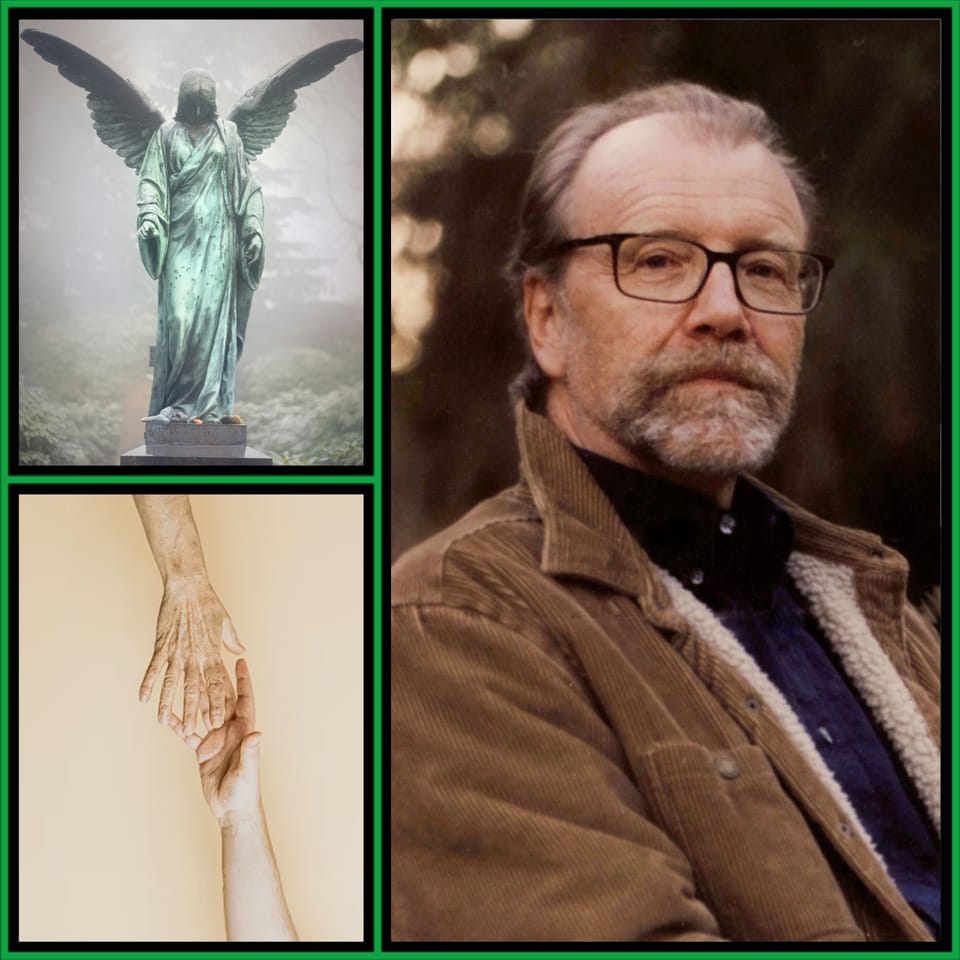
George Saunders: Angels, Ghosts and the Moral Imagination
Novelist George Saunders talks about creative inspiration, his fascination with ghost stories, and why dying may be the ultimate experience of wonder.
0:00 / 0:00
21 Feb 2026
George Saunders: Angels, Ghosts and the Moral Imagination
Novelist George Saunders talks about creative inspiration, his fascination with ghost stories, and why dying may be the ultimate experience of wonder.
Episode Notes
What if dying is not an ending, but a moment of radical clarity? In his new novel "Vigil," George Saunders conjures a strange and often comic world of bickering angels visiting a dying, deeply flawed man—debating and waiting to see whether he can face the truth about himself before it’s too late.
In this conversation, Steve Paulson talks with Saunders about the evolution of his ideas about death and the possibility of an afterlife. Dying, he says, may be “the ultimate experience of wonder,” and he believes ghost stories can open powerful imaginative spaces for novelists. Saunders reflects on his own Buddhist practice as he considers these life-and-death questions, and he tells us why he thinks fiction is uniquely suited to grappling with complex moral issues and why Tolstoy and Chekhov are his personal sources of inspiration.
Saunders is the author of such celebrated books as “Tenth of December,” “Pastoralia,” and the Booker Prize-winning “Lincoln in the Bardo.” His nonfiction book about the great Russian writers is “A Swim in a Pond in the Rain.”
This interview was recorded at the Central Library in downtown Madison shortly before Saunders spoke at the Wisconsin Book Festival.
- To the Best of Our Knowledge: On his short story collection 'Tenth of December.'
- To the Best of Our Knowledge: Reflecting on 'Lincoln in the Bardo.'
- Substack Story Club with George Saunders
Transcript
Anne Strainchamps: Welcome to Wonder Cabinet. I'm Anne Strainchamps.
Steve Paulson: And I'm Steve Paulson. Picture a dying man, a luxurious bedroom, and a visiting angel crash-landing in the nick of time.
George Saunders: And here he was, a tiny crimped fellow in an immense mahogany bed. I was not too late. Before me lay a person who had not willed himself into this world and was now being taken out of it by force. Soon it would come. Accompanied by disbelief and panic, and he would find himself on the wrong side of a rapidly closing door. Everything he had ever known and loved out of reach. Over there. Beyond it. At such moments, I especially cherish my task. I could comfort. I could.
Anne Strainchamps: That's George Saunders reading from his new novel, Vigil. The story of a dying oil baron, the epitome of corporate greed and climate denial. And the question is whether he should repent before he dies.
Steve Paulson: Except he doesn't think he did anything wrong. So the angel has her work cut out for her. And it is going to be a test of wills at this moment of final reckoning. Heaven seems very far away.
Anne Strainchamps: This is Saunders' second novel in a row about the afterlife. Steve, don't take this the wrong way, but why did you want to have him on Wonder Cabinet?
Steve Paulson: Well, I wanted to know why he keeps writing ghost stories. I mean, he is clearly fascinated by the big existential questions of what happens when we die. He's also a Buddhist, he grew up Catholic, and he has created entire metaphysical worlds filled with dead people.
Anne Strainchamps: You read his earlier one, Lincoln in the Bardo, and that was teeming with ghosts. I mean, there were something like 166 different characters, most of them dead and definitely not happy about it.
Steve Paulson: Especially the recently deceased who are stuck in the Bardo. So I wanted to know, is this just a literary device, you know, sort of a creative exercise that frees up his imagination? Or has Saunders had some personal experiences with any kind of otherworldly realms? And as you know, questions about the nature of consciousness are kind of my personal obsession.
Anne Strainchamps: Oh, I know that well, yes.
Steve Paulson: And I think they have everything to do with wonder.
Anne Strainchamps: Well, it can't hurt that he is very much in the tradition also of some of your other favorite authors, the great Russian writers.
Steve Paulson: True. Saunders loves Tolstoy and Chekhov and Gogol. But I think the common thread is that he also really cares about the big moral questions. You know, how are we supposed to live? What is truth? And do we need to atone for our moral failings?
So I felt like we could go pretty deep into some of these issues - and the conversation got really personal for both of us.
Anne Strainchamps: Let's listen.
Steve Paulson: So I want to ask about this world of dead people that you have created. So most of your story is told by Jill Blaine, who is, I don't know if she's an angel or a ghost.
George Saunders: She doesn't like labels. But she's not mortal.
Steve Paulson: I have to say, she reminded me of Clarence, the angel in It's a Wonderful Life, you know, trying to get his wings. Because she has a mission, too.
George Saunders: Yeah.
Steve Paulson: And her mission is to comfort the dying. Can you tell me about her?
George Saunders: Well, I mean, she died very young herself. And I think at the moment of her death, she had a kind of, I would think of it as like a denial experience where she couldn't believe that it was over. And in that moment, she kind of inhabited the person who was responsible for her death and had this kind of big philosophical insight that's sort of inspired her to stick around since 1976.
So the book is kind of told from her point of view. And I think gradually we start to see that maybe she's not exactly a reliable narrator. She doesn't have a lot of self-awareness. But she's a sweetheart. And I kind of fell in love with her.
Steve Paulson: So the dying man who she's trying to comfort is this guy named K.J. Boone, this old oil tycoon, very powerful guy, the villain of your story, I think it's fair to say. You would acknowledge he's the villain, right?
George Saunders: He is. He doesn't think so. And we're mostly in his head. But, yeah, I think he's not a great guy.
Steve Paulson: Right. I mean, he was the embodiment of corporate greed and the primary denier of climate change when it mattered. You know, back decades ago when there was debate about this and he was out front saying it's a hoax and he's proud of that. So the question, sort of the central question of the book is, should he repent for his sins before he dies? Why was that a meaningful question for you?
George Saunders: Well, I think because it's kind of every moment for everybody. I mean, he's a particularly bad guy and he's in a particularly rough fix because it's the last couple hours of his life. But I think, in every moment, I've come to feel that one of the big sins is denial. You know, are you in an honest relation to the moment you're in? And it's not as easy as it sounds, of course. So I think that was what interested me about him.
And then also, you know, I write pretty intuitively. And so sometimes books get layered in ways I didn't expect. So in this one it was kind of interesting to see two things that I actually believe in my heart directly in contradiction. So one is, Jill thinks that we should be infinitely merciful given the fact that, you know, none of us chose to be who we are in the womb. And even our ability to alter ourselves is somewhat predetermined. So I believe that. And I had some early experiences in Catholic grade school that made me think that.
But also, you know, we're in this world. And so in a relative sense, if someone's misbehaving, you've got to correct them. And that's part of being a virtuous person. So it was fun to have those two ideas - and embodied in him, this guy who's undeniably a bad dude.
Steve Paulson: Yeah. So one of the questions that comes up, I mean, that Jill says on various occasions is that the reason she wants to comfort him is there's no point in him trying to repent for his sins. And she, I mean, there's this word inevitability that comes up, sort of the idea that once your character is formed, you're going to go that way. Which is sort of an excuse, essentially, for, you know, okay, Boone was going to do what he was going to do. And there's no point in trying to get him to confess. There are other angels who think otherwise, who say he should confess. What was that tension for you? I mean, it seems like you were wrestling with the question.
George Saunders: I still am. I mean, I think one of the things that I think I'm learning as a writer is you can put certain questions into play and not exactly weigh in with any kind of final judgment. So in a book like this, there's six or seven rhetorical presences all making their best case. And I just walk away while they're fighting. I mean, that, you know, that Chekhovian idea that you don't have to solve a problem. You just have to formulate it correctly.
But for me, I think one thing that came up was, does it matter if he repents? Because he's, you know, he's minutes away from death. And I thought of this beautiful Tolstoy story called The Death of Ivan Ilyich. And in that one, there's a guy who is not quite as bad, but he's got an issue with, he's a very conformist person. His whole life, he's just tried to be like everybody else. And in the end, that meant that he didn't have much real connection with his family and people around him.
And so, very moving because at the very end, he's in such pain. And Tolstoy based the story on a neighbor of his who supposedly screamed for the last three days of his life. And I think Tolstoy was wondering, well, what would do that? So there's a physical pain, but it's also the pain that he can't figure out what he should have done differently in his life. And at the very end, there's a moment where he says sort of to God, all right, okay, maybe I didn't live in the right way. And he sits with that for about a day. And then a day later, he says, but if I didn't live in the right way, there must be a right way. And so gradually, he gets some relief from his pain just by this reasoning.
So with this guy, K.J. Boone, I thought, well, it actually does matter. Even if you're a terrible guy and in the very last moments of your life, you repent, I think it matters. It certainly matters to you. And I think in some larger sense, it's right, you know, to do so if you can.
Steve Paulson: So I want to switch gears and talk about death because it's obviously a subject that you are very interested in. I mean, your last two novels are filled with people who were either dying or are dead, Lincoln in the Bardo and your new one, Vigil. And there's a story that I've heard that might explain some of this, that you were in a plane and you thought you were going to crash?
George Saunders: Yeah, it was a plane coming out of Chicago and a seagull flew into the engine. But they didn't know that and they didn't tell us. So it was just a feeling of flying along, reading a magazine, and suddenly it was like a minivan had hit the side of the thing. And the plane started dropping and people were screaming. The flight attendants fell silent and it was just a terrifying thing. And I thought, oh, I've got to get out of this body. That was really the feeling of it.
Steve Paulson: You were thinking you have to get out of this body? That's an interesting response.
George Saunders: No, I mean, it was a visceral thing. The seat back right there was the thing that was going to do it. And it was very kind of humbling because I always thought I'd be the guy who would lead everyone in singing kumbaya or something. But I was not in any, I couldn't even remember my name, honestly. It was just like, no, no, no, no, no, no. So that was a big deal.
But actually my death thing was long before that. Even as a little kid, I would be in our grandparents' house and I'd hear them breathing from the next room and think, oh, my God. They were ancient. They were 40 or something. But this could end. This will end.
Steve Paulson: So you've been sort of worried about death or maybe obsessed with death basically your whole life.
George Saunders: I think so. I'm aware of it. And I actually think it's, I mean, as a Buddhist, I think it's kind of healthy because it's true. And it could happen. There's no promises. So it's kind of like if you were at a really great party and someone sidled up and said, you've got to get kicked out of here. But I can't tell you when.
And I don't really think I'm obsessed with death. But maybe in my limitation as a writer, if I go there, I am more able to talk about life.
Steve Paulson: Did that experience on the plane, when you thought you were going to crash, did that change anything for you?
George Saunders: For about a day. I mean, the next day was very, very sweet. No, I mean, it's kind of the same experience as when you go to a funeral of somebody you care about. For a couple of days, you're wide awake and you think, why am I sleepwalking through this life? But I think maybe we can't stay there full time.
But the other thing was, I was meditating like crazy at that time. And I still was terrified. So that made me think, oh, maybe you're not such a great meditator. I need to work on that a little harder.
Steve Paulson: So I want to ask you about ghost stories. A few years ago, I was talking with Lorrie Moore, your fellow writer.
George Saunders: A great writer.
Steve Paulson: And she happened to say that one of her favorite teaching assignments was to ask her students to write a ghost story. And she said because it opened up this imaginative space, you know, would take you to unexpected places. And I'm sort of asking her, you know, what she had in mind. And she said, well, have you ever had the experience of what felt like to have a visitation?
And I have, actually. I've had a few where I've had these very powerful dreams where basically, you know, dead people, people who had been close to me, came to me. And they felt very real to me. And it's stayed with me ever since Lorrie said that.
Does that resonate for you in any way, either as a writer, as part of the creative act, or because you've had some weird experiences that you can't explain?
George Saunders: Yes, on both. On the writerly level, for me, it was a big milepost in my development when I could figure out how to disrupt my natural realist urge. So I was kind of a Hemingway imitator when I was young. And it was just, it wasn't enough. And as soon as I started setting the stories in theme parks or putting ghosts in them, it just made them automatically comic.
You know, just as a, almost as a self-protective thing to say, okay, put a ghost in it. And I can see that if, you know, if you naturally gravitate towards more sort of realistic kinds of writing, it's going to knock you out of that, I would assume. As soon as you say, Jim and Margaret sat at the table on a cool autumn afternoon, and her dead father drifted by. Suddenly, you've got to do something with that. You know, you can't be quotidian.
But on the second point, I did have a visitation from my grandfather just after he died. And it's the only one in my life, which is why I kind of really believe in it. And it was just very profound, not scary. And it was just comfort. He was just saying, I'm good. Don't worry about it. And he also was kind of saying, you're going to be okay, you know, which is, and it was very, not flashy, very brief. The minimum amount of communication from a formalist kind of thing.
But I remember even during it, I thought, am I asleep? And I'm not, you know. And it didn't, it wasn't entirely brief, you know.
So have you read this book by Patricia Pearson? And I think, I'm going to get the title wrong, but I think it's called Opening Heaven's Gate, I think.
Steve Paulson: No, I haven't.
George Saunders: Well, she had a, her sister had a profound dream experience. Well, it was with her father who was alive, but he died during the night while she was having a dream. And he came to her and she had cancer and told her everything's going to be all right. Gave her a very long, beautiful vision of this. Then she woke up happy and found out that he had passed in the night.
And so Patricia Pearson, the sister of this woman, said, that's amazing because my sister is not susceptible to that. Let me use my skills as a science writer to research this. And she found that 50% of people, when you interviewed them in a way that they would be frank about it, have had experiences, visitations from across that border. You know, so it's actually not supernatural. It's natural, but we are just a little embarrassed to admit it.
Steve Paulson: Well, it might be supernatural. I mean, if you want to try to explain it.
George Saunders: But if it's happening 50% of the time, it's natural. I mean, you know.
Steve Paulson: That's true. Well, I mean, it's interesting that you say that for you, your experience was comforting because in these dreams that I had, they were all comforting in a way. And one was, I'd been very close to my grandparents and my grandfather died a few years earlier and then my grandmother just died. And, you know, I was in their house, which I had spent a lot of time in. And my grandmother came and said, Scott, it's going to be okay. I mean, to her husband and like, I'm going to come and join you. And I was witnessing that. And as I say, it felt great. But I can explain it away. It's a dream.
George Saunders: Yeah. But I think, you know, we make that division between mind and body and sense and supernatural. But in fact, if there was some dimension that we don't know about, how else would it tell us, you know, but in dreams or in visitations?
And also, I was thinking, my grandmother came to me in a dream a few years after she passed away. And I was very close to her - lovely woman. I said, Grandma, I'm so sorry you passed away. She goes, that's okay. You're going to be dead within a year.
Steve Paulson: Wow.
George Saunders: So that was a pretty charged year.
Steve Paulson: Oh, my God. I would be totally freaked out if I heard that.
George Saunders: Yeah, I would. And then I just, I wrote down the date, you know. But so I thought, well, that was just an errant dream. But it was like, you better pay attention this year. And I did. I paid close attention that year.
But, I mean, you know, for me, the books are kind of, I don't know what they are when I start. In other words, I never start because I'm fascinated with ghosts.
Steve Paulson: But it's striking that your last two novels are about ghosts.
George Saunders: Yeah, yeah. And a lot of my stories have them in there, too. So, I mean, on one level, it's just a way of shaking the table and going, don't fall into the habit of realism since you don't do that very well. But, of course, once you start talking about the dead, you're talking about the big, you know, the big question. And the finite nature of our time here is, to me, very beautiful.
It's like, I mean, if you were here infinitely, suddenly the moral stakes go down and there's no real pressure. So, I am kind of interested.
Steve Paulson: So, death kind of does give us meaning.
George Saunders: I think so. I mean, it's certainly going to happen, they say. Not to us, but to most people.
Steve Paulson: So, the name of our podcast is Wonder Cabinet. And I want to bring in this idea of wonder to see if this is meaningful in any way to you. And first, I'm interested in, you know, as a fiction writer. I'm not a fiction writer. I marvel at people who create imaginative stories, and wonder, where do the characters come from? Where do sentences come from? Where do the ideas for the stories come from? It seems kind of like a magic trick to me and for you especially - because you are so wildly inventive in what you do. And so, is the experience of writing for you, is that an experience of wonder?
George Saunders: Oh, every day. Well, you're hoping so. Often, it starts in a pretty quotidian way, which is just reading what you read the day before. But for me, the wonder is you can be reading something and there's a certain mindset I try to get into, which is fairly quiet-minded and just attentive to the text. And there's a little bit of a hearing of it in your mind. I'm not saying it aloud, but I can hear it.
But, okay, so you're scanning it that way and the wonder is suddenly something from somewhere corrects you. There's a phrase that needs to be cut. You just know it and you cut it. And then you keep reading and suddenly there's a little voice that utters a phrase that you need to put in. And you just put it in there.
So, you're in relation to that, whatever that is. And it's a very delicate thing. You don't want to overpower it. You don't want to let it be unrestrained. So, that state of high attention is really, I crave it. But mostly because if I do that over and over and over, put the changes in, do it again, the thing starts to have a will of its own. And it's a more interesting being than I am, than this person is.
So, over many, many iterations of a book, it starts to reveal some patterning and some truth that you didn't know you had in you. And that, for me, is wonder, you know, because I don't know where it comes from really, I call it the subconscious. I don't know if that's correct, but it's reliable. And it's so hope-giving because it means that I'm not trapped in George, you know, the guy who gets up every day. But either I have in me or I have access to something that's much more everything, really, you know.
Steve Paulson: So the logical explanation is that it's somewhere in your subconscious. But it's interesting that you said maybe it's coming from somewhere else. I mean, even that you're entertaining that possibility.
George Saunders: Well, I think in consciousness studies now, there's a couple of theories. One is that consciousness is what your brain makes. The other one is it's what it receives.
Steve Paulson: Right. It's like a radio.
George Saunders: Right. Right.
Steve Paulson: Our brain is like a radio and, you know, we sort of can receive the signals.
George Saunders: Yeah. The other feeling that I have sometimes had is that the story is perfect in one's mind. But when you go to tell it, it breaks. It falls out and it breaks on a table into 100 shards and or 1,000 shards. But then you forget all that. And then the rewriting is finding little parts that fit together and through rewriting, reassembling this perfect thing. And sometimes there's a shard from another story and you put that over here.
But that's a feeling I've had many times - that how in the world, this paragraph that I cut three years ago is now perfect on page 80, you know. So I don't understand it, but it's a very beautiful feeling. And it gives me a sense of hope and wonder because it sort of defies limitations. You know, at 67, you're like, yeah, I pretty much know what I'm going to do in every situation, you know. Well, in this one, you don't. And that's kind of exciting.
Steve Paulson: Yeah. So I want to ask about wonder in another context. And this is about death, which to me is the most mysterious experience there can possibly be. You know, what happens when we die? What happens possibly after we die? And it seems profoundly mysterious. The ultimate experience of wonder, I think.
George Saunders: Yeah. Yeah. I, you know, have you heard anything? [Laugh] I don't know. I mean, the only thing I know is, I think these spiritual traditions exist because there are people who in different ways can or have spanned that, you know, whether it's in near-death experiences or in the Tibetan tradition. There's something called a delog, somebody who actually goes there and comes back.
But the only thing I feel like I know is that the cultivation of one's mind now is probably important, you know. So if you have a certain kind of anxiety or neurosis or negativity now, you'll probably have some version of that in the last moments. And I feel, even if only in that transitional state, there's some of your mind is involved in that. You don't just click off.
So I think that's what I've gleaned from, certainly from Buddhist practice. And I think if you look at Catholicism, there's a lot of that too.
Steve Paulson: Well, and you mentioned near-death experiences. And it's striking that one of the subjects of your novel, Vigil, it's the sense of a life review. I mean, you're going back and you're thinking about, you know, your failings. And one of the very common experiences that people report in near-death experiences is they have this life review. In some cases, their whole lives flash before them. And we're talking a different sense of time here. So it's like, you know, all of your life can reveal itself, but in clock time, it's a very short period of time.
And there's this sense of moral accountability in these experiences, which is absolutely, I find that absolutely fascinating. Like, where does that come from?
George Saunders: I sometimes think of it as, you know, you've got your inner self all your life because how could you not be? And then maybe in that brief second, you get out from behind that smudged window that is self. And you see things as they are. And you just have that moment of juxtaposition like, oh, here's myself infused with total godliness. And here's what I actually did. And, you know, maybe that's your heaven and hell. If you did pretty well, you're, oh, that's good. And if you didn't, you just must regret it.
But I think the one thing I'm pretty sure of is, and this is in the Buddhist teachings, and it's in the near-death experiences, the idea that when you leave the body behind, you get a little bit unbounded, which can be good and probably could be bad as well.
The Buddhists say that when you're in a body with your mind, then all the neurotic qualities of the mind are somewhat tamed by the physicality. So they say you're like a horse, a wild horse tied to a tree. Well, when you die, they cut the rope. And your mind is still wild. And it's wild and the flavor was wild in life. But it's supersized. So that can be a little, you know, if you were a big Kardashians fan, suddenly the afterlife is populated with the Kardashians accusing you of things.
Steve Paulson: I mean, it does kind of, it raises the question of the soul. If I'm trying to understand this idea that you have this life review, you know, your moral failings are flashing. This is soul talk here, which is not a popular word anymore. I mean, if you're not a devoutly religious person, does the word soul, does that mean much to you?
George Saunders: Not so much anymore. I think it's, for me, it's mind talk. Like the mind is a thing and it's a powerful thing. It's not just brain, I don't think. So my view is you're sort of, at birth, you get beautifully bound into this one particular body, this mental phenomenon. And you're there all along and you just think that's the world, you know.
And then at the end, you get out of that little jail and suddenly, I don't know what you see, but it's not that. And I know even from doing hallucinogens, like one of the experiences is, oh my God, I've got a particular set of visors on. I think that's a universe, but actually it's just my visors. And sometimes, like the one time I've done that, those things dropped away a little bit. And that was kind of beautiful, a little terrifying also. But I'm guessing something like that would happen, but I really, I don't know. I mean, I like that line about it.
Steve Paulson: Well, speaking of my own hallucinogenic experiences. Yes, my sense of self has dropped away. And going back to what you said, the brain is a kind of receiver. That was Aldous Huxley's theory that, you know, it's like in our normal waking state, we have these filters on. We don't have access to that other stuff.
So you mentioned Buddhist metaphysics. Are you familiar with the phenomenon of Tukdom?
George Saunders: I don't think so.
Steve Paulson: So, very experienced lamas will die. I mean, they are clinically dead, but they can lie in state without any bodily decomposition. And people have been noticing, like, it can go on for weeks.
George Saunders: Yeah, I've heard that called the Delog Phenomenon.
Steve Paulson: Oh, okay. A different word for it.
George Saunders: Yeah, yeah. Which is just so, I mean, if you're talking about sort of the mysteries of death, it's like, wow. Well, I've read some of those accounts, and the thing that really interests me is that, okay, so we can say that death is a mental phenomenon. When you die, you have a private mental phenomenon, and it could be anything, okay?
But in these accounts, the travelers will meet the emanations of other dead people who will tell them things that they will then take back to real life and find is true. So, that's different. That's actually a commons area, you know, as opposed to a strictly private. So, that's pretty interesting.
Steve Paulson: So, it sounds like you're open - I know you didn't go for the word supernatural here, but you're open to the idea that there is maybe consciousness that extends beyond just our individual brains.
George Saunders: I think that, I mean, I think we're in a very limited, we're in jail. You know, the self is a jail. And so, and, you know, neuroscientists are now saying, I read something from Trungpa Rinpoche, and he said, every human experience, joy, happiness, resentment, a dinner, it's all a memory. Which neuroscientists are now finding is true. It's just a construction that the senses make, an approximation, and we go, oh, it's a restaurant.
So, that's kind of exciting, and I think it does mean that it would be shocking if, it would be shocking if the way we perceive the world was right. That would be really weird, you know. So, we struggle around here on Earth, and we have these crazy visors on, and I think that at the end we, you know, someone takes them off for us very kindly.
Steve Paulson: Does this way of thinking, does that feed into how you think about composing stories? It's maybe a bigger fictional universe if you sort of acknowledge there's other stuff, you know.
George Saunders: Yeah.
Steve Paulson: That consciousness is bigger than just our quotidian reality.
George Saunders: Yeah. Well, I think, I mean, for me, that is the compositional process to try to tap into some little touch of that other thing. I kind of find myself longing for narratives that at least suggest that quotidian reality is sort of a sweet but kind of a joke, you know.
So, I keep a quote from Ed Ruscha on my desk, and it says something like, every artist dreams of opening the gates of heaven. I kind of burned out on, you know, sort of Hemingway-esque realism when I was younger, and I still love Chekhov realism, but I can't do it.
So, I think for me, it's just to say, yeah, you know, let's try to, just almost like a book could be a love letter to my reader saying, let's just remind ourselves that the way things feel every day is only part of the story. Which is good news, because it means we could feel more love, we could feel more sympathy, and our natural inclinations to imagine ourselves as separate from other people and maybe in opposition to them is just a construct, and we could maybe get past it. I think fiction has a little tiny role to play in that.
Steve Paulson: I'm talking with George Saunders. So, how can a novelist help us think about really complicated moral ideas? That's where we'll go next, after the break.
---
Anne Strainchamps: Hi, it's Anne. I am so glad you're joining us. We have some amazing guests lined up for the weeks ahead, and I'm really excited about them. And here's a tip. Maybe you know this already, but if you follow Wonder Cabinet on Apple Podcasts, those new episodes will show up automatically, like a little weekly gift in your podcast feed. I hope you like it.
---
Steve Paulson: This is Wonder Cabinet. I'm Steve Paulson, and we're back with George Saunders, talking about moral accountability in fiction, and what he makes of that Dwight Garner review.
So I want to come back to your story, Vigil, and come back to Boone, the villain in the story. And near the end of the book, he's being visited by various people, dead and living. One of them is his daughter. His daughter clearly loves him, but is also thinking, maybe he needs to be held to account. And there's a passage in there that I'd love to have you read that gets at that.
George Saunders: Is it here?
Steve Paulson: Yeah.
George Saunders: So she goes to visit him. "Daddy, she whispered, do you have any idea what people are saying about you on TV and the internet and in so many articles and books and podcasts lately? Is it true? All of it? Any of it? If so, maybe you were a darker, trickier bastard than I ever... not bastard, guy, not darker, complicated, not trickier, secretive, a much more complicated, secretive guy than I ever... If so, if you did know and did it anyway, which if I'm being frank, I feel was probably, yes, the case, it breaks my heart. And I have to say, because I want, if we are really parting, for us to do so from a place of total honesty. It disappoints me, Daddy. Disappoints me greatly. I just feel really let down by you. I always saw you as someone who tried to do what was right, no matter what. So this is a truly hard pill for me to... Pausing for a look down at my charge, she noted that his hair, badly in need of cutting, was just a little bit in the front there, shaking or quaking or whatever, just slightly moving with the motion of his frail old body. Now the shaking stopped and he went completely still and it occurred to her that, good Christ, she'd killed him with this selfish last minute bitch fest. Then his lips slightly moved as if he were trying to moisten them. Oh, thank God. Lord, forget it. They could talk about it later. Or not."
Steve Paulson: Now we should say, we're talking about big, serious ideas. But it's a very funny novel. And I have to say, Boone, your villain, he's a great character. I mean, he's vulgar. He's not going to take any shit from all these people who are trying to set him on the right path. He's basically twitting people like you and me who are really pissed off at him because he was a big climate denier. Did you have fun writing that character?
George Saunders: A lot of fun, yeah. I used to work in the oil business when I was young. And so there was a lot of that kind of hidden energy. I worked in Asia in the oil fields in the 80s. And even then, there was a little bit of anti-oil sentiment. And I went to a place called the School of Mines in Colorado, which was very oil-based. So within that culture, there was a lot of defensive kind of positions. And how did you get to the protest?
And they used to say, one of the things, it was a popular bumper sticker was, ban mining. Let the bastards freeze in the dark. So as a young guy, kind of an Ayn Rand guy, I was very proud to be in the oil fields. And it was an incredibly beautiful, exotic experience. And it's not easy. There's lots of amazing people exerting themselves in incredible ways. So I could definitely channel that in him. I mean, I was working in the tradition of Christmas Carol and a couple of Tolstoy stories of repentance at the last minute. And of course, as a writer, you're always thinking, well, does it ever go the other way? Are there ever people who are so entrenched in their denial that they just stay there? And I'm like, of course, there have to be, you know, there have to be. So it was kind of fun to just sort of write for a couple of years and see which one he decided to be.
Steve Paulson: Yeah. Yeah. There's obviously a politics to all of this, speaking of climate change and, you know, we're in this very fraught political moment right now. And this whole question of whether people will speak out, will acknowledge their sins essentially. And to me, one of the great tragedies of our political culture, maybe it's every political culture, is that it so rarely happens when people in power do this. They have to know a lot of the time that what they're doing is wrong. And to me, the classic example is someone like Robert McNamara, one of the architects of the Vietnam War. Only later near the end of his life did he acknowledge it was a terrible blunder. And it's so rare that someone, when they still have power, when they still can do something, to acknowledge that. And obviously, given our political situation right now, you have to assume that a lot of people around Trump know that what they're doing is wrong.
George Saunders: We know that they know that because they tell people off the record that they feel that way.
I don't know. I mean, for me, this book was interesting because that's exactly what I had to figure out for him. You could have a book where he's just a complete bastard. But I don't think, I think people who do evil generally, you know, they're sociopaths, but I think they generally wake up in the morning thinking they're doing something good, or at least something desirable. And that therein lies a trick. Because if you're this guy, you've spent your whole life in this position. Do you have the strength to get out of it at the very end? I don't know.
So I think the question of saying, let's put aside the kind of cliched, almost movie villain, who's like, yeah, yeah, yeah, I love being evil. I've never met evil. I've met some pretty rotten people. But I've never met someone who would say, I enjoy being evil. "I know I'm evil, up yours." I don't see that. I think people have systems of virtue that are insane. And they work within those systems of virtue. And maybe like McNamara at the end, it's interesting. I wonder what clicked in with him at that point. Because I think the habit is more to say, I didn't do anything wrong. And the panic you would feel if somebody could convince you, it was totally wrong for you to be in radio. I mean, that would be...
I was someone, actually, on that plane, the incident we talked about, I didn't have the feeling that writing was bad. But I had zero, I didn't even think to take comfort in the fact that I'd written books, not even for a fraction of a second. So that's a pretty terrifying thing to think. I mean, every day we get up and we have some kind of comfort system that allows us to feel virtuous and therefore have a good day, you know. And it would be terrifying to me if at 80 years old, I saw abundant evidence that my system had been wrong from the beginning. That would take an amazing amount of character to then say, like the Tolstoy character, maybe I have lived wrong. Okay. And what happens with him is breathtaking, this little man who's never done anything original in his life says, all right then, if I was wrong, there must be a right. What is it? What is it? You know? And that he opens up in the last probably 30 minutes of his life into almost this age. You know, he understands that his, like Jill, he understands that the only useful thing you can do is serve other people. And that's what he tries to do. But the tragedy is at that point, he's too far gone. He tries to say, forgive me, but he can't say it to his wife. He just says, fu ga.
Steve Paulson: Well, since you have referred to Tolstoy and Chekhov and the Russian writers that you love, I did go back and was reading some of your earlier book about how to read the Russian writers, your book, A Swim in a Pond in the Rain. And you talked about what they did is they asked the big questions. And so I'm going to quote from your introduction here. "How are we supposed to be living? What were we put here to accomplish? What should we value? What is truth? And how might we recognize it? How can we feel peace when some people have everything and others have nothing?" Those are not usually the questions that I think most fiction writers today at least deal with, but you do, obviously. I don't know if you object to the word a "moral writer," but there's clearly a lot of moral seriousness in what you do.
George Saunders: Yeah. I've always had the idea that a writer is primarily an entertainer and the entertainer has to grab you. And the way that we grab you is by talking about something you care about, you know? So I think sometimes literature can slide off into the merely clever, you know, somebody doing magic tricks. And that, that can be wonderful too. But for me, I never had any interest in writing something that wasn't kind of about, a cringe statement, but the meaning of life, like, what are we doing here? That, that I don't, otherwise I don't really know what the thriving factor would be.
Steve Paulson: So what, what do you think a fiction writer can do to address those questions that, you know, the big questions that I just quoted, that a really good nonfiction book or an essay just can't do? Where can fiction take us?
George Saunders: Yeah. Well, that's, that's the question you ask with every book. You hope that there's an answer and you're trying to steer your book into that zone where it's doing something that only it could do. I think for me, the main thing is it can be so speculative, you know? In other words, if I make up a person and I do a good job of making up, there he is, he's on the page. You and I are both looking at him and he's got incredible freedom and I've got incredible freedom to make him do whatever I need to do. So that introduces a kind of a wildness in the moral universe where there, I don't have to be constrained to the facts or to anything, but also there, there's a second way that fiction works, which is not to do with the details of the story, but with the details of my relationship with you, the reader. So in Chekhov, for example, who's a real model for me, one of the patterns I've noticed in his work is I'll start to read him and my very natural tendency to want to know who the good guy is, asserts itself. And I say, oh, this is the right person. Chekhov doesn't have much patience with that. So he'll, he'll show something else. And suddenly you think, oh, okay, I'm sorry, Anton, I misunderstood. This is the right view. And he'll do that four and five times. And by the end, your judging tendency has been a little bit challenged and neutralized and you think, okay, okay, I don't know what's going on here.
So the idea that a work of fiction can kind of exhaust our everyday mundane desire to judge things simply and put them into categories and be done with it. And at the same time, it reminds us that we have a higher capacity to abide with ambiguity and contradiction. So when I read Chekhov, I just come out of it feeling a slightly greater respect for my ability to abide with situations instead of having to nail them, which these days, I think social media does sort of the opposite. It says, what's your opinion on the rainforest? And yeah, I don't know. Well, okay, you know, vote quickly.
So I think we're living in a time where everyone seems to think that we have to have constant opinions about everything. And it's very stressful. Whereas in the fictive world, you are encouraged to take your time. And by the end, with that open mind, you're able to take a lot more information and, and sometimes judgment disappears and you have a feeling of like, oh, that's how it is, you know? And I think that's a very powerful moral position simply because you're more patient and you are less inclined to make a mistake because you're watching, you know?
Steve Paulson: Yeah. So it's interesting what you were saying about Chekhov and how he kind of shifts your perspective, like, you know, what you should really believe. And it made me think... did you watch the TV show Succession?
George Saunders: Yes. Yes.
Steve Paulson: Which I thought was so brilliant because, you know, they're all despicable characters, but just as you just sort of couldn't stand someone, then they make that person a little bit more likable and then someone else a little bit worse. And they kept going back and forth. And to me, that was sort of the genius of it.
George Saunders: Yeah. And in a sense, what you're left with is you, you see how quickly you wanted to write somebody off and the universe of that show says, well, not so fast, you know?
Steve Paulson: Yeah. Yeah.
George Saunders: And for the writer, it's really interesting because it, it has to do with actually not about anything moral, but it has to do with something technical, which is watch your own text and see where you're leaving the reader. You know, right now I've got you thinking the person A is a villain. As a writer rereading one's own work, you should go, oh, okay, I can use that. And that's, I think what Chekhov did and what the writers of Succession did. So in a certain way, it's about intimacy between the reader and writer. I have to know fairly well where I've left you. So then I can then surprise you. I would say bad writing is kind of disrespectful writing because it, it, it's a phone-in, you know? So that's another thing I love about writing is it trains me to imagine other people more fully.
Steve Paulson: So it sounds like you're always shifting back and forth in terms of how much you want to empathize with a particular character. I mean, it's like, if, if there's too much empathy there, maybe you want to pull it back a little bit and like make that person a little bit less likable and the same with the unlikeable.
George Saunders: And also I would, I mean, I get tagged with that empathy thing a lot. So I kind of take that word aside. Let's think about accuracy. So this KJ Boone guy, if I make him a cartoon Cruella de Vil villain, I think a fair-minded reader is going to go, eh, you phoning that in. If I make him a secret saint who's so sweet, but he just accidentally plundered the earth, the same reader is going to cry bullshit. So somewhere in the middle, I think you're looking for, for accuracy, fundamental accuracy of statement as Nabokov put it, which means, well, what it really means is you have to be super sensitive to the two extremes. If I start making him a character of evil, I have to revise that. If I start attributing virtues to him that he wouldn't have, I have to trim that back. And all that comes down to line by line stuff, you know?
Steve Paulson: So I want to ask you about Dwight Garner's review of Vigil, not his judgment of the book, but his starting premise that anytime a novelist focuses on virtue, it's bad for art. It becomes prescriptive, it becomes mushy. And I'm guessing you fundamentally disagree with that premise.
George Saunders: Well, yeah, I do disagree with that. I mean, it's demonstrated in all kinds of great literature that the examination of virtue and vice is part of the game. So I don't know. I don't know. I am reluctant to review reviews.
Steve Paulson: And I get it that you don't want to comment on someone who reviewed your book, but the premise of it.
George Saunders: Well, one thing that I think happens sometimes, it happened in that review and it happened in another one a few years before at the Times, I kind of get tagged as being a kindness advocate or more or something. And sometimes there's a certain cherry picking of other sources to support that. And I...
Steve Paulson: St. George. I mean, that's what you've been tagged with, you were the apostle of kindness and goodness and, you know, the good Buddhist and all of that.
George Saunders: Yeah. So that's a little, I mean, I'm sure I'm in part responsible for that, but there's also kind of a stone rolling downhill quality where if we talk about rhinoceroses here, then the next interviewer brings it up and pretty soon I'm the rhinoceros advocate. So I think in... I guess as a writer, you hope that the book at hand will be reviewed. And I think in that particular review, there might've been some tendency to equate my view with Jill's. But I think if... I mean, my reading of the book is that the book is poking at that all the time. So I, you know, it's a free country. So reviewers get to review and I... that's fine.
Steve Paulson: But I'm wondering, I mean, to pull back a little bit, I'm wondering if maybe we need more of a sense of moral reckoning in our culture now. And maybe we've let that slide a little bit and it's time to come back and pass judgment a little bit.
George Saunders: Well, it kind of depends. I mean, the moralizing... I don't think you want to moralize... I would agree that you don't want a moralizing quality in the book because that's not what a novel does. A novel is supposed to... As I said, it formulates the problem correctly. But if the problem that the novel is formulating is trivial, then there's no moral heft. I mean, a good book is... I think it's always fundamentally taking up moral issues in the sense that a character is being asked to make choices. And on what basis would he do that? So I don't... I think in that review, there was some sense that this book was a propaganda message for kindness, which I think... I can't. It isn't. I mean, you know, I wrote it and it isn't. So I don't think it's really...
Steve Paulson: It's sort of like your reputation preceded how some people read it.
George Saunders: Yeah, it preceded the reading of the book, which is a little bit unfortunate from my point of view. And also, you know, the kindness thing was a speech... I made one speech...
Steve Paulson: A commencement speech.
George Saunders: And I certainly believe in kindness, you know. But the speech is about my own failure at the same, you know. So... And I try to be nice in public. I try to, you know, have good public manners. But... So it's a little bit of a bit of an albatross. I might have to go rob a bank or something. But I think, you know, the work... In the work... I mean, a lot of my work is very dark. And I think... I do intend my books to be morally charged in the sense that I want them to ask what we're doing here. And are there ways that we get off the path? Of course there is. How can we get back on the path? And the primary moral function I think of a book is to, through specificity, lead us up this mountain of reduced judgment we talked about earlier, you know. So if I'm having a frank conversation with you as a reader and we're talking about something that matters and I'm doing it in a skillful way, we're going to find ourselves in a kind of a beautiful motorcycle sidecar ride up this mountain. And at the end, we're going to just be both a little more full of wonder, to use that word again. It just means we're going to not know. And we're going to feel that that not knowing is actually okay for a little bit. You know, that's... That's the moral part of it.
Steve Paulson: Yeah. Thank you. This has been such a pleasure.
**George Saunders.** I've enjoyed it so much. Thank you very much.
Steve Paulson: Yeah. It's just been wonderful. Thank you.
George Saunders: Thanks.
Steve Paulson: George Saunders, talking with us at the Central Library in Madison just before his appearance at the Wisconsin Book Festival. His new novel is titled Vigil. I'm Steve Paulson.
Anne Strainchamps: And I'm Anne Strainchamps. On our next episode, I'll talk with literary scholar Renee Berglund about Emily Dickinson, Charles Darwin, and natural magic, a scientific discipline that's maybe due for a revival.
Steve Paulson: Thanks to our audio engineer, Steve Gotscher, and to digital producer, Mark Rickers. I hope you'll subscribe to Wonder Cabinet on your favorite podcast platform.
Anne Strainchamps: And sign up for the newsletter so you never miss an episode. You'll find it all at wondercabinetproductions.com.
Steve Paulson: Until next time.
Subscribe to make sure you never miss an episode.