

30 Apr 2026
Mapping Time
Anne swims in the swirls of deep geological history.
0:00 / 0:00
Episode Notes
Dear Wonderfolk,
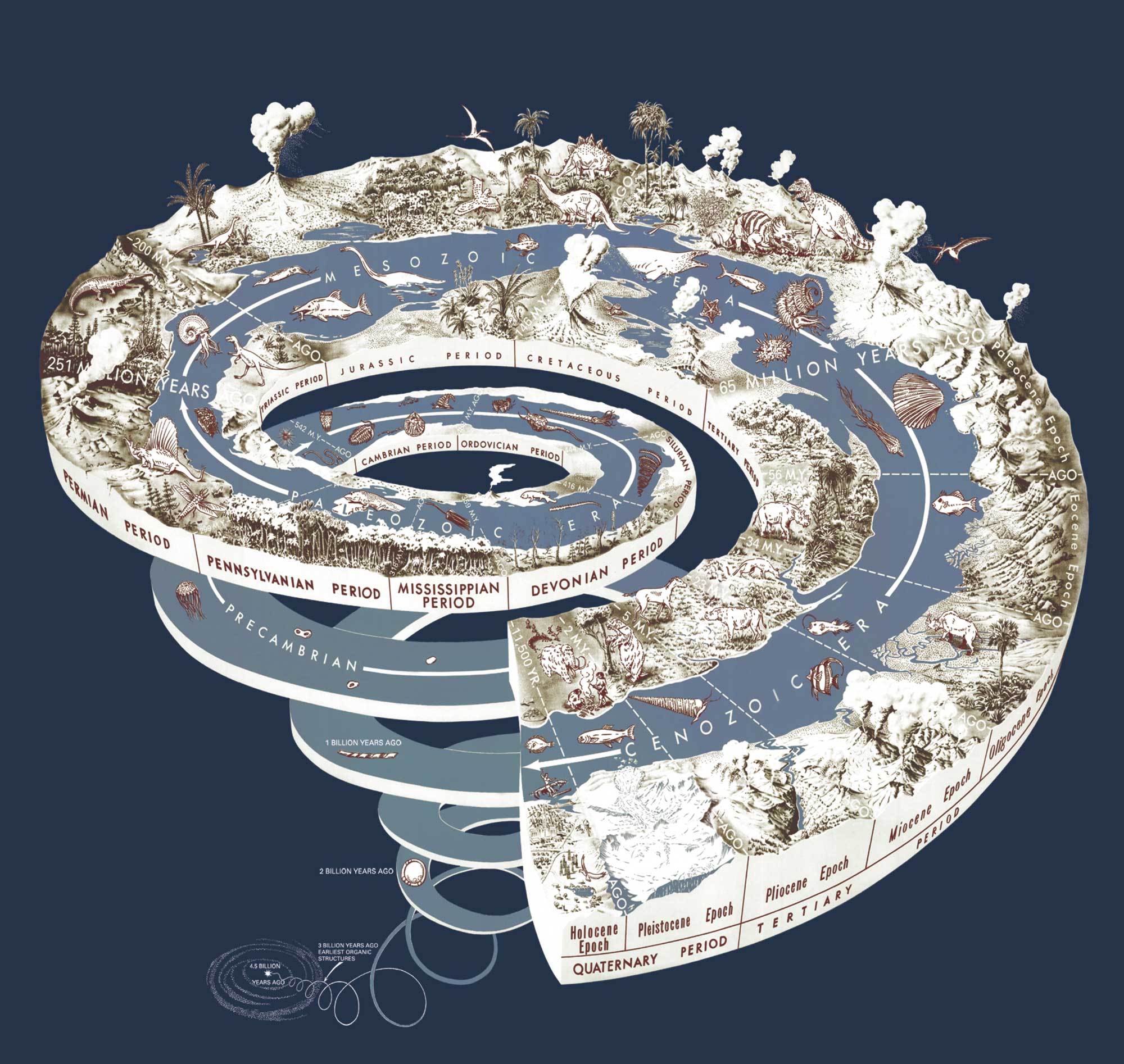
How do you imagine time? To be more specific, how do you picture time? Irreversible arrow, ever-flowing river, wheel of seasons, cosmic spiral? One of my new favorites is this Geologic Time Spiral, which maps the 4.5 billion year history of the Earth in a single image. (You can order a copy or download it for free from the US Geological Survey.)
If you followed my work on To the Best of Our Knowledge, you know that I’m never done thinking and talking about time. To my mind, it’s the mystery at the heart of existence. Or the riddle, as Gollum puts it slyly to Bilbo in “The Hobbit,”
This thing all things devours:
Birds, beasts, trees, flowers;
Gnaws iron, bites steel;
Grinds hard stones to meal;
Slays king, ruins town,
And beats high mountain down.
The answer, of course, is time – in its guise as the Great Destroyer. Personally, I prefer time’s other face: the Great Creator. I’ve been thinking about that this week, in the wake of my conversation with historian Caroline Winterer about her wonderful book, “How the New World Became Old: The Deep Time Revolution in America” (Princeton University Press). It’s the best kind of intellectual history: the story of an idea that unfolds panoramically across an actual landscape – the American West— uncovering layers of the past to reveal something new about the present.
Caroline writes about how shocked Americans were to discover, in the 19th century, that the land beneath their feet was once home to gigantic beasts like T. rex and Brontosaurus, to fossilized forests and woolly mammoths and saber-toothed cats. As early explorers, naturalists and engineers delved into the geological strata, they uncovered a world hundreds of millions of years older than the Bible taught – and an entire generation was wonderstruck. The deep time revolution profoundly shaped America’s national identity, but as I said, time cuts two ways. The discovery of the continent’s ancient past imbued the American landscape with a sense of rapture, but it was also used to justify the eradication of Native peoples and their history and culture. So the concept of deep time has been both a creative and a destructive force in the nation’s history, in ways that are still embedded in civic and cultural narratives today.
After talking with Caroline, I’ve been remembering a spring break trip Steve and I made years ago, to see some of Utah’s legendary national parks. We marveled at the jagged canyons in Zion and the fairytale red rock formations in Bryce. But the most primal experience was the few days we spent hiking in the Grand Staircase-Escalante National Monument. It’s high desert country, famous for sinuous, striped-rock slot canyons and soaring cliffs in every shade of ochre, gold, chocolate, rose and crimson. You can stand on a roadside and as your eyes sweep the horizon, you’re scanning 270 million years of geologic history. You can go for a walk through dry creek beds and sagebrush and suddenly find yourself staring at dinosaur footprints. It’s stunningly beautiful and also breathtakingly terrifying. Creation on a scale of space and time that’s so vast, a human lifetime is a speck of dust.
What changes when you can map the history of an idea onto a place? When you can look out across a sun-drenched sandstone plateau and feel layers of geologic time and human history swirl together? Caroline helped me understand a little better how powerfully extremes of scale and dimension speak to us, why awe and wonder are sensations we crave – and also, why it matters to think critically about them. Creation and destruction: sometimes we have to choose where to stand.
May this week bring you more things to wonder about!
— Anne
P.S. — If you love images of time as much as I do, check out the illustrations in Caroline Winterer and Karen Wigen’s 500 hundred year history, “Time in Maps: From the Age of Discovery to Our Digital Era.” (Princeton University Press)
Subscribe to make sure you never miss an episode.