

04 Sep 2026
Time out for wonder
Anne on heading to Ravenna, Byzantine wonder of the world.
0:00 / 0:00
Episode Notes
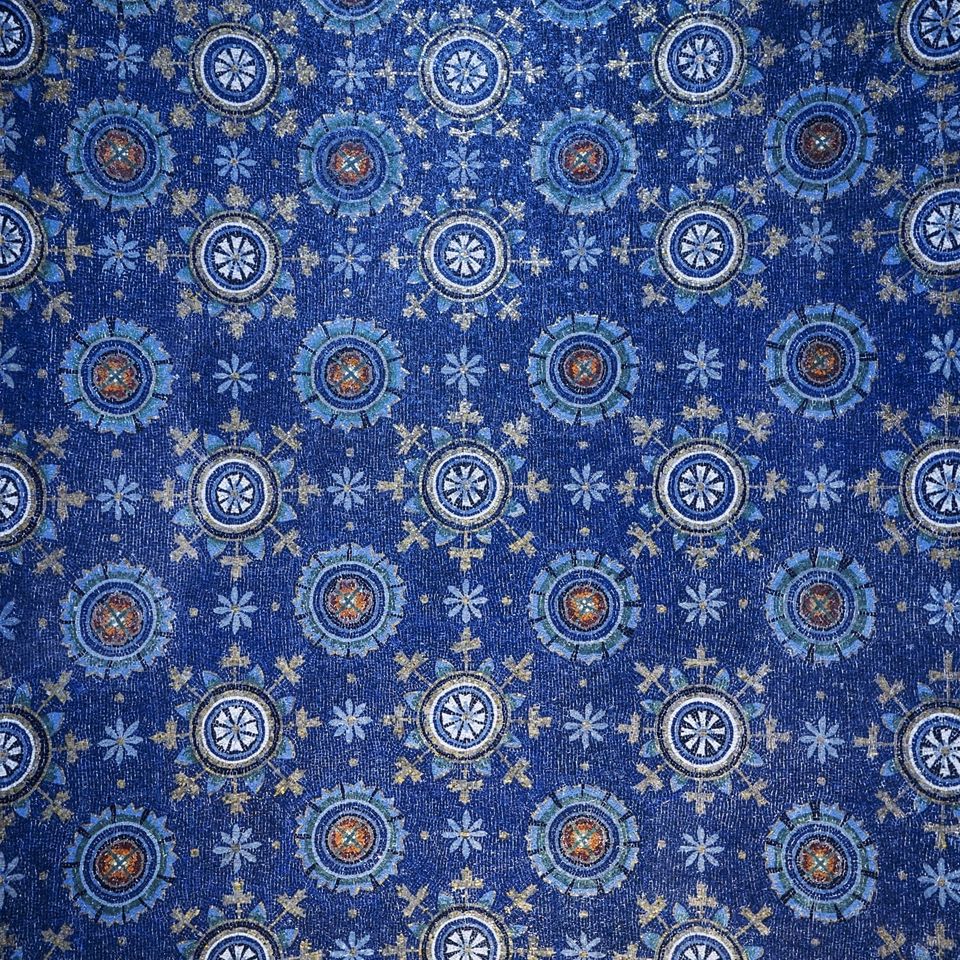
1600 years ago, one of the most powerful women in the world imagined resting for eternity under a blue-domed sky spangled with golden stars. And so she built it: a site of wonder for the ages. A mausoleum that would bear her name – though not, as it would turn out, her body – into the future. Today Galla Placidia’s chapel is a monument to the 5th century art of mosaic, a shimmering treasure house alive with the flickering light of millions of tiny shards of stone and colored glass: lapis lazuli and cobalt blue, crimson and copper, jade green, alabaster white. And in concentric circles overhead, hundreds and hundreds of gold stars. I’ve wanted to see this place for years, so you can imagine how excited I am to be heading there this week.
The woman who bequeathed this wonder to the world lived during a time every bit as complex and tumultuous as our own. Galla Placidia (392-450 AD) navigated power during the waning years of the Roman Empire. She was the daughter, sister, wife and mother of emperors. She survived the Visigoth’s sack of Rome, only to become (briefly) the Queen of the Visigoths. After her first husband was assassinated, she married Constantius III. Later, she ruled the Western Roman Empire as regent for her son Valentinius, and helped defend it against Attila. She survived sieges, storms at sea, murderous advisors, childbirth, and at age 58 she died and was buried, not in Ravenna as she’d planned, but in Rome. As a woman of faith, she had restored churches in Rome and Jerusalem, but the Mausoleum she built in Ravenna is the sacred space that endures as hers. That she herself is missing from it strikes me as a potent absence – like the echo of a question, hanging in the air. I wonder what she thought of its beauty, if she had any idea how long it would last or how many people it would inspire.
For centuries now, people have been making the pilgrimage to stand rapt under the starry sky in Galla Placidia’s Mausoleum, and the beauty has rippled outward into the world. Gustav Klimt visited twice and found the Byzantine gold mosaics so exciting, he began painting in gold himself, launching what would become his famous “golden decade.” The poets Ezra Pound and Lord Byron both wrote verses here. Cole Porter arrived on his honeymoon and is said to have fallen so in love with the starry blue dome that he wrote his jazz classic “Night and Day” after seeing it. For Carl Jung, the wonder was Galla Placidia herself. Writing years later in his autobiography, he describes a sense of personality so strong that “her fate and her whole being were vivid presences to me.”
But it’s another writer – another woman – who first made me want to visit these mosaics myself: Terry Tempest Williams. Her book “Finding Beauty in a Broken World” (2008) begins with a trip she took to Ravenna to study in a mosaic workshop. She describes learning to cut pieces of colored glass and stone with a hammer, meticulously placing each tiny cube in stucco, struggling to make a design emerge. It’s harder than it looks, which leads her to marvel at the skill of the anonymous ancient artisans who covered acres of church ceilings and walls with mosaics. But it’s the metaphor she’s after, the analogy to rebuilding a fractured, broken world, to finding new beauty even as things fall apart. 1600 years ago, as the empire she was born into crumbled, Galla Placidia commissioned a body of sacred mosaics that has endured and inspired wonder for centuries. There’s a lesson there for us.
After Ravenna, Steve and I will be in Siena for two weeks, doing interviews and recording sessions at another Island of Knowledge gathering. We’ll get a new Wonder Cabinet episode up as soon as we get back in late September. Stay tuned!
— Anne
Subscribe to make sure you never miss an episode.