


20 Aug 2026
Tree Time
Steve on the majesty of trees and their often gnarled history.
0:00 / 0:00
Episode Notes
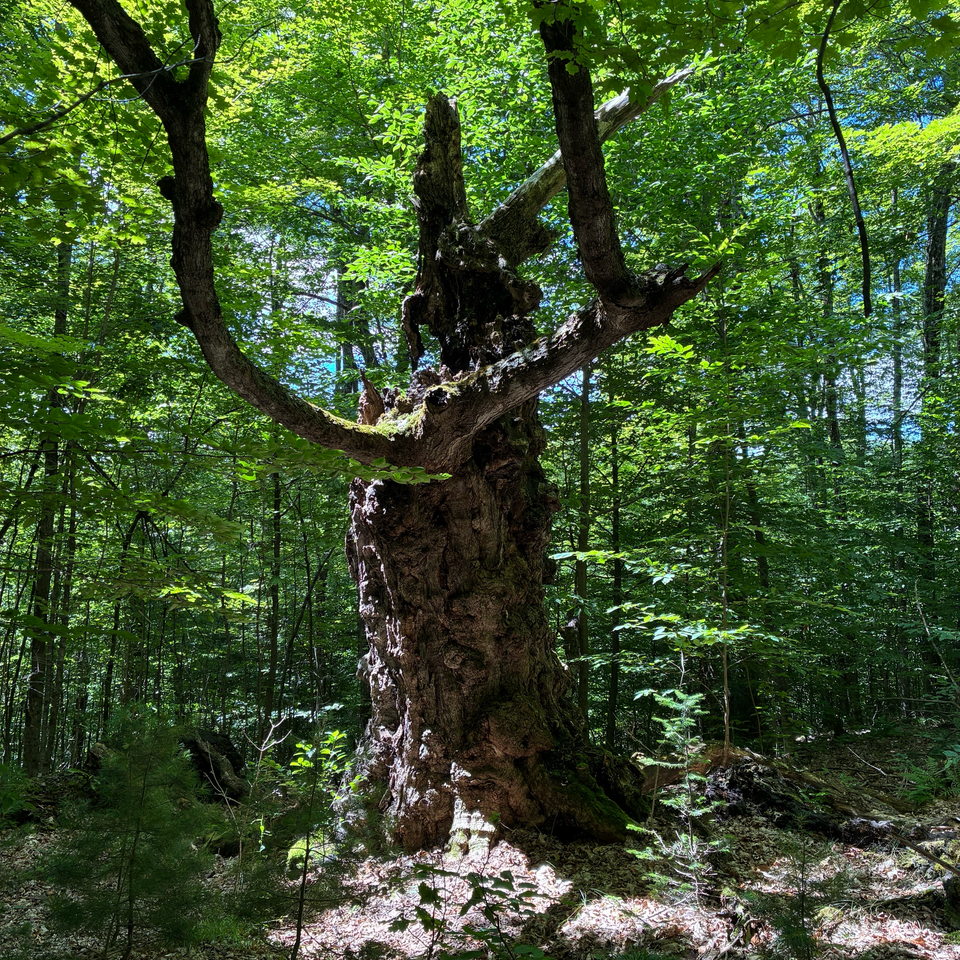
Trees have been on my mind lately. Anne and I are in rural Vermont for the summer, where we’re ringed by trees on the hills around us. Every few days, I walk our dog Alfie in the woods above our house and we stop to greet my favorite tree, an ancient maple that was split in half by lightning but still somehow survives. For years, one of our neighbors has sugared the maples in these woods, and we’re the beneficiaries of the best maple syrup I’ve ever tasted. Meanwhile, the emerald ash borer has crept into Vermont and will decimate a lot of the ashes I see on my walks. There’s one magnificent elder overlooking our tiny pond that we can’t bear to lose, so we just got it inoculated and hope it survives the scourge.
Trees power Vermont’s forest economy and are a surprisingly active presence in our daily life here. Two days ago, a falling tree branch snagged a nearby power line and snapped off our internet and phone service. Good luck getting a podcast episode up without a working internet! Luckily, friends and family members are still online and happy to have us sit in their kitchens chatting while uploading files to our audio engineer, Steve Gotcher.
I’ve also been editing next week’s episode with Robert Moor, author of the dazzling new book In Trees. It’s the story of his obsessive determination, in his thirties, to master professional-style tree climbing, hauling himself into giant sequoia canopies with ropes and harnesses. Moor is fascinated by Darwin's Tree of Life, so he investigated how humans evolved from an arboreal species to the ground-hugging primates we are today. He traveled to Papua to visit a treehouse-dwelling tribe of hunter-gatherers and to Tanzania to sleep in a chimpanzee nest. (A miserable experience.) He also joined a renegade band of climate activists for a tree-top sit in a desperate attempt to halt an oil pipeline in British Columbia.
But for all our love of trees, there’s also a shadow history, which Anne explores in this weekend’s conversation with eco-womanist scholar and ordained minister Melanie L. Harris. During the Jim Crow era, trees became vehicles of terror when white lynching mobs used them to murder African Americans. The trauma had a lasting impact on how many African Americans relate to the land, alienating generations who once had an intimate knowledge of the natural world. Moor also writes of this awful history: “Just as the practice of lynching stole physical land from Black families, it stole land, in the broader sense, from the Black imagination.”
So what to make of this complicated and often gnarled history? Trees are not just silent giants among us; they’re also potent symbols – simultaneous embodiments of wild nature and markers of a tragic history.
And for me on my hillside in Vermont? Every morning I take my coffee out to the Adirondack chair next to our house and look out at the many shades of green on the hills and mountains that stretch to the horizon. I watch hummingbirds flitting by, crickets climbing through the grass, clouds of every shape drifting across the sky - and miles and miles of trees.
—Steve
Subscribe to make sure you never miss an episode.