15 Aug 2026
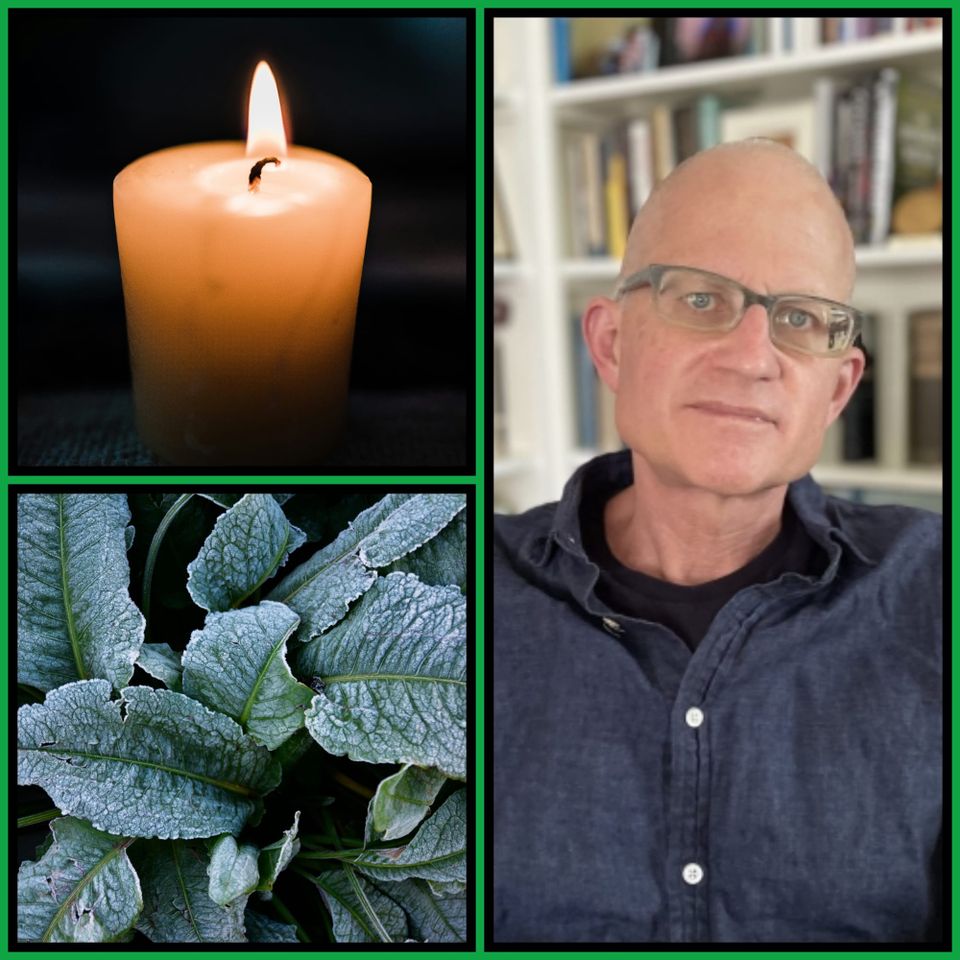
Poetry Against Despair with Christian Wiman
Poet Christian Wiman reflects on everyday wonders, his ambivalence about religion, a long struggle with cancer, and how he finds joy in suffering.
0:00 / 0:00
15 Aug 2026
Poetry Against Despair with Christian Wiman
Poet Christian Wiman reflects on everyday wonders, his ambivalence about religion, a long struggle with cancer, and how he finds joy in suffering.
ShareEpisode Notes
How do you find joy in suffering? That’s one of the questions Christian Wiman explores in his poetry and his life.
The former editor of Poetry magazine, Wiman is the author of seven books of poetry, including his latest, The Dance. He also teaches at Yale Divinity School. He’s been called “the most important Christian writer in America,” though his relationship with God is marked by uncertainty as much as faith. That tension runs through his poetry, where mystical experience, doubt, suffering, and joy continually collide.
His understanding of mortality is also shaped by a 20-year battle with cancer. Diagnosed with a rare form of lymphoma and initially given only a few years to live, Wiman has come close to death several times. Yet he speaks about suffering not simply as something to endure, but as a strange territory in which beauty and wonder can sometimes be found.
Wiman craves direct experiences of the world, but he finds that writing poetry helps him fully appreciate these fleeting moments of awe and wonder. A frosted hosta, an old candlestick, the trills of a red-winged blackbird—small encounters like these can open onto deeper questions about meaning, eternity, and what Wordsworth called “seeing into the life of things.”
Poems in this episode
“I Was Where the First Leaf Stirred”
China sky, November’s neural trees,
clear clairvoyant morning.
Alert, alive, in dawn’s indivisible realities.
A gift. A warning.
Frosted hosta, a black trunk burled
like a half-melted candle, leaf-fall
in a locked embodiment of swirl.
A cosmic stillness over all.
Evaporates at the thought of God.
Implicates in the vise of mind.
Leaf-stir, lone bird (was it there?) pecking the hard sod.
Alone, apart, on the other side of shine.
“Before the Bone Marrow Transplant”
It is Christmas 2023.
I am me, sitting in my studio looking over these notes.
An early snow (for atmosphere) floats
—clear, spare—through the bare limbs of the oak tree,
lightly and precisely redefining its guise.
The silence is such as makes one realize
silence never is, this hum the mystics call eternity.
Behind me a vast tranche of suffering lies,
in both senses: reality
I have endured and assimilated as I can,
extracting from pain a keener means to see; and,
strict formulation that says,
for all the beauty there is, for all this quick of limb and eyes
merged and made available to mind,
it is suffering that makes it shine.
Soon my wife will stir,
sunlight, because I see it, cherishing her
as she emerges from sheets and begins to dress.
My children will wake to what they think is godless joy
texting me to come down to Christmas
Now, Now
and I will think back to Christmas as a boy
and how, amid much suffering, for a time all was instant
and bright surprise. This will be done,
poem, prayer, piece of being, the tiny and entire story
of the passionate transitory in which our lives are hung.
I in my undominion rising to be among.
“Balm”
“The poems are a balm,” the poet said,
whose ear endured,
besides the natural atrophy of any unearned gift,
history, mastery, and all the mosquito demons
of email and oil changes, underlings and overlords,
afternoons of disappointment and self-taste
too heavy and humid to move. “Amid it all,”
the poet wrote, meaning loves, meaning
deaths, meaning the lack of meaning
infiltrating even heart and hoard, love and death,
“the poems are a balm”—meaning,
in ancient days, a substance fragrant, resinous,
effective, for a time, against decay.
- Book: The Dance
- Book: Glimmerings: Letters on Faith Between a Poet and a Theologian
- Book: Zero at the Bone: Fifty Entries Against Despair
- Yale Divinity School website
- Profile of sculptor Lee Bontecou
Transcript
Anne Strainchamps: Welcome to Wonder Cabinet. I'm Anne Strainchamps.
Steve Paulson: And I'm Steve Paulson. It can be hard to find moments of wonder when we're bombarded by the noise of everyday life.
Anne Strainchamps: News of war and political scandal, climate fears, AI anxieties.
Christian Wiman: We all walk around worrying about the world all the time and having it shoved in our face. But the only antidote to that is to preserve your own consciousness first. It was like on airplanes — when those things come down, you've got to put your own mask on first, or you're no good to anybody else.
Anne Strainchamps: This is the poet Christian Wiman.
Christian Wiman: So I think being attentive to those moments of wonder and awe, when the world is annihilated and yourself is annihilated — those are the first steps toward changing the world, actually.
Anne Strainchamps: Christian Wiman believes in the transformative power of everyday experiences of wonder. Small observations, like a particular slant of light, a bird feather at your feet, a bit of tree bark.
Steve Paulson: He's the former editor of Poetry Magazine, an acclaimed poet, the author of seven poetry books, and several essay collections, including Zero at the Bone: Fifty Entries Against Despair.
Anne Strainchamps: And part of what makes his practice of wonder so remarkable is that he's had a lot of experience resisting despair.
Steve Paulson: Twenty years ago, Christian Wiman was diagnosed with a rare form of lymphoma, and he was given just a few years to live. He's come close to dying several times, but he's still here and more productive than ever. He also has a new poetry collection titled The Dance.
Anne Strainchamps: I know you admire him a lot as a writer, but also as a thinker.
Steve Paulson: Yeah, he has a really nuanced way of thinking about all kinds of things, especially when it comes to questions of religious faith. He actually teaches at the Yale Divinity School, although he has a pretty complicated take on God, and all of this makes its way into his poems. He has this heady mix of mystical reverie and spiritual uncertainty, so he's always probing and asking these deep questions about how we find meaning in our lives.
Anne Strainchamps: That's part of what draws you, right? The way he grapples with despair?
Steve Paulson: I think a bit of existential angst goes a long way for me. Christian talks about finding joy in suffering, and given all his medical struggles, he knows this territory intimately.
There's also a paradox at the center of how he thinks about his poetry. He craves direct experience of the world, those moments of awe and wonder, but he sees language — including the poems he writes — as one step away from that experience. So he's constantly working through these contradictions, this push-pull within his life and his work.
Anne Strainchamps: Okay, let's listen.
Steve Paulson: Chris, I would love to have you start with a short poem from your new collection, The Dance. Could you read "I Was Where the First Leaf Stirred"?
Christian Wiman: Sure.
China sky, November’s neural trees,
clear clairvoyant morning.
Alert, alive, in dawn’s indivisible realities.
A gift. A warning.
Frosted hosta, a black trunk burled
like a half-melted candle, leaf-fall
in a locked embodiment of swirl.
A cosmic stillness over all.
Evaporates at the thought of God.
Implicates in the vise of mind.
Leaf-stir, lone bird (was it there?) pecking the hard sod.
Alone, apart, on the other side of shine.
Steve Paulson: Okay — so I wanted to start there with something short, because I'm so curious about your creative process. Here you are writing about trees in November, the leaves have fallen. I love that phrase, "neural trees." You refer to the frosted hosta, the bird pecking into the ground.
And then the poem opens up into a cosmic stillness overall — evaporates at the thought of God. So I have this picture: I'm picturing you out on a walk on a late November day, sort of looking intently at the trees and the plants around you. And then, boom — you have this existential rush, sensing the cosmos and where God fits, or does not fit, into this whole picture. Is that anything like what actually happens for you?
Christian Wiman: Well, it happens in recollection. I often don't know that I've had a moment until the moment occurs to me through language. It's not as if I have a moment and realize and think, "Oh, I've got to write about this." That's not what happens.
It's the language that unearths the moment and shows me what I wasn't able to feel — or I would put it a little differently, what I felt too deeply to need a meaning. And this poem is about one of those moments where the reality of the world is indivisible, dawn's indivisible realities. But then it evaporates as soon as you give the name "God" to it. And then you're on the other side of that shine.
You're back in consciousness. What we know of is consciousness. There are moments in our lives, I think, when we're freed from that. But mostly we live on the other side of shine. Yeah.
Steve Paulson: So it's those moments of shine that you are looking for?
Christian Wiman: Yeah, well, I think that is an earnest, or a pledge, or a testament of something of God. I think those moments are an experience of God. But as soon as we start naming God, God, we've taken a step away.
In those moments, you don't need the name. You don't need words like faith or anything like that. You just have it.
Steve Paulson: And yet the whole point of being a poet, putting this into words, into language, is you are naming things, right? But is that process then one step away from the direct experience?
Christian Wiman: It is. But the mystery of poetry is that somehow that direct experience you had is recoverable within the poem. Language is always a fallen thing — it's always a step away — but there is something in the music of the language that can, I believe, actually get to that essence of the experience. But it's more in the music. It's in things other than the denotative sense of the words.
Steve Paulson: In the music of the language — which I get, that's sort of what poetry is all about — but it's almost like you're saying, don't just read it for the meaning, read it for... I don't know, the way it sounds. Can you sort of explain the difference there?
Christian Wiman: Yeah, I would say read it first of all for the way it sounds, and then second of all for the meaning. I often don't know what a poem means when I first read it — I'm just hearing the sounds, hearing how it works and fits together, and then afterwards I go deeper in and begin to figure it out.
But there remains an essence of meaning, something you can't be critical about. You can't explicate it. You can't say something outside of the poem that exhausts the poem. I think that's the music of the poem, the formal energy of the poem. And you don't need to be an expert in this at all — it's just like listening to music, it goes straight into your bloodstream.
And I think poetry's nearest kin is music. It's much further away from the novel — poetry and the novel seem to me to have very little to do with each other. But poetry and music seem to have a lot to do with each other.
Steve Paulson: So clearly, experiences of awe and wonder are very important to you — they're all through your poems. And this is actually one of the reasons I wanted to talk to you, because this podcast that we do is called Wonder Cabinet. And what I have discovered is that experiences of awe and wonder are quite complex, and they vary from one person to the next. So how do you think about these two experiences, these two words — awe and wonder?
Christian Wiman: Well, I've given a lot of thought to them. Somebody wrote me the other day and praised me for my skeptical stance toward faith, and I did not take that as a compliment, because I think skepticism comes so readily to people like me, and to the whole intellectual culture of our time. It's faith that comes with great difficulty.
And I take those moments of wonder and awe to be moments of faith, even if you don't have to use that word — I don't care if you use that word. But they're complex, because C.S. Lewis said that a moment of joy makes us homesick for a home we didn't realize we had.
Richard Wilbur has this beautiful poem called "Hamlen Brook," where he describes the brook all the way down. It's this meticulous bit of description where he's just seeing everything so clearly, making music out of it. And then at the end he says, "Joy's trick is to supply dry lips with what can cool and slake, leaving them dumbstruck also with an ache nothing can satisfy."
So joy is in some way completely fulfilling, and yet there's a shadow of absence in it. It asks something of us afterward — it asks, what are you going to do with this moment of joy? And it can call you to the world. Jürgen Moltmann said that compassion is the other side of a living joy. It can call you to change your own life, or it can call you to simply integrate those moments into your own life.
That's what happened to me. That's why I consider myself a person of faith — because I had moments in my life that were asking something of me.
Steve Paulson: You have this wonderful passage in your earlier book, Zero at the Bone, where you say the only true antidote to the plague of modern despair is an absolute and perhaps even annihilating awe. And then you go on to quote the Jewish theologian Abraham Joshua Heschel, who said, "I pray for wonders instead of happiness." And I'm assuming you're in his camp too, that you would choose wonders over happiness.
Christian Wiman: Yeah, yeah, I would. I think of happiness as being a temporal phenomenon — something you experience in a linear way. Certain things can make you happy, whereas joy cuts in vertically and comes from somewhere else. It can illuminate a life of happiness. It can make you realize that you're happy. But it can also make you realize that you're unhappy.
Steve Paulson: Wait — joy can make you realize you're unhappy?
Christian Wiman: Yeah, if you have a moment of joy, and then you're on the other side of it, you think, well, it should cast a light on the rest of your life. And suddenly you look and think, oh, what's going on here? At the end of Rilke's great poem, "Archaic Torso of Apollo," he describes that statue, and then the last line is, "You must change your life." That's what the statue is telling him. That's what his experience is telling him.
And so you can have a moment of absolute rapture that leaves you bereft.
Steve Paulson: Because then you realize, oh, the rest of your life has no joy, is lacking joy. It's the discrepancy between the experiences.
Christian Wiman: Or you just don't know what to do with it. It can be some great fire that shows the firelessness of the rest of your life. But there's great hope in that, because you've had this moment where you see life can be different — I can be different.
Heschel — the theologian you were talking about — said that those moments of wonder are the criterion for every religion, for every faith. They are made of those moments. And if they're not made of those moments, then they're not real. He also said that faith is mostly being faithful to the times when you had faith, so that in that moment you're aware of this unity, dawn's indivisible realities, like that poem says. And on the other side of it, you have to ask yourself, well, how do I remain faithful to that?
Steve Paulson: So in that quote I just read, there's that phrase, "annihilating awe." What does that mean to you?
Christian Wiman: Well, I think it annihilates yourself. All that you think of is yourself, your ambitions and your worries and all of that. A moment of awe frees you from all of that. And it annihilates your social concerns for a minute — all of the worries you have about the way you fit into society, that the world is going to hell, all that, that too gets eased. That's what Moltmann meant — that compassion is the other side of living joy. Then on the other side, you ought to ask yourself, well, okay, now what? What do I do?
Steve Paulson: Well, "annihilating" — I don't know if negative is the right connotation, but it has a destructive connotation. Annihilating awe — annihilating yourself? Is that kind of what you're talking about?
Christian Wiman: Well, I think it annihilates the self for an instant, yes, and reveals the soul. I think it annihilates concerns that are not the soul's, for an instant. You have to have a self — you come back to yourself, and then you've got to deal with them. But for a minute, yes, I think those are annihilated.
Steve Paulson: What do you see as the connection between awe and poetry?
Christian Wiman: Well, poetry, for me, is made up of those moments. I wouldn't be a religious person if I hadn't — I wasn't a religious person for 20 years. But if I hadn't had poems that kept showing me these things in my life that I hadn't realized, and also just giving me the sensation of them happening again in the poems, and not knowing what to do with that...
Writing the poem was joyful, but after the poem, I always felt completely deflated, and my poems were often dark. So for a long time, I think I was living in a state of not being able to admit joy, not being able to let yourself feel it.
Steve Paulson: This is before you became a religious person? I know you grew up in an evangelical family in West Texas, but then you've written about how you became what you've described as an ambivalent atheist, contemptuous of Christianity, and then you came back. Are you describing that period when you were writing poetry, but there wasn't joy in the poetry you were writing?
Christian Wiman: There was joy, but the joy was simply in the joy of making. There's always joy in making something, even when it's a work of art that's expressing torment. Simply putting the pen to the paper is to rouse yourself from despair, even if you're going to express despair.
But for too long, I had a vision of the world that was dark, and the poems I wrote came out of that. And so the joy I had was completely self-contained in a way, because it was just the joy of creation — my own creation, and not capital-C Creation.
That began to shift as things in my life shifted. And I didn't become religious until I was thinking, what am I supposed to do? What am I supposed to be seeing?
Steve Paulson: So I want to ask a bit about your personal history, because I'm guessing that anyone with a passing familiarity with you knows two things about you: you nearly died of cancer, and this threat of dying continues to hover over you. And you are a devotional poet — you've been described as the most important Christian writer in America now. I'm wondering how closely those two parts of your life are linked.
Christian Wiman: Not so closely. I've had cancer for 20 years, and I've had 13 last-ditch treatments. So you get a little used to it.
Steve Paulson: Thirteen times when you nearly died?
Christian Wiman: No, only three times that I nearly died. But I've had 13 times that the cancer was out of control and they were treating it. Only three times did it look like I was done.
Steve Paulson: Wow. Can you give a brief summary of your medical history? I think that will take us to where we are today. So — 20 years ago, you got this terrible diagnosis, and then what happened after that?
Christian Wiman: Yeah, I got it on my birthday, actually — the morning of my 39th birthday.
Steve Paulson: Wow, what a birthday present.
Christian Wiman: Yeah, and I had only been married for seven months with the love of my life. It was quite bad, and the prognosis was not good at the time — they gave me five years at most.
But you're lucky, if you're going to get cancer, you want a blood cancer. Not always — I've known so many people who've died. But there's a lot of research in blood cancers, and I've benefited from the last 20 years of that research, which is getting shut off now. One thing after another came up that was brand new when I needed it — experimental therapies.
Steve Paulson: Experimental therapies, yeah.
Christian Wiman: And I responded to all of them, and sometimes not for very long — I would only get like six months or something. But I responded to every single treatment I was given, which is very rare. That's 20 years of living with that.
Steve Paulson: And I'm assuming during this process, lots of rounds of chemotherapy, and you had a bone marrow transplant.
Christian Wiman: Yeah, two, if you count the clinical trial I had recently — CAR T-cell therapy, where they take your T-cells out, re-engineer the DNA, and put them back in. So yeah, I've had a couple of those.
Steve Paulson: That's rough business. Are you in remission now?
Christian Wiman: Yeah, I'm very healthy at the moment. This therapy has been around so few years that no one knows what's going to happen — in fact, I was the first person with my disease in this country to get it, I was told. So no one knows what's coming, but it's worked better than anything I've had. I haven't had this level of remission in 20 years.
Steve Paulson: So given this history, given how close you've come to dying, how do you think about dying? Does it scare you?
Christian Wiman: Not much. I mean, it terrifies me for my family — there's a lot of grief involved, but that's where it's directed. When I first got diagnosed, I felt an animal fear. It's like you can hardly move, you just want to run, but there's nowhere to run. It's really a horrible feeling, and it lasts a long time.
But when you live with something that long, go through that much, it goes away. This last time, I'd had no fear.
Steve Paulson: Really? Wow.
Christian Wiman: Of my own death, yeah.
Steve Paulson: You have a poem where you reflect on some of this, called "Before the Bone Marrow Transplant." Can you read that?
Christian Wiman: Sure.
So this poem was written at Christmas in 2022, but I begin the poem by saying it is Christmas 2023 — so what I'm doing is imagining the next year. I'm about to have this bone marrow transplant, and it seemed like I'd probably die this time — everybody thought so, I thought so. Except for maybe my doctors — they seem to always...
Steve Paulson: I'm glad you have those kinds of doctors. You want some hope there.
Christian Wiman: This is "Before the Bone Marrow Transplant," and it has the epigraph "Christmas 2022."
It is Christmas 2023.
I am me, sitting in my studio looking over these notes.
An early snow (for atmosphere) floats
—clear, spare—through the bare limbs of the oak tree,
lightly and precisely redefining its guise.
The silence is such as makes one realize
silence never is, this hum the mystics call eternity.
Behind me a vast tranche of suffering lies,
in both senses: reality
I have endured and assimilated as I can,
extracting from pain a keener means to see; and,
strict formulation that says,
for all the beauty there is, for all this quick of limb and eyes
merged and made available to mind,
it is suffering that makes it shine.
Soon my wife will stir,
sunlight, because I see it, cherishing her
as she emerges from sheets and begins to dress.
My children will wake to what they think is godless joy
texting me to come down to Christmas
Now, Now
and I will think back to Christmas as a boy
and how, amid much suffering, for a time all was instant
and bright surprise. This will be done,
poem, prayer, piece of being, the tiny and entire story
of the passionate transitory in which our lives are hung.
I in my undominion rising to be among.
Steve Paulson: Wow. So you really thought you weren't going to make it through this bone marrow transplant?
Christian Wiman: It seemed unlikely. I was the first person with my disease to have it — I barely got into the trial, got kicked out of it twice. I was really on my last legs. I'd lost 30 pounds, and I don't really have 30 pounds to lose. I couldn't really walk. So I was in bad shape.
Steve Paulson: You have that line, "It is suffering that makes it shine." What do you mean by that?
Christian Wiman: Well, before that it says, "Behind me a vast tranche of suffering lies." So it lies there, but it also lies — tells a lie. The first reading is that it's enabled me to extract from pain a keener means to see. This is what I'm imagining a year later — I've gone through all this pain, and okay, now I have different eyes to see the world with.
But then the other lie — the thing that's lying there — is that it's only suffering that makes it possible, only suffering that brings forth the beauty of the world. The poem splits the difference — it makes both readings possible. You can read that it is in fact the case, that it is suffering that makes the world shine. Or you can read that it's a lie — that in fact there are other things that make the world shine. You don't need suffering for that.
Steve Paulson: Why would you need suffering to make it shine in the first place? Take that one reading of it.
Christian Wiman: Suffering does make the world shine, or it can. In my experience, and in the experience of a lot of writers I love, there is some great truth in suffering if you can remain awake enough to perceive it — both in the moment of suffering, and in the way it scours your life clear of lesser things.
Steve Paulson: So it's stripping you down to the essentials.
Christian Wiman: Yeah. You don't want to say that you need suffering in order to perceive the depth of existence, but there is something in suffering that can enable you to perceive the depth of existence, if you're lucky enough to survive.
Steve Paulson: Is there joy in the suffering?
Christian Wiman: There can be great joy in suffering, not happiness — happiness gets obliterated. But there can be great joy.
When my kids were young — they were little, I first got diagnosed when they were like four, five, six, seven — sometimes they'd come into my hospital room and be just so fascinated. They thought it was a hotel room, and they'd be so fascinated by the equipment. They'd draw on the nurse's chalkboard. They were experiencing joy — they didn't understand what was going on. And it was joyful for my wife and me, too. Joy fraught with darkness, of course, but it was still incredibly joyful.
Steve Paulson: Because it brought you all together? Do you think that was where the joy came from?
Christian Wiman: There was just so much love. Of course it was painful — joy can be painful. But it can certainly come in the midst of suffering.
Steve Paulson: So thinking about that poem you just read — and this is true, I think, with so many of your poems — there are these fleeting moments, like watching your kids on a Christmas morning, and then you are contemplating eternity. It seems like you're always bringing those two things together, the ephemeral of daily life with your philosophical reflections about God and meaning. Do you see that as sort of your project — bringing together, I guess what I'd call, the prosaic and the sacred?
Christian Wiman: I wouldn't have — I've never had a project writing poems, although I think you can. William Wordsworth, probably my favorite poet, said of his Lyrical Ballads, which really changed English poetry, that every single poem in that book had a purpose. And that's inimical to modern writers — they think you shouldn't have a purpose when you set out to make art, or it becomes didactic.
Steve Paulson: You don't agree with that, I take it.
Christian Wiman: Well, I did agree with it for years, and I'm so trained by the modernists that it's still embedded in my consciousness. I love Wordsworth, and I love him most of all for what he's able to say about experience — he renders experience beautifully. But what you really remember in Wordsworth are these moments when he steps back and tells you what it means. He gives you these beautiful formulations that locate it in a context of philosophy or theology or whatever he's talking about, and those are just so beautiful.
I think a lot of poetry has given up on trying to speak in those general terms. And part of what I wanted to do in this book — although again, it's kind of retroactive, I realized I wanted to do it in this book — is to be able to make those general statements.
Steve Paulson: Do you think a lot of modern poets have given up on that because it seems too pretentious to be talking about meaning?
Christian Wiman: Yeah, too pretentious, and you can't speak in general terms — you can only speak about your own experience, or the experience of your identity group. So these kinds of statements are suspect, and they are suspect — they should be suspect. But still, I think you have to risk them.
Steve Paulson: So you obviously write a lot about God, you write about your faith. It's worth mentioning that you teach in the Yale Divinity School, so obviously these ideas hit close to home for you. And one of your other poems — the poem is "The Eye," which looks like it's set in a monastery — there's a monk who describes the narrator's faith as mostly his faith in art. Is that you? Do you experience your spiritual faith mostly through art?
Christian Wiman: Not anymore, but for an awfully long time, that's all it was. I do still find art probably the most powerful way I have a sense of the divine — not just my own, either, other people's art.
Steve Paulson: So more than, say, prayer — it would be through art that you really have those experiences of the divine?
Christian Wiman: Yeah, I used to really resist the notion that poetry was prayer, that there was a very separate line between them, but I've become less suspicious of it now. It's a cliché in contemporary poetry that everybody says poetry is prayer, but they don't really believe in prayer, and that's why they say that.
Steve Paulson: It's sort of like a substitution for religion — these are sort of the secular poets, but they want to say that what they're doing is sacred in its own way, without actually using religious language.
Christian Wiman: Right. But I think God probably gives people different ways to pray, and poetry seems to be mine, or writing seems to be mine. I was very surprised — Marilynne Robinson told me that she didn't pray, that she thought of all of her writing as her prayer. If she can think that way...
Steve Paulson: You have said that you are ambivalent about religion, and you've also said you consider faith more a provocation than a comfort. Can you talk about that?
Christian Wiman: Yeah, I have a hard time at churches. I've tried so many churches — I go for a while, and then I just get frustrated. I told my wife the other day, "I'm a Christian as long as I don't go to church."
Steve Paulson: Does it complicate things for you to be teaching in the Yale Divinity School?
Christian Wiman: Yeah, somewhat, sometimes. Although Yale Divinity School is a pretty liberal place. But I'm pretty quick to say I don't consider myself a good model — I don't think you could build a church around me. I feel like the failure's mine. I do have my complaints about institutional Christianity, but there are enough churches out there where I should be able to find one. It's something about me — I can only see myself at the edges looking in.
Steve Paulson: Okay, hold that thought for a moment. After the break, we'll be back to talk about the connection between poetry and science, and why Christian is fascinated by recent discoveries in neuroscience and physics.
Anne Strainchamps: Hi, it's Anne. I am so glad you're joining us. We have some amazing guests lined up for the weeks ahead — I'm really excited about them.
And here's a tip, maybe you know this already: if you follow Wonder Cabinet on Apple Podcasts, new episodes will show up automatically, like a little weekly gift in your podcast feed.
I hope you like it.
Steve Paulson: This is Wonder Cabinet. I'm Steve Paulson, talking with Christian Wiman, whose new poetry collection is called The Dance.
So I want to ask you about something else you wrote recently — you had this great essay in Harper's Magazine, with the subtitle "Is Consciousness God?" I don't know if you came up with that or your editor did, but it touched on a number of things we've already been talking about.
You also tell a story about your daughter, Eliza, when she was quite little, who you said had this uncanny ability to see things in the natural world — little details that passed the rest of you by. And you quote Wordsworth about "seeing into the life of things." Can you describe what she would do?
Christian Wiman: Yeah, we called her our little mystic. It was a little freakish, because she just had this eye that was uncanny — she would see things nobody else would see. A bird way up in the tree, completely obscured, not making a sound, and she would stop and be riveted by it. All kinds of things — it happened all the time, it wasn't something rare.
One of us would try to get her to go on a walk with us in the early morning, if she woke up, because she would see all these things. It was like having this little machine that suddenly turned the world up.
Steve Paulson: It's like Dorothy Wordsworth going out with William and Coleridge — she would see stuff that they didn't see, but then they would write about it.
Christian Wiman: Yeah, exactly. We have an old house in Tennessee, and recently we found these pictures Eliza had made when she was seven or so. One is just a tree that any kid would draw, and the next one is a tree that has leaves and stuff, but the branches and the trunk are filled with these runic symbols — they look like they're almost letters, but they're not, just symbols.
And then in the final one, the tree is filled with language, and the language spills down to the trunk, and in the trunk it becomes legible words, and it says, "Standing in the stream, I've never felt so loved." There's a river or stream that runs right by the house, and that's just extraordinary — to see that kind of consciousness working out in a seven-year-old.
Steve Paulson: I assume you've talked about this with her. Did it go away? How does she think about all of this?
Christian Wiman: She still has an amazing eye, and she's an artist — she has a great talent and a vision as an artist, but she's pretty secretive about it. She still sees things we don't see, but it's gone, that kind of merging that used to happen. She's too well defended for that now — it doesn't happen at all. She does remember things, though — lots of those moments, and what it felt like. She's reluctant to say it has anything to do with God. But gosh, it just seemed so obvious to my wife and me.
What do you think it takes to see into the life of things? It takes a kind of attentiveness that's very readily available in childhood. I think we're probably all able to see into the life of things early on, and then it gets — I think Wordsworth is right about this — blunted by everything we've learned, turning the world into symbols, into language and numbers and categories.
Steve Paulson: Into abstractions.
Christian Wiman: Yeah. What it takes is somehow learning to recover that part of yourself that is part of the world. It's different for everybody — for me, it's been through poetry, but for another person it could be through birdwatching. It could be basically anything you brought full attention to. Simone Weil has that idea that any absolutely unmixed attention is prayer.
You could argue with that — you can have attention that's pretty malign, like a torturer, probably pretty focused. But still, it's useful, if you think of most everything we do as mixed attention. And how do you get to unmixed attention? It takes discipline, especially now.
Steve Paulson: Yeah. So I want to go back to that essay you wrote in Harper's, because there's a lot in there about the nature of consciousness — a very thriving field, there's a whole industry about it, and it's totally mysterious. No one has an explanation for where consciousness comes from. There are philosophers and scientists who say consciousness is a fundamental force of nature, universal everywhere, which is totally different from the standard neuroscience model — that it's generated by the brain.
You seem to be very interested in these scientific theories about consciousness, and I'm wondering where that comes from for you, as a poet and also as someone interested in mystical experience.
Christian Wiman: Well, poetry is where it came from — that's what led me to begin thinking about consciousness. I thought I had the idea — this is like a lot of my life — I thought I had this idea that's at the center of that essay, and then I began reading more deeply and, like everything else, realized there aren't really that many new ideas.
But it would be Wordsworth again who I think I probably first got it from, because he talks about something you "half create and half perceive." So it's this fusion of perception and reception that defines consciousness.
Steve Paulson: And some of the modern theories about quantum physics seem to bear that out — this idea that observing a particle actually changes the way it behaves. It's sort of like observation creates reality.
Christian Wiman: Yeah. Even the very existence of the particle is in question. Marcelo Gleiser, the physicist, says it may be that the word "exists" is too strong to use for an electron — no one's ever seen one, and it doesn't exist in the way the world around us exists. It seems to be in a state of probability, as far as we can tell.
I always think, well, if the word "exists" can be too strong for a particle, it might be too weak a word for something else. Maybe the idea of God we have — the whole question of "does God exist" — makes no sense, because we don't know what "exist" means. We don't know what it would mean to be more than existence. We don't know what it means to be less than existence, like a particle. So we're stuck with our human framing, which more and more we're learning doesn't match reality — it only matches the part of reality susceptible to our measurements.
I'm very sympathetic to the idea that consciousness is not an emergent property of the brain, but something we share with the rest of reality. And the mind acts more as a filter than it does as a projector.
Steve Paulson: The Aldous Huxley theory of consciousness.
Christian Wiman: Yeah.
Steve Paulson: So that question, "Does God exist?" — it sounds like maybe that's not a central question for you.
Christian Wiman: It's really not. Most of these theological questions I find a little tedious, because I often feel the language is exactly like science: the language we're using doesn't show us anything about the true reality of what it purports to describe, any more than science does. So we're sort of playing in a sandbox when we're in this huge desert. The question of the existence of God is not one I spend a lot of time on.
Steve Paulson: Do you spend much time thinking about AI, and whether it might be conscious or become conscious at some point?
Christian Wiman: I spend a lot of time thinking about AI. I think it will look conscious, but I do not believe it can become conscious — I think there's something distinctly organic in consciousness.
Steve Paulson: It's just striking that AI — the large language models we know of — it is language, it's about words. That's your medium, words. But I guess the question is, is there any reference to reality, or is it just self-referential — going down the rabbit hole of what's been fed into the computer program?
Christian Wiman: There's definitely a reference to reality as we perceive it day by day. But the problem is that all the major jumps in any field are made by people who leap beyond that — I forget who it was, I think it was Niels Bohr, who said that any great leap of science begins as a leap of faith. You're not simply following the rules of what's there — somehow somebody has to make a huge leap. That's the way a poem gets written, or a painting gets made. Einstein, as I say in that essay, credited all of his great discoveries to music.
So that's the part I just don't believe AI will be able to do. But the people working on AI know a lot more about it than I do. Just from what I believe about consciousness, though, it doesn't seem possible to me.
Steve Paulson: Yeah. There's one last poem I'd love to have you read — it's actually the last one in your new collection. It's called "Balm." Could you read that?
Christian Wiman: This was written — I hadn't been able to write anything for a while, and I had an exchange with an old friend, Kevin Young. He's a wonderful poet — he and I have known each other for 35 years, I guess. He was talking about writing, and he had this one throwaway sentence, "the poems are a balm," because at the time he was head of the Smithsonian's African American Museum. He had this big job, but he was still writing, and he said, "The poems are a balm."
I went to bed that night and woke up in the morning with that line in my head, and I wrote this poem. It's called "Balm," and it has an epigraph from one of Kevin's poems, "The Heart It Hoards."
“The poems are a balm,” the poet said,
whose ear endured,
besides the natural atrophy of any unearned gift,
history, mastery, and all the mosquito demons
of email and oil changes, underlings and overlords,
afternoons of disappointment and self-taste
too heavy and humid to move. “Amid it all,”
the poet wrote, meaning loves, meaning
deaths, meaning the lack of meaning
infiltrating even heart and hoard, love and death,
“the poems are a balm”—meaning,
in ancient days, a substance fragrant, resinous,
effective, for a time, against decay.
Steve Paulson: That is wonderful. And what a great closing poem for your collection.
So I have one final question, and I'm hoping you were game for this. We were talking about wonder earlier, and mentioned that we have this podcast called Wonder Cabinet. One idea we're playing with is what an imaginary cabinet of wonders would look like today, in the 21st century. So if you could put anything in this imaginary wonder cabinet — an object, a concept, an experience, a thought experiment — what would you put in your wonder cabinet?
Christian Wiman: Oh, gosh. What's just leaping into my mind — I don't know how this is going to fit in your wonder cabinet — is the sculptor Lee Bontecou, who's dead now. She started out making these huge works made out of military materials, back in the '60s and '70s — terrifying-looking things, they all have a hole in them, they often have teeth, they're scary. Then she goes through all kinds of other stages in her development, and near the end of her life she made these mobiles that hang from the ceiling, and they're like little wonder cabinets, because they're made of feathers and wires and all kinds of things she's just collected.
They're big, and they hang down from the ceiling, and they have a hole in them — everyone has the hole. And it's as if that earlier hole of suffering has been lifted into a hole of joy. It's become a space of singing rather than mourning, unlike that early work.
I remember, gosh, it stayed with me so ineluctably — it's when my wife and I had first met, and we went into that exhibit, and both of us cried seeing them, because it was just so stunning. So if I could have something in the Wonder Cabinet, it would be one of those mobiles. They just seem to be so beautiful.
Steve Paulson: Okay.
Christian Wiman: I might have to go see one of these.
Steve Paulson: Where does one see this?
Christian Wiman: She has something in the Museum of Modern Art, although I think they only have the early work. I saw it in Chicago, but it was a traveling exhibition — you can't see it online, you can't get a sense of it at all.
She had an interesting career — she was very much a part of those expressionist artists in New York, but left. She didn't like the scene, and moved to Pennsylvania and spent the rest of her life there — she just left the art scene, found a big barn to do her work in, and vanished for a number of years. But then late in her life, she had these huge retrospectives at the Museum of Modern Art and in Chicago. So I don't know where they hang now, but it's worth a trip.
Steve Paulson: This has been such a pleasure talking with you. Thank you.
Christian Wiman: Great to be here. Thanks so much for having me.
Steve Paulson: That's Christian Wiman. His latest poetry collection is called The Dance. He's also the co-author, with Miroslav Volf, of the new book Glimmerings: Letters on Faith Between a Poet and a Theologian. And there's another book I'd highly recommend, his essay collection Zero at the Bone: Fifty Entries Against Despair.
Anne Strainchamps: Wonder Cabinet comes to you from Madison, Wisconsin, and Vershire, Vermont. Thanks, as always, to our audio engineer, Steve Gotcher, and our digital producer, Mark Riechers. I'm Anne Strainchamps.
Steve Paulson: And I'm Steve Paulson. We'd love to hear from you — send questions or comments to us at wondercabinetproductions.com, and sign up for the newsletter while you're there.
Anne Strainchamps: Be well. See you next time.
Subscribe to make sure you never miss an episode.