
28 Feb 2026
Renee Bergland: The Enchanted Science of Emily Dickinson and Charles Darwin
Emily Dickinson and Charles Darwin shared an enchanted view of nature. Could “natural magic” restore wonder to science?
0:00 / 0:00
28 Feb 2026
Renee Bergland: The Enchanted Science of Emily Dickinson and Charles Darwin
Emily Dickinson and Charles Darwin shared an enchanted view of nature. Could “natural magic” restore wonder to science?
Episode Notes
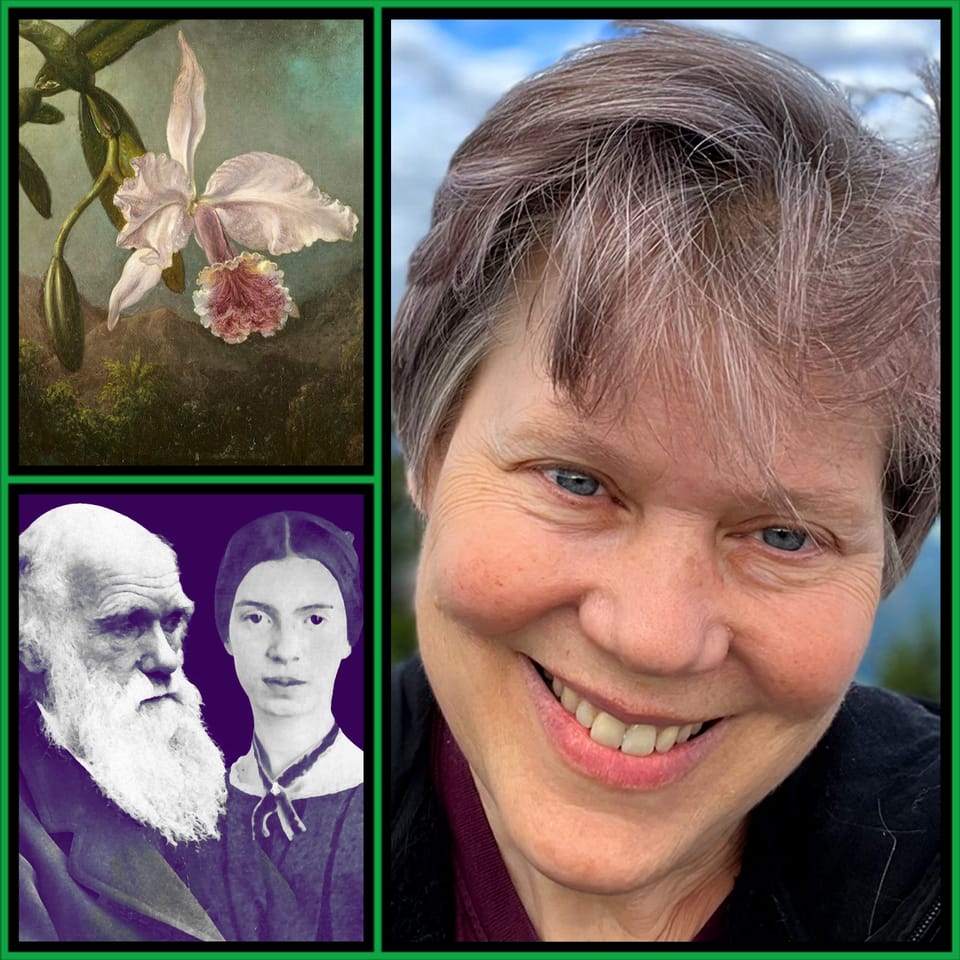
Emily Dickinson and Charles Darwin both saw nature as alive with mystery – and treated wonder as a way of knowing. Literary scholar and science historian Renee Bergland, author of "Natural Magic," is our guide to the forgotten kinship between the reclusive poet and the celebrated naturalist.
Dickinson and Darwin never met, but they had at least one close friend in common. Both were both fascinated by fossils. Both wandered the woods and swamps near their homes, studying insects and documenting rare plants. They shared a vision of the interconnectedness of all life. We know that Dickinson, with her background in botany, geology, astronomy and chemistry, was enthralled by Darwin’s evolutionary theory. And it certainly seems possible that Darwin, with his degree in theology and his lifelong love of poetry and literature, might have admired the American poet whose close observations and delicate perceptions echoed his own.
Bergland’s dual biography, just out in paper, is vivid, sparkling intellectual history – a window onto a time when scientific thinking still embraced emotion and wonder as modes of perception. Could the belief in “natural magic” that infused Dickinson’s and Darwin’s ideas restore our own faith in a universe alive with meaning? Our conversation about the poet who studied natural history and the naturalist who loved poetry suggests a way forward – by reclaiming their shared ecological wonder.
Subscribe to make sure you never miss an episode.