
28 Feb 2026
Renee Bergland: The Enchanted Science of Emily Dickinson and Charles Darwin
Emily Dickinson and Charles Darwin shared an enchanted view of nature. Could “natural magic” restore wonder to science?
0:00 / 0:00
28 Feb 2026
Renee Bergland: The Enchanted Science of Emily Dickinson and Charles Darwin
Emily Dickinson and Charles Darwin shared an enchanted view of nature. Could “natural magic” restore wonder to science?
ShareEpisode Notes
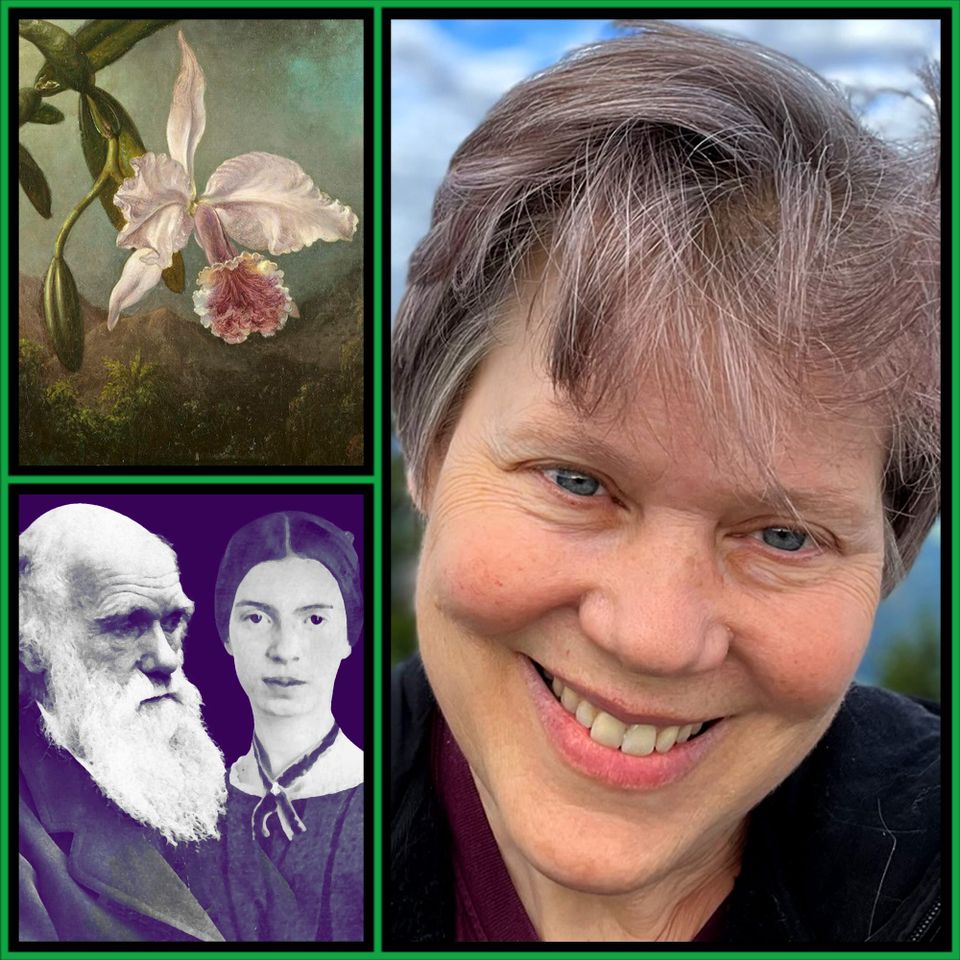
Emily Dickinson and Charles Darwin both saw nature as alive with mystery – and treated wonder as a way of knowing. Literary scholar and science historian Renee Bergland, author of "Natural Magic," is our guide to the forgotten kinship between the reclusive poet and the celebrated naturalist.
Dickinson and Darwin never met, but they had at least one close friend in common. Both were both fascinated by fossils. Both wandered the woods and swamps near their homes, studying insects and documenting rare plants. They shared a vision of the interconnectedness of all life. We know that Dickinson, with her background in botany, geology, astronomy and chemistry, was enthralled by Darwin’s evolutionary theory. And it certainly seems possible that Darwin, with his degree in theology and his lifelong love of poetry and literature, might have admired the American poet whose close observations and delicate perceptions echoed his own.
Bergland’s dual biography, just out in paper, is vivid, sparkling intellectual history – a window onto a time when scientific thinking still embraced emotion and wonder as modes of perception. Could the belief in “natural magic” that infused Dickinson’s and Darwin’s ideas restore our own faith in a universe alive with meaning? Our conversation about the poet who studied natural history and the naturalist who loved poetry suggests a way forward – by reclaiming their shared ecological wonder.
- Now out in paperback: "Natural Magic: Emily Dickinson, Charles Darwin, and the Dawn of Modern Science"
- "Maria Mitchell and the Sexing of Science" and "The National Uncanny: Indian Ghosts and American Subjects"
Transcript
Anne Strainchamps:
Welcome to Wonder Cabinet. I'm Anne Strainchamps.
Steve Paulson:
And I'm Steve Paulson. If there's one American poet whose work is synonymous with wonder, it's Emily Dickinson. The legendary 19th century spinster poet of New England. An intensely private recluse who famously only wore white. Even if you've never read an Emily Dickinson poem, you probably know some of her lines. I dwell in possibility. "Tell the truth, but tell it slant." Hope is the thing with feathers.
Anne Strainchamps:
But here's what you might not know about Emily Dickinson. She had a great mind, not just for poetry, but for science. Because in her day, art and science weren't as separate as they are now. In fact, they had something in common. An enchanted view of nature. Which is precisely what many of us are looking for today.
Renee Bergland:
We have one, and this means wild thing. She's very wild. Hey, Bob, come say hi to Anne. Hi, pretties. Hi, guys. Oh, cute, oh, cute.
Anne Strainchamps:
This is Renee Bergland and her two dogs at home in Hanover, New Hampshire.
Anne Strainchamps:
You are a gardener.
Renee Bergland:
I'm doing my best. I don't know. Should I walk around this way? No, no, let's go out through the front door, but I won't.
Anne Strainchamps:
Renee is an Emily Dickinson scholar and author of a book that has been really important to me. It's called Natural Magic. It links Emily Dickinson and Charles Darwin, the poet and the naturalist, and argues that even though they had such different fields, they shared an enchanted view of nature.
Anne Strainchamps:
Okay, so I want to dig into that word enchanted for a minute. I assume you are not talking about gnomes and fairies in the garden.
Renee Bergland:
No, an older tradition called natural magic. So you can think of it as a scientific discipline that valued emotion and mystery and interconnectedness and a sense of wonder.
Steve Paulson:
You're not saying you love this book because it's about Emily Dickinson. And I have to say, I don't ever remember seeing you reading any of her poems.
Anne Strainchamps:
She's not my favorite poet, but I find her fascinating. And she was this fiercely intelligent woman with a vibrant creative life, which she protected with that room of one's own, to quote Virginia Woolf. And we actually saw that room a couple of years ago. We visited the Dickinson House in Amherst. Her writing desk was tiny. And to think that that's where it all happened? You walk into her bedroom, and there's a dressmaker's dummy standing right there in the middle of the room wearing one of her white dresses.
Steve Paulson:
Kind of creepy, I have to say. A bit like a ghost.
Anne Strainchamps:
Right, yeah. The Emily Dickinson Museum lets writers book what they call studio sessions in that bedroom. Renee Bergland told me she's one of the writers who's done that.
Steve Paulson:
Oh, really? Okay, and you asked her about that. What was it like?
Renee Bergland:
Well, it was haunting. For me, it was really quite emotional. So they do those writing sessions before the museum opens. They give you a little card table. Okay, I'm sitting at the card table right next to the writing desk. But you get a sense of the view and stuff like that.
Anne Strainchamps:
So what did you, did you try to write or did you just sit and commune?
Renee Bergland:
I had a notebook like this, just a big notebook. And it was interesting because at that moment, sitting in the room, I could remember her poems perfectly, which I can't always do. But I was, like, just writing out a verse and then making my comments on it. Yeah, it was really fun.
Anne Strainchamps:
Did you get any kind of frisson of her or personality or anything? I have this weird feeling about houses that the residue of the lives lived in them does kind of seep into the walls. You know, you can walk into a house and feel like this is a happy house.
Steve Paulson:
Yeah.
Anne Strainchamps:
Or not. The aura.
Renee Bergland:
Definitely. I definitely had a sense of something, but one of the things that freaked me out when I was writing the book about Darwin and Dickinson, because I've been an Emily Dickinson scholar for a long time, but I realized about two-thirds of the way through the book that if I had to choose one as a personal friend, I would choose Chuck, not Em. I was like, he was such a nice guy. He was just so affable and kind. And she was prickly.
Anne Strainchamps:
Was she?
Renee Bergland:
Oh, she was definitely a prickly person. And that was part of what enabled her to be a great poet, right? So I love her poetry. But if you have to choose someone to sit and have a cup of tea with, play backgammon with, I think Darwin would be more fun to hang out with. And when I realized that that's what I thought, I was really surprised. I was like, wow. I never expected to have that feeling.
Steve Paulson:
Well, and I will say, she's not a poet. I have actually, I confess, warmed up to enormously just because her poetry is hard to understand. It's so compact and elusive. You know, you think you know what's happening at the beginning of a poem, and then she goes somewhere and you think, what is she talking about? Why? Why did she do that?
Renee Bergland:
Yeah. I think the people who like Dickinson enjoy that kind of crossword puzzle aspect of it. It's hard, complicated poetry with lots of clues. If it strikes you as overcomplicated, that can be off-putting. If it strikes you as playful, as a riddle, it can actually be really fun. Like, why is she jumping from this to that? How do they connect? For me, it is really, really fun. I love to try to follow those connections.
Anne Strainchamps:
Okay, here's one. With pinions of disdain, the soul can further fly than any feather specified in ornithology. It wafts this sordid flesh beyond its dull control and during its electric gale, the body is a soul. Instructing by the same, how little work it be to put off filaments like this for immortality. That's kind of a cool one, isn't it? What is she talking about? How do you read that one?
Renee Bergland:
Oh, so there's matter, there's a material body, and then there's that electric spark that neurologically, and she knows about the nervous system, right, that just travels through that physical body and makes it into a soul. Yeah, one of my favorite things is actually her teacher, Edward Hitchcock, who discovered fossil footprints. And he wrote and believed that the dinosaurs, walking around, feeling hungry, searching for food, had thoughts that caused their bodies to move, that caused them to step where they did, that made prints that became stone. And that when we see those footprints, we actually see the thoughts and emotions of prehistoric creatures from millions of years ago.
Renee Bergland:
And Hitchcock, who was Dickinson's primary teacher and who structured her curriculum, really thought that you cannot think or speak without impacting the world forever. And I just love that thought, that like the dinosaur thoughts are there in the rock. And the same thing, of course, happens when you write, right? You have electrical currents in your brain just flashing, doing their things, and it sends messages to your hands, and your hands go to your pen. Make those symbols, and it's a capture of a mysterious electrical energy.
Anne Strainchamps:
It's a view of magic inside material.
Renee Bergland:
Exactly.
Anne Strainchamps:
Substance.
Renee Bergland:
Right, exactly. It's not rationality and reason inhabiting mute lumps of flesh.
Anne Strainchamps:
Right, right. It's more of an...
Renee Bergland:
It's a storm. It's an electric gale making a body into a soul.
Anne Strainchamps:
It's kind of an animist philosophy.
Renee Bergland:
It is, yeah, definitely.
Anne Strainchamps:
So you said that she certainly would have read Darwin, been influenced by his ideas. Again, you know, we don't think of her as a poet who was particularly influenced by science. At least I didn't. I thought of her as a gardener and she really liked plants and birds, but I didn't realize that she thought so seriously about the scientific ideas of her time.
Renee Bergland:
And that science really structured her thought, which I think is the case. So people have known for a long time that Emily Dickinson's education was very heavy in the natural sciences. She studied geology, she studied chemistry, she studied astronomy, she studied lots of botany. But most of the scholarship about it has kind of stopped there. It said, oh, yes, she studied natural sciences. Isn't that quirky and strange? And what I wanted to do was to talk about what that meant for her.
Renee Bergland:
And it's pretty confusing because all of the disciplines as we understand them were different then, right? So that even the word science, Dickinson would have been more likely to call natural philosophy, natural history, identifying things is natural history and categorizing museums of natural history still kind of do that, right? They give us labels of, this is a dinosaur. Natural philosophy was about finding general laws like the inverse square law of gravitation or the second law of thermodynamics. That's when you try to take the specifics and find a general law. And then at the time in the early 19th century, natural theology was another big, really big one.
Anne Strainchamps:
What was natural theology?
Renee Bergland:
That's trying to figure out what the natural world can tell you about the divine, about God. Like, if you look at flowers, what do you figure out about the mind of God?
Anne Strainchamps:
It sounds like a sense that there was an underlying order to the world.
Renee Bergland:
If you believe in a divine creator who organized everything, then you believe that by looking closely at the natural world, you'll start to understand how well everything is organized and what God's plan is. Studying chemistry, geology, botany, astronomy would equip you to admire the world and to remind you perhaps of your place in it.
Anne Strainchamps:
I want to jump ahead to just, honestly, I fell in love with your book from the title, Natural Magic, and then Emily Dickinson and Charles Darwin. But natural magic, I just really wanted to understand what is that? Because it's a hard phrase even to conceptualize today.
Renee Bergland:
It really is. Yeah. So natural magic in the 17th and 18th and leading into the 19th century was a way to talk about experimenting with mysterious properties like gravity, right? That happen in the natural world, chemical reactions, magnetism. The treatise on natural magic was first published in Italy, and a lot of it is about garlic.
Anne Strainchamps:
Garlic?
Renee Bergland:
Yeah, which I think is so interesting, right? Because garlic is strange, right? It's like it repels ants, and it gets kind of sticky, right? And it has all of these odd properties. But what I find so fascinating is that magic, the word itself today has two connotations, I think. Make-believe, superstition, or neo-pagan, witchcraft. That's not what we're talking about.
Anne Strainchamps:
It seems like what you're talking about is a kind of science that was infused with wonder still.
Renee Bergland:
Absolutely, yes. John Herschel was a huge influence for both Darwin and Dickinson, and he said that a natural philosopher was a person who walked in the midst of wonders. And I think that's one of the things that really ties them together is that they both approach the natural world with a great sense of wonder. And part of wonder that I think is really important is humility. Neither Darwin nor Dickinson imagined or even wanted to master the natural world. They didn't want to take it over.
Renee Bergland:
And I think that's the other thing that thinking about natural magic gives us, is a sense of wonder, a sense of not necessarily being able to know absolutely everything, but instead to observe carefully and try to think your way through with an awareness that, as a thinker, you can't be in charge of the entire natural world.
Anne Strainchamps:
So when Weber, Max Weber, the German sociologist, talked about disenchantment, which is how he described what happened in the 19th century, he said that during the 19th century, people began to believe that the world could be mastered by calculation. He called it entzauberung, de-magicking, which is translated usually as disenchantment. He was describing what he thought had happened. And for a long time in the 20th century, people just believed that that is what happened, that magic went away and that the current intellectual attitude was, yes, humans can master everything. They can figure out all the calculations and the formulas and they can understand absolutely everything.
Renee Bergland:
Rationality took over when science and art and religion or theology completely divorced.
Anne Strainchamps:
Separated from each other, yeah. But the anthropologists who study magic now think that Max Weber is wrong, that there's always been magical thinking and that the world wasn't really disenchanted the way that polite society sort of assumed it was.
Anne Strainchamps:
That's so interesting, because I would have said that most of us have this kind of intuitive, bone-deep sense of what it means to live in a disenchanted world.
Renee Bergland:
Right.
Anne Strainchamps:
That's part of what I found so interesting about your work, is I think it is really difficult, if not impossible, to imagine what would it have been like to live when the world was still enchanted. But maybe this is some, like, romanticized Garden of Eden view, that there was a time when, you know, the beast spoke and all the plants felt, you know, alive and sang to us or something.
Renee Bergland:
Well, it's interesting. So the historians of magic would say, and I'm totally convinced, that it's always been sort of spiraling around. And I wasn't kidding when I said polite society is disenchanted. For example, we were talking about going to Emily Dickinson's bedroom and feeling like there's some energy there. It's something that definitely happens. But many of us now kind of step back from saying like, oh, I believe in magic. You have to say these things in kind of a way with a slight wink.
Anne Strainchamps:
Right.
Renee Bergland:
But it doesn't mean that those feelings have gone away. And so what I wanted to argue in the book is that denying that sense of natural magic has really terrible, terrible consequences. I'll just take myself as an example. If I pretend that I truly believe that the natural material world is completely random and has no meaning, first of all, that makes me a little sad. And second of all, if I really believe that the material world has no meaning, then it's very hard to make a case for turning your lawn into a meadow, for trying to feed a pollinator, for the kinds of ecological action that I think is really important.
Anne Strainchamps:
So part of your project, then, is to reclaim natural magic as a subject for actual serious thought.
Renee Bergland:
Absolutely. Absolutely. That is definitely part of my project. And the reason to do it is not at all, I want to be really clear about this, it's not to be anti-science, but instead to grant the sciences the kind of significance that they actually have. Letting people who identify as scientists talk about wonder and joy and despair and all kinds of emotional connections when they're measuring molecules. One of the things I've been really pleased about with natural magic is how many physicists and chemists and astronomers are really loving reading the book. And, you know, they write to me, they send me emails all the time because it's been a little bit secret for many people.
Anne Strainchamps:
What do they say?
Renee Bergland:
Oh, that's what they say. They say, this is exactly how I feel. I've always felt like there was this magic there, but I don't know how to talk about it. It's just so amazing to realize that Darwin felt it too, things like that.
Anne Strainchamps:
So let's go on and talk about Dickinson and Darwin. You describe them both as some of the last people pushing back against disenchantment and the separation of science and poetry or religion, but they come from two such different directions and they're so different. You know, he travels the world, she rarely leaves Amherst, Massachusetts, he sees lots of people as a big public figure, she's a sort of recluse, he publishes widely, she doesn't publish anything until, or barely, until somebody publishes after her death. So what are their similarities?
Steve Paulson:
Okay, hold that thought. We'll take a very quick break and be right back with the answer. Thank you.
Steve Paulson:
Hey, it's Steve. I want to invite you to visit our Wonder Cabinet website where you will find more information about the show and Anne and me. And I really hope you'll subscribe to our newsletter. We'll tell you the story behind the name of this podcast and some of the amazing guests we'll be talking with in future episodes. You can find us at wondercabinetproductions.com. And please tell your friends about Wonder Cabinet. This is a brand new podcast and we'd love your help in getting the word out. Thank you.
Anne Strainchamps:
This is Wonder Cabinet. I'm talking with Renee Bergland about her book Natural Magic, a portrait of a poet and a scientist who shared an enchanted view of nature. Emily Dickinson and Charles Darwin.
Anne Strainchamps:
So, it's important to know that they never met.
Renee Bergland:
That's really important, right? And Emily Dickinson never left the United States, and Charles Darwin did travel the world, but he never visited North America. He never visited the United States, so they had no chance of meeting. They are 20 years apart in age. When she was just taking her first steps as a toddler, he was aboard the Beagle. So those are really, really big separations. But one of her main editors was her good friend, Thomas Wentworth Higginson.
Anne Strainchamps:
The one connection you found between, the one actual connection.
Renee Bergland:
Yeah, he visited Dickinson in Amherst, Massachusetts, and he visited Darwin in Kent in England. And he went back and forth. He visited Dickinson, then Darwin, then Dickinson, then Darwin.
Anne Strainchamps:
God, do you think Darwin ever read any of her poems?
Renee Bergland:
It seems possible, doesn't it? We know he talked to Higginson a lot.
Anne Strainchamps:
And he loved poetry.
Renee Bergland:
And he loved poetry. And we know that Higginson carried all his papers around with him and I'm sure had some Dickinson poems in his desk. I mean, you would think at night sitting around he would have said.
Anne Strainchamps:
Yeah, we'll never know. But it does seem almost possible.
Renee Bergland:
So that's one connection between them. They also, I think, Dickinson, because she's younger, and she starts learning about Darwin's ideas as he starts to publish them. He publishes On the Origin of Species in 1859, and that's right when she is becoming a serious poet. And her poetry really takes off during the Civil War, which is a time when she's thinking a lot about extinction and death and the struggle for life and the sorts of things that Darwin was writing about, that's not a two-way connection between them, right? Because Darwin doesn't know much about Dickinson at all. But it's a huge shaping influence on her poetry and the way that she thought about the world.
Anne Strainchamps:
Well, you can kind of think of him as a natural philosopher because he wouldn't have used the word scientist, who also loved and even wrote like a poet.
Renee Bergland:
Oh, absolutely.
Anne Strainchamps:
You can think of her as the poet who loved and wrote about science. But what was, I mean, you're an English professor. What do you love about Darwin's writing? What do you notice about it that, I don't know, a biologist might not?
Renee Bergland:
Oh, it's, well, he writes a beautiful sentence. Adam Gopnik has a book, Angels and Ages, which is about Charles Darwin and Abraham Lincoln, who I guess were born on the same day. And Gopnik argues that they're the two inventors of modern English prose, that the two of them together sort of took all of the slightly frilly, over-elaborated sentences that they were reading and made something really clean and simple and persuasive that still actually has that resonance of all the reading that they've done. It's full of allusions, but it reads really clean. I think Gopnik is right about that. That's definitely true of Darwin. He worked so hard on his writing.
Renee Bergland:
When he got onto the Beagle, the captain, Captain Fitzroy, gave him Charles Lyell's Geology, which he hadn't read because it contradicted the story of Noah and therefore as a theology student at Cambridge he'd been a little discouraged from reading it.
Anne Strainchamps:
I mean, this is the book that created deep time and our understanding of the age of the planet.
Renee Bergland:
So he opens the door to Darwin's being able to think about evolution and tiny incremental changes and also to the concept of extinction because suddenly here are all these bones.
Anne Strainchamps:
Right, the fossils.
Renee Bergland:
Right, the fossils that were, you know, Darwin was partly hunting, and gosh, I mean, there are fossilized footprints near Amherst that Emily Dickinson would have seen.
Anne Strainchamps:
Right, absolutely, the fossils, they were so excited about fossils and confused by them, too.
Renee Bergland:
But when he got on the Beagle, Captain Fitzroy gave him Lyell's geology and gave him a composition, writing instructions, and said, learn to write. And he spent the voyage, yeah, bounding through the rocks and hammering, looking for fossils and trying to see the world through a Lyellian eyes, and also working incredibly hard on his writing. His shipmates read his writing and his drafts, and they really liked them, which was incredibly encouraging to him. But also, he really wanted to write in a way that common sailors would be able to understand what he was talking about. It was a huge goal for him.
Anne Strainchamps:
I love this vision of Darwin on this small boat.
Renee Bergland:
Very small.
Anne Strainchamps:
With these sailors who are, you know, they're spending their day taking the sails up and down and steering. But he's reading them Darwin.
Renee Bergland:
Yeah, he is. He's writing it and reading it to them at the same time.
Anne Strainchamps:
But the other thing you point out about his writing, though, is how much in love with the natural world he is. I mean, he says it over and over.
Renee Bergland:
Where he talks about, you know, what is the famous line, you know, wondrous forms.
Anne Strainchamps:
Yeah, he was fascinated by those tiny barnacles that he studied for many years.
Renee Bergland:
Barnacles, yes, my God, he studied barnacles for years, right? Minuscule barnacles, yeah, he just loved them. He was trying to figure them out. But it turns out there are thousands of barnacles, and he studied them for about 10 years, barnacle after barnacle, in his grand house with his kids and his servants. And when his son went to visit another grand house in the neighborhood, he sort of looked around at another big, similar house. And he's like, yeah, where does your father do his barnacles? Because he thought that's what fathers did, right? Was that they spent all day in one corner of the house just studying these tiny barnacles.
Anne Strainchamps:
Yeah. Wow.
Renee Bergland:
Yeah, I love the barnacle stories. He started out fascinated by them, and then he felt like he would never, ever finish. He'd never figure out the barnacles. He's like, I hate a barnacle. I just hate them. But eventually he did publish, I think, four volumes about barnacles.
Anne Strainchamps:
So the work that he did, The Idea of the Origin of the Species, famously that's the work that we think of as having separated this earlier age of kind of non-science from real science. And it's, if you had to say, what's a work that really separated science from religion? I mean, you would point to the origin of the species. After Darwin, we understood evolution as, well, about competition. Nature, red and tooth and claw.
Renee Bergland:
Yeah.
Anne Strainchamps:
Not magic.
Renee Bergland:
Right. Nothing magical about it. Yeah, that's absolutely right. And it's also, I think sometimes people use post-Darwinian almost as a synonym for disenchanted.
Anne Strainchamps:
So how did Darwin see it himself? I mean, did he think his work was about removing magic?
Renee Bergland:
Absolutely not, no. One of the deep connections, I think, between Darwin and Dickinson is that both of them just could not stand dogmatism of any sort. I think he was frustrated by being associated with that phrase that you mentioned, nature red in tooth and claw, which comes from Tennyson. But it wasn't Darwin's phrase. And Darwin did not see the struggle for life as violent in that way. He was also really frustrated that people started to associate his ideas with Herbert Spencer's phrase, survival of the fittest.
Anne Strainchamps:
Oh, he didn't like that either.
Renee Bergland:
Nature Red and Tooth and Claw and Survival of the Fittest, neither of them were Darwin. Eventually, at different times, he used both of those phrases as he tried to explain things. But they never got the whole picture.
Anne Strainchamps:
What was wrong about them, did he think?
Renee Bergland:
Darwin did not believe things changed because of big, violent catastrophes. He believed that they changed because of very, very small things. And this is actually one of the reasons that I love reading Dickinson's poetry to gain understanding of Darwin. It's because Dickinson understood that, right? In Origin of Species, he's very clear that the struggle for life is not like two dogs fighting over a bone. That's not what it is. It's the very small things, growing slightly more brilliant feathers, or if you're a plant, smelling a little better.
Anne Strainchamps:
Making your leaves taste bad.
Renee Bergland:
It's these very small things that enable one plant or animal to live in a world with lots of other plants and animals and cooperate well with them.
Anne Strainchamps:
But it's interesting because it seems like it's a view of entanglement, mutual relationship, just web after web after web of mutual relationship. And of an evolution driven in a way by desire, by love, even by beauty.
Renee Bergland:
Right. Absolutely. Absolutely. So one of my favorite Dickinson poems that I think describes it, it starts out, there is a flower that bees prefer and butterflies desire. And it's about clover. And she talks about the clover struggling against the grass, right? So there's clover in the grass, and they're struggling, and she calls them contending kinsmen. And then later in the same poem, she describes both of them as sweet litigants for life.
Anne Strainchamps:
I love it.
Renee Bergland:
It's Darwinian for sure, but it's this Darwinism of co-adaptation and collaboration. If the clover wins, it wins because it's more beautiful and more desirable because it smells better, and it's got the bright flowers and it can attract a few more bees and butterflies. But when she calls them sweet litigants for life, I don't think she's saying that the clover and the grass litigate against each other. I really don't. I think she's saying that they litigate, they advocate for the living world.
Anne Strainchamps:
For life.
Renee Bergland:
Right, exactly. They're sweet litigants for life. And it aligns perfectly with the kinds of things that Darwin said, but it points out the aspects of Darwin that were lost, I think, in the furor around where Darwin was caricatured. He was caricatured as a radical, violent atheist. And then he was sort of taken as an emblem of super harsh capitalism, right? Very soon, social Darwinism became a way to talk about how people shouldn't cooperate with each other. They should struggle against each other. And that was a vision that Darwin just found abhorrent. He never, ever thought that.
Anne Strainchamps:
And beauty seems like the other place where his thought and Dickinson's thought and work really coincide.
Renee Bergland:
Right, it absolutely does. I think they both thought of beauty as truth. That's why the I Died for Beauty...
Anne Strainchamps:
Oh, what's that poem?
Renee Bergland:
I should read it for you. It's a great one if I can find it. It's such a great connection between them. Dickinson says, I died for beauty, but was scarce adjusted in the tomb when one who died for truth was laying in an adjoining room. And they start to talk to each other through the graves, right? They're like each in these adjoining graves, and they're talking to each other, and they realize that they're kinsmen, that beauty and truth, if you died for those together, you're a kinsman. And so that one ends. And so as kinsmen met a knight, we talked between the rooms until the moss had reached our lips and covered up our names.
Anne Strainchamps:
Yeah, it is beautiful, isn't it? But it's also, I think it's true. I think that conversation between Dickinson and Darwin has continued and will continue, I would say.
Anne Strainchamps:
I'm so curious about how spending so much time with these two people, extraordinary people, how that might have trickled down into the way you see the world. You live in a beautiful place, Hanover, New Hampshire. I'm sure you can walk along the banks of the Connecticut River. You carry their voices with you. And did they sort of help teach you to feel or be in the natural world differently?
Renee Bergland:
Absolutely. Yes. I would say I do want to talk about the natural world, but I would also say that being really grounded in Darwin has been really helpful for me in this time of great change in universities. It's kind of an extinction event, right? In many ways, universities are drastically changing. It's a crazy time to be a professor when you see all of those institutional changes. And Darwin has taught me not to fear extinction or not to fear change, but instead to be like, okay, it's always, there's something new. I mean, in one of his letters, Darwin says, it fills me with woe to think of the planet Earth exploding into a red ball of gas. But what a fresh start. And I love that idea. There's going to be something new. Who knows what it's going to be?
Anne Strainchamps:
So even when thinking about extinction, what he was really thinking about his life.
Renee Bergland:
Right, absolutely. The world is the story, the universe is the story of life after life after life, not death after death. We live in an age of extinction, and a lot of us are filled with despair. I share that despair much of the time, but I am really inspired by Darwin's sense of curiosity. And then in terms of the practical, the other thing I wanted to say was, as you can see, since we're at my house, I've been trying to do this lawn into meadow thing. And Darwin wrote specifically about that in ways that are just hilarious and turned out to be true for me too.
Renee Bergland:
He's like, well, if you stop mowing your turf, a lot of the plants will disappear and die, which is absolutely true. While you mow your lawn, things have sort of an even chance. But when you stop mowing, as I have in part of my yard, some things thrive and other things dwindle. And it's shocking to sort of see that. You're like, wait, I thought everything was going to thrive. So yes, it's a struggle, definitely. But it's not nature red in tooth and claw, right? It's a different kind of struggle. Emily Dickinson often uses the word sweet when she's talking about this stuff and I think it is very sweet work. It's not violent work. So as I get out there and try to fuss and make a pollinator meadow, I think about them all the time.
Anne Strainchamps:
I really love that you find hope for this present moment in both Darwin and Dickinson. Maybe a good place to end would be to ask you to read there's one poem you have of hers. It's about hope or begins hope.
Renee Bergland:
Yes. I will read the poem, and then I will read...
Anne Strainchamps:
And then explain it to me.
Renee Bergland:
I'll read a couple of paragraphs that I wrote about it. So she'd written a poem that is well-known that says, Faith is a strange invention. And then about 15 years later, she wrote this one, where she changed faith to hope. Hope is a strange invention, a patent of the heart, in unremitting action, yet never wearing out. Of this electric adjunct, not anything is known, but its unique momentum embellish all we own.
Renee Bergland:
Dickinson's hope resembles the faith in her earlier poem, in that it's an invention. But in the later variation, she does not even hint at an opposition between hope and science. Instead, Dickinson invites us into the mystery of a living heartbeat, in unremitting action, yet never wearing out. The energy that drives Dickinson's poetry, like that of Darwin's thought, is both scientific and profoundly mysterious. Emily Dickinson and Charles Darwin invite us to invent a new kind of hope for our strange moment of planetary despair. Our task is to allow the mysterious electric spark at the heart of all beings to rekindle our sense of kinship and interconnection. Let us hope for a new birth of natural magic.
Anne Strainchamps:
Oh, that's so beautiful. Thank you so much.
Renee Bergland:
Oh my gosh. Just thank you so much.
Anne Strainchamps:
Oh, it was a great pleasure.
Anne Strainchamps:
Renee Bergland is the author of Natural Magic, Emily Dickinson, Charles Darwin, and the Dawn of Modern Science. She's a professor of literature and creative writing at Simmons University in Boston. And coming up in our next episode, we'll have a somewhat related subject. I'll talk with Robert MacFarlane about animism and the rights of nature movement, and what might change if we think of a river as alive.
Steve Paulson:
I bet Emily Dickinson thought of rivers as alive.
Anne Strainchamps:
I bet she did. Yeah.
Anne Strainchamps:
Wonder Cabinet Productions is based in Madison, Wisconsin, and Versher, Vermont, or wherever else we happen to be. Our audio engineer is Steve Gotcher, and our digital mastermind is Mark Riechers. If you like the kinds of guests and conversations we have, subscribe to our newsletter so you can keep track of what we're reading and thinking about and what's coming up next. To sign up, visit wondercabinetproductions.com. Thanks for listening. Until next time.
Subscribe to make sure you never miss an episode.