31 Jan 2026
Sophie Strand: Ecological Storytelling and Mythic Imagination
A conversation with writer Sophie Strand on illness, ecology, myth, and why wonder begins in soil, decay, and our kinship with all living things.
0:00 / 0:00
31 Jan 2026
Sophie Strand: Ecological Storytelling and Mythic Imagination
A conversation with writer Sophie Strand on illness, ecology, myth, and why wonder begins in soil, decay, and our kinship with all living things.
ShareEpisode Notes
Writer and ecologist Sophie Strand thinks at a scale that can feel dizzying—in the best way. In a single conversation, she can move from the chemical structure of cells to mushroom spores, from ancient weather gods to mycorrhizal fungi, from Bronze Age collapse to the slow intelligence of soil.
In this episode of Wonder Cabinet, we talk with Strand about wonder that doesn’t float upward but roots downward—into bodies, ecosystems, decay, and deep time. We begin with her essay “Your Body Is an Ancestor,” published shortly before Halloween and the Day of the Dead, and follow her imagery into our shared prehistoric past.
The conversation also explores how Strand’s experience of chronic illness reshaped her understanding of nature, selfhood, and health. Rather than seeing the sick body as broken, she turns to ecological metaphors: spider webs, soil structures, caterpillars dissolving inside cocoons. What might it mean to understand ourselves not as machines that fail, but as landscapes that change?
Along the way, we talk about fantasy and “romantasy,” Tolkien, Harry Potter, Dramione fan fiction and communal storytelling rituals.
This is a conversation about wonder with dirt under its fingernails: embodied, mythic, ecological, and deeply alive to the cycles of death and regeneration that bind us all.
- Substack: "Your Body is an Ancestor"
- Sophie Strand's website
- You can follow her work on Instagram
- Follow her on Substack
- Order her memoir
Transcript
Steve Paulson: And I'm Steve Paulson.
Anne Strainchamps: And we are so excited to welcome you to the first episode of our new podcast.
Steve Paulson: These are intimate conversations with scientists, poets, and philosophers. People looking for ways to add more meaning and substance to our lives, more wisdom.
Anne Strainchamps: And more enchantment.
Steve Paulson: Together, they are shaping a new story for our time.
Sophie Strand: Your body is an ancestor. Your body is an altar to your ancestors. Every one of yourselves holds an ancient and anarchic love story. Every decision. Every idea. Every poem you breathe and live is a resurrection of elements that date back to the birth of this universe itself.
Anne Strainchamps: Okay, that is the poet and writer Sophie Strand. And she's someone I only discovered recently. And I am knocked out by her work.
Steve Paulson: Yeah, well, I have to say, you were obsessed with her this past summer. I mean, there were a few weeks when you really couldn't stop talking about her.
Anne Strainchamps: Well, it wasn't just me. It was this summer where I could not stop hearing about Sophie Strand. And it was mostly from other women, this kind of very viral, organic, word-of-mouth thing.
But the other thing is, this was the summer of the death of To the Best of Our Knowledge. It was both an end and a beginning.
Steve Paulson: We were saying goodbye to this radio show, but it played out differently for each of us.
Anne Strainchamps: Yeah, you didn't really want to hear that much about sadness.
Steve Paulson: Yeah, I was kind of ready to move on.
Anne Strainchamps: Meanwhile, I was crying, while recording our farewell show. But somehow in this time, Sophie Strand's writing just really resonated for me. She writes a lot about death in one way or another. She writes about processes of transformation and decomposition. And so her metaphors are all mushrooms and underground mycelial networks and spiderwebs and ghosts and dying gods. And somehow it just all fuses into this lyrical, interspecies kind of scripture.
Steve Paulson: Okay, so I don't know that much about her. Who is Sophie Strand?
Anne Strainchamps: She is a very young writer, 31 or 32. She writes a very popular Substack called Make Me Good Soil. She wrote a recent memoir called The Body is a Doorway.
Steve Paulson: She seems too young to have written a memoir.
Anne Strainchamps: Just wait. She goes back and forth between fiction and nonfiction. She has also written a historical novel about the relationship between Jesus and Mary Magdalene. It's deeply researched.
Steve Paulson: Quite a range.
Anne Strainchamps: Yeah. She's got this big mind and the scale of her thinking is kind of exhilarating. And she has a really interesting backstory, too. She grew up in the Hudson River Valley in the mountains in this very bookish, counterculture world of eclectic spirituality. And she also had a very free-range childhood. She writes about having lots of time outdoors in all seasons, barefoot, poking at frogs and salamanders.
And then it all came crashing down. As a teenager, she was on a family trip in Jerusalem. And she suddenly collapsed and became debilitatingly sick. Like, couldn't eat, couldn't walk. And then had years when she was in and out of hospitals before finally being diagnosed with a genetic connective tissue disease. And her health still goes up and down.
Steve Paulson: That's a huge amount to deal with. And, I mean, amazing considering all that she's done. But my sense from what you've said is that that's not the main thing that's drawn you to her.
Anne Strainchamps: No. And, I mean, she did write about this whole story in The Body is a Doorway, that memoir. But she's actually not all that interested in talking about her own experience of illness. It's more that that experience led her to think pretty deeply about where our ideas of health and wellness come from. And then about ways of thinking about the body and what it means to be embodied.
Steve Paulson: So, what are we going to hear?
Anne Strainchamps: Well, this is a conversation that goes all over the place, which is what I love. But we began with a piece that she had just posted. I talked with her right around Halloween, depending on your spiritual background. All Hallows' Eve, Samhain, the Day of the Dead. And she was thinking about ancestors.
Steve Paulson: Okay. Let's listen.
Anne Strainchamps: All right. Sophie, I'm so excited to talk with you. I've been reading and loving your Substack and your work.
Sophie Strand: Thank you so much.
Anne Strainchamps: Welcome to Wonder Cabinet. So, I wanted to start by asking you, on your Substack, you posted a piece not too long ago that I just keep thinking about. Like, I've been carrying this around in my head. So, I wanted to ask you to begin just by reading a section, if you would be up for that. And then maybe we can talk about it.
Sophie Strand: Yeah, absolutely.
Anne Strainchamps: . This is from the "Your Body is an Ancestor" piece.
Sophie Strand: Your body is an ancestor. Your body is an altar to your ancestors. All you need to do to honor your ancestors is breathe in, slowly, knowing that your breath loops you into the biome of your ecosystem. Every seven to ten years, your cells will have turned over. If you live in a valley, chances are, the ancient glacial moraine, the fossils crushed underfoot, the spores from grandmotherly honey fungi, have all entered into and rebuilt the very molecular makeup of your bones, your lungs, and even your eyes.
Even your lungfuls of exhaust churn you into an ancestor altar for Mesozoic ferns pressurized into the fossil fuels. You are threaded through with fossils. Your microbiome is an ode to bacterial legacies you would not be able to trace with birth certificates and blood lineages. You are the ongoingness of the dead, the alembic where they are given breath again.
Today, I realize it is even possible that my body somehow holds the cells of my great-great-grandmother or your great-great-grandmother, or that I am built from carbon that once intimately orchestrated the flight of a hummingbird or a pterodactyl. Your body is an ecosystem of ancestors, a web of relations that ripples outwards into the intimate ocean of deep time.
Anne Strainchamps: Oh, God, Sophie, that is so unbelievably gorgeous. I remember the first time I read it, like that line, the image, "I am built from carbon that once intimately orchestrated the flight of a pterodactyl." There was a moment reading that, where I just stopped and looked up. I guess my eyes automatically went to the sky. And I just thought, it's more than that it evokes a sense of wonder. There is something explosive about that, I think. Where does that sense of explosiveness come from?
Sophie Strand: I think that we are so blinkered by anthropocentrism and by a very short view of a single human life that we forget that we are part of a stream of evolutionary becoming, whereby every piece of matter has been used, decayed, recycled many, many times. I often times like to tell people that I believe in reincarnation, not metaphysically, but materially, that nothing is ever lost or squandered. Everything is used to build everything again.
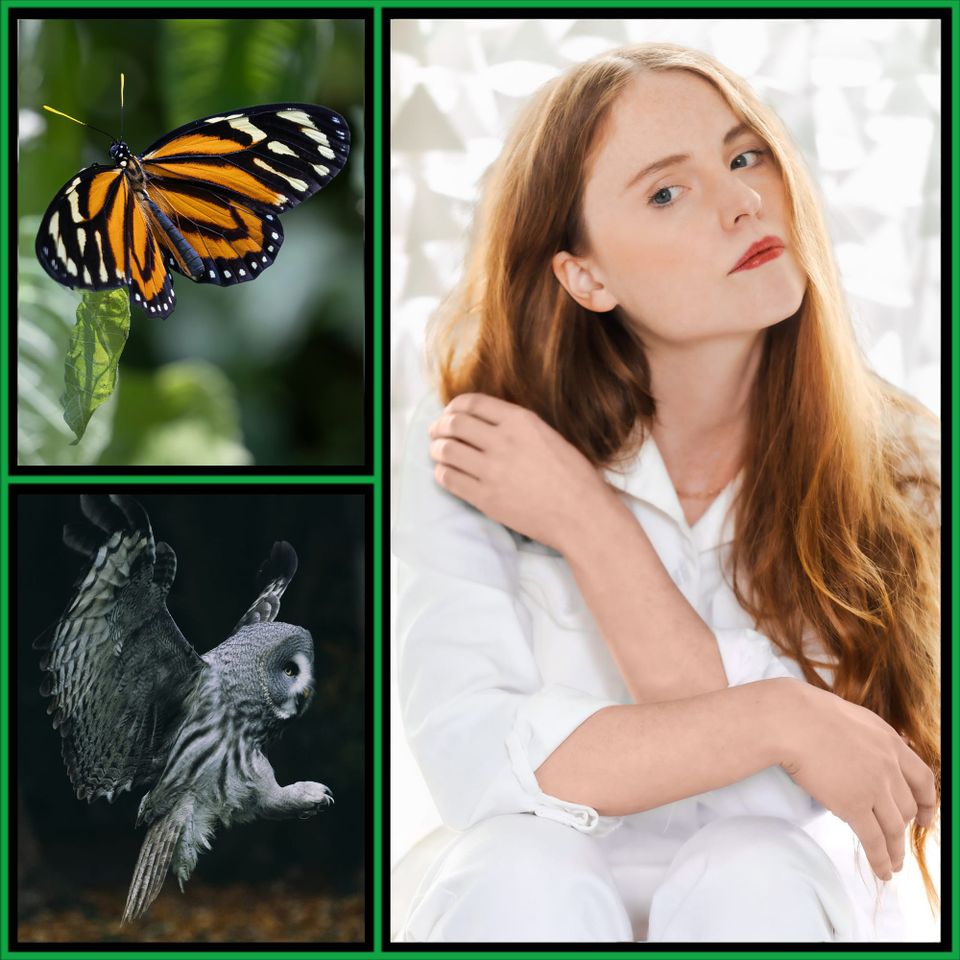
The metaphor I like to use is about the monarch butterflies. I love monarch butterflies. In fact, I'm going to be one for Halloween this year. It's so important to me that we focus on trying to rebuild their populations in the Hudson Valley and we protect them. We stop spraying glyphosate. We don't mow down our fields of milkweed and weeds where they will build their cocoons and feed themselves and stop on their long migratory process.
And for me, monarchs really queer our idea of a single self and generations. Something that I think about also is the Haudenosaunee confederacy, the indigenous confederacy that predates colonialism here. This idea that every decision you make as a community, you have to think like seven generations ahead, that you really have to think beyond your own lifetime.
So those monarchs for me are this great, more-than-human realization of the Haudenosaunee's idea of making decisions for more than one generation, because when they migrate down to the South every winter, it takes five different generations. The butterfly that starts the journey is not the butterfly that ends it. And I think about what does it mean to start a journey knowing that you are not going to see the end of it? You are not the destination. You don't get to see the ending, but you can participate.
Anne Strainchamps: And I do think this is a worldview that, if we're going to use language of reincarnation, that is cycling around and coming back. We are all, I think, learning to be more responsible about the way we treat the earth, the waste that we cause. Usually, I think those realizations come with, for me at least, a fair amount of guilt. And I don't think that I'm alone. I mean, you've written a lot about the religious roots of so many of our attitudes. It seems to me that one of the challenges facing us today is to hold on to the sense of wonder and not slip into this feeling of being sinful, guilty.
Sophie Strand: Yeah. I think something very interesting is, so I wrote a historical fiction novel about Second Temple Period Palestine and about all of the different types of Jewish traditions at the time of Roman imperialism.
Anne Strainchamps: The Madonna Secret.
Sophie Strand: Yeah. And in it, I was very interested in the Aramaic and Jewish roots of the idea of sin. So the idea of sin has really been mistranslated from Aramaic to Greek through different cultures. It actually carried a lot less moral baggage originally. The word meant to miss the mark or debt. And so sin was a way, actually, of attuning to your relationships, attuning to the ways that you were affecting other beings.
Anne Strainchamps: Really? It wasn't part of this idea that we're fallen, where our nature is sinful?
Sophie Strand: Well, this becomes, with Augustine, you have a progression of Gentile Roman people misinterpreting the idea of sin over many, many successive generations as Christianity becomes codified outside of its original culture. But sin is a more complicated, more nuanced term in Aramaic. And so in the original folk traditions of Northern Galilee, where we can place Jesus, it had a much looser understanding.
But sin has become something that paralyzes us. I think for me, sin is more of a verb of attunement in its original Aramaic sense, which is, well, if I'm out of right relationship, if there's a debt, if I've eaten the berries and I've accepted the gifts of the land, how do I keep feeding the land so that that relationship is constantly rebalancing?
Anne Strainchamps: It's more complicated even than that, though, because what goes along with the idea of sin is the idea of, well, at least I'm thinking about St. Augustine, the idea of the body itself.
Sophie Strand: Yeah.
Anne Strainchamps: And especially women's bodies, as being somehow dirty, impure. And the opposite of where we want to go, which is, I don't know, up in the sky, to a purer, better kind of state.
Sophie Strand: Absolutely. I mean, I've written a lot about the history of monotheism and empire. I don't have any answers, but I'm very curious about how you see the schism of mind and matter, purity and impurity, humans and nature, men and women. And you see these value dualisms emerge post-Bronze Age collapse.
So before that, in the Mediterranean basin and Europe, you see much more earth-reverent, partnership-based cultures. Rianne Eisler, who's one of my favorite scholars of these early states, says—
Anne Strainchamps: Oh, I remember. She wrote The Chalice and the Blade, right? Early feminist, kind of archaeological, let's go back and look at the earth goddesses and the divine feminine.
Sophie Strand: Yeah, and she writes that what a culture doesn't depict in its art is even more important than what it does depict. And one thing that's so interesting about many of the early Mediterranean states and cultures, and I'm thinking of Cabal Hayek, Mohenjo-Daro, these early states, they don't depict violence, they don't depict murder.
And I'm curious about this period of time of collapse in the Mediterranean basin where there were droughts, famine, plagues, genocide, mass exodus of people. And after this mass cultural traumatic event, you see a schism between mind and matter, men and women, humans and nature, and purity and impurity. That the body where you can suffer — from plague, from dislocation, from battles — is unsafe and impure. And that there's some other place that's safer, that's abstract, that's in the sky.
Anne Strainchamps: Well, are you suggesting that in some ways, we are all survivors of this civilizational collapse, and we are carrying the memory of this trauma?
Sophie Strand: Yeah, I mean, I do think so. Our cultures are stories. So I think it's important to understand how these collapses may have inspired certain kinds of narrative survival mechanisms that made sense in the moment, but are perhaps obsolete now.
Anne Strainchamps: Play that out a little bit. What's the narrative that you think that we are subconsciously holding on to? And in what way would that have been a refuge from or a response to trauma?
Sophie Strand: Well, as a survivor of violence in my own life, I know that one of the ways that you survive insurmountable violence is you dissociate, that you leave your body. And it can protect you from psychologically breaking. But that dissociation, when it is carried out over a long period of time in a personal life, can mean that you're not paying attention to your body.
So I see a period of time where people experience natural disasters, drought, dislocation, plagues, a lot of things that are deeply traumatic and that make you hyper aware of how fragile the body is.
Anne Strainchamps: Right.
Sophie Strand: And that maybe your God isn't going to save you.
Anne Strainchamps: Or that the earth is going to kill you.
Sophie Strand: Or that your neighbor is going to kill you. And so for me, I'm interested in what happens when a culture dissociates, when it goes into its head and leaves behind its body, is really seeded with this base separation between mind and matter and good and evil.
Another thing I will say is that when we are in situations that are very threatening, we seek to simplify them so that we know where is safe. So we simplify everything into binaries. We live in a highly binaristic culture. It does not have a high threshold for ambiguity and complexity. And especially when we're stressed, it gets worse, as we're seeing right now with the American political landscape.
Anne Strainchamps: Absolutely.
Sophie Strand: And you add in a pandemic, you add in COVID, you add in the onslaught of information and misinformation online that our neurobiology is not built to accommodate. Yeah, of course, our very organisms are overwhelmed. And so we seek ways of simplifying our environment so that we can feel safe. So I have a lot of compassion for survival mechanisms. And I also think that we have to be conscious of the ways in which they can inspire our worst behavior.
Anne Strainchamps: Yeah. Going back to the idea that when your body feels too much pain, and your psyche feels too much pain, body and psyche, when it's more than you can handle, we leave. We leave the body and live up in our minds and our heads. And so you can look at where we are culturally today. And, I mean, I don't want to pathologize the entire development of Western science and enlightenment thought, but there is a strand of that.
And so that's why I said, going back to where we began with that piece that you wrote, and I said it felt explosive. That's what I feel like you are implicitly exploding all the time. The idea that we are a singular self or that decay, rot, the body, that these are things to flee from. You keep taking us back into earth, the body, decay. Exactly the opposite of where our culture tells us to look for wonder.
Sorry, that's a very large statement to get you to react to, but that's kind of what I see happening over and over, the movement I see over and over again in your work.
Sophie Strand: Thank you. Yeah. I mean, I always say I want to stitch ascent back to descent. I'm much more interested in cycles.
One metaphor I've used in my book about myths, The Flowering Wand, is mushrooms send out millions of spores. And we now know through modern science that these mushrooms sprout up from underground mycorrhizal systems. So filamentous, lace-like fungi in the soil that connect plants, bacterial colonies, and trees. They send up their fruiting bodies, these mushrooms, that then sporulate millions of spores. And the wildest thing is that these spores cloud seed. There are so many millions of tons of spores in the air that they act as the nucleus of water droplets. And then they actually create cloud systems and thus rain.
Anne Strainchamps: Wait, wait, wait. The spores of the mushrooms create clouds?
Sophie Strand: Yeah.
Anne Strainchamps: Create weather?
Sophie Strand: Create weather. And so for me, spore gods or storm gods are rock gods. It's a way of tying all of these movements together.
Anne Strainchamps: I mean, somehow this is also reminding me, we were talking about monarchs, but you wrote about the cocoons and the way the caterpillar melts and becomes a butterfly.
Sophie Strand: Oh, yeah. I'm very interested in consciousness studies.
Anne Strainchamps: You have to talk to my husband, Steve. That's his whole thing.
Sophie Strand: It's so fascinating. And a lot of my scientist friends are saying that we're on the edge of what they call a Copernican shift.
Anne Strainchamps: Really?
Sophie Strand: Which is like our ideas about consciousness are about to change so radically that it will feel that big. Some of my favorite thinkers are beginning to say that brains and thinking have been conflated, but they're not the same thing.
And you brought up the butterfly, which is this great problematization of the idea that thinking or memories are stored in the brain. So you have caterpillars. Caterpillars are eating leaves, getting fat, getting ready. Then they create a cocoon. There's this hormone that gets stimulated. I think it's called ectosine. And they basically begin to melt. And I always wonder, what does that feel like to a caterpillar? It probably feels like dying. And their brain liquefies. That's the craziest thing. Their brain liquefies.
And there are numerous studies of moths and butterflies. And it's so fascinating that butterflies have the same memories as they did when they were caterpillars, even though their brains have been liquefied and rearticulated.
Anne Strainchamps: How is that possible?
Sophie Strand: They'll remember the leaves that they originally ate and go back to the same leaves and the same plants. They did a study where I think they shocked — I hate studies like this, by the way — but they hurt the caterpillars when they exposed them to a certain smell. And the butterflies remembered to associate that smell.
Anne Strainchamps: Stay away from that smell.
Sophie Strand: Yeah.
Anne Strainchamps: In that case, where are the memories?
Sophie Strand: What are the memories? And for me, that's where my wonder is. My wonder is in the questions we can live inside rather than answer immediately.
Anne Strainchamps: Yeah. This journey, it's been personal for you, right? I mean, you got really sick in your teens. Maybe you can just tell a little bit of that story.
Sophie Strand: Sure. At the age of 16, I went from being a very athletic, very physically fit young woman to being so radically ill that I was in and out of the hospital overnight. And it took many, many years of misdiagnosis, mistreatment, and really degenerating health to finally get a diagnosis of genetic connective tissue disease.
Anne Strainchamps: Ehlers-Danlos syndrome.
Sophie Strand: Yeah. And many other co-morbidities. And then some other autoimmune things.
Anne Strainchamps: Like what you can eat is pretty limited, as I recall.
Sophie Strand: Yeah. I have mast cell disease, and Ehlers-Danlos predisposes you to gastroparesis and autoimmunity and many gastrointestinal metabolic issues.
Anne Strainchamps: So, I mean, reading your memoir, you've come close to death many times.
Sophie Strand: I have indeed.
Anne Strainchamps: You've gone into anaphylactic shock, I don't know how many times, been revived, and I don't know how many ambulances.
Sophie Strand: Yeah.
Anne Strainchamps: So, first, I want to just pause there and just say you're about the age of my own daughter, and I could not read any of that without reacting as a mother. I began thinking about your own mother, wondering how the hell she handled any of those.
Sophie Strand: I know. I mean, I think about what it's like to have a sick child. I've had friends who've had children die, and I think of my own parents and how terrifying it was for them, especially when they realized, the meaning of our for-profit health care and COVID has completely destabilized the way people can access health care in America. It's a mess and expensive and complicated.
Anne Strainchamps: I think it's really hard for my generation, looking around and seeing so many people our children's age and younger are sick. They're getting earlier cancers. They're getting autoimmune diseases. It's hard. I don't know whether this is true or not, but in my head, it's impossible not to conflate — oh, the earth is sick, and so are the young people.
Sophie Strand: Yeah, I mean, very scientifically and practically, there are all these boundaries that if you violate them, we can't actually predict how the earth will rebalance. And one of them are called novel particles — creating chemicals and novel particles and introducing them into the chaos of earth systems without knowing how they might cascade into feedback loops and change how things work. And we have well exceeded the amount of novel particles and molecules we have introduced into our ecosystems in the past couple of years.
We're in an experiment right now, biologically, with plastics, with all of these things. We don't know what the long-term effects are. I'm not surprised that we are sick. We have really created a very interesting soup.
Anne Strainchamps: Well, so where I was going with that, I think, is kind of thinking we need new myths, right? The old mythic structures that we were talking about, they're just kind of part of the problem. And it seems to me that you're interested in both myth and the ecological language of science and bringing those things together, like your image of the hermit crabs.
Sophie Strand: Yeah.
Anne Strainchamps: Lining up on the sand to exchange—
Sophie Strand: Shells.
Anne Strainchamps: Helping each other.
Sophie Strand: Yeah. I do love that metaphor of the hermit crabs. And for people who are listening who don't know it — hermit crabs don't grow their own shells. They steal them or they borrow them. They find them and they eventually outgrow them. And so what they do is they'll find a new shell and it probably is not the right size, but they'll exit their old shell and wait next to the new shell. And slowly over time, a bunch of hermit crabs will coalesce into a gathering and then they'll all exchange shells so that every single one finds the right sized shell.
I love that because it's about communal storytelling and how the only way to compost these older toxic paradigms is together. We can't do it alone. Learning to listen and to dialogue with beings and people who are different than us is a really important part of whatever comes next.
Anne Strainchamps: I want to pause on that image of hermit crabs lined up together on the beach. This is Wonder Cabinet.
MUSIC
________________
Anne Strainchamps: I'm Anne Strainchamps, talking with writer Sophie Strand, and I want to pick up on that idea of communal storytelling. What does that look like for you in practice?
Sophie Strand: Well, in practice, it means I have been hosting on and off for years potluck events. Sometimes they're clothing swaps, sometimes they're just meal sharing. And usually a lot of people show up locally, people invite other people, friends of friends, you share food, you light candles.
And then I always invite people to share a story from their life that in telling it threatens to make them look insane, or whatever word you want to use. It threatens their credibility. So tell a ghost story, tell a weird, spooky story, something you can't explain.
And the incredible thing about it is you can have people from many different generations, many different walks of life. And if you get them laughing, eating food together, sitting on the ground, trying on each other's old ratty sweaters, you get them into this kind of intimacy, and then you turn off the lights and you light candles, and you ask people to share stories that they don't understand, really amazing transformation starts to happen. People start opening up and sharing things that are outside our modern framework of how we know things.
Anne Strainchamps: Let's do it now.
Sophie Strand: Totally.
Anne Strainchamps: What's a story, something that's happened to you that you can't explain?
Sophie Strand: Absolutely. One of my favorite stories that I sometimes tell is — me and my friend Nora lived during the summers between college in a tiny little upstate town that was nearer to a much bougier town with lots of fancy restaurants. So occasionally we would treat ourselves, we would drive from our tiny little town over to this much fancier town to go out for dinner.
So we finished our work, we drove over there, we had done the drive many, many times. And we ate dinner, we were totally sober. It was dark, but early. And we started to drive back. The drive should have taken 15 minutes, we'd done it many times. And suddenly, we were out of service. Our phones weren't working. And suddenly the clock on the car wasn't working. And we were driving through farm field after farm field. And we had no idea where we were, we were totally lost. So we kept driving.
And I said, Nora, I have to pee really badly. Will you pull over so I can pee on the side of the road? She was like, no, we're not stopping the car, which is amazing, because she was beginning to feel like something really intense was happening.
So the distance between Rhinebeck and Tivoli is very short. But we were driving for a long time. And we had no street signs, no markers that we recognized, nothing. And then all of a sudden, a giant owl flew down in the road in front of her car, causing her to slam on the brakes. And we screamed. And then the owl put out its wings, looked at us and flew off. And then our phones got service. And the clock started to work again.
And suddenly we kept driving. And there was a street sign. And we were five minutes from Rhinebeck. And we'd been driving for a long time. And we were both so spooked that we actually parked the car, got out of the car. We had no way of making sense of what had happened.
What I now know is, this is the area where Rip Van Winkle was written. And it was written because this is an area where there's a deep folkloric tradition of something called time loops. People will report getting stuck in loops where you don't know where you are. Time moves at a different pace. And then you get out of it. And you can't quite make sense of what happened.
The beautiful thing about these stories is I hold them lightly, which is if there happens to be an explanation that does describe it, I'll accept it. I want to be able to update my understanding. But I also don't want to rush to a bad description of what happened, just because I need an answer.
Anne Strainchamps: So when I said, let's share one of these stories. And then I thought, oh, shit, I don't have any. And then I started thinking, what the hell is wrong with me that I don't have any?
Sophie Strand: I'm sure you do.
Anne Strainchamps: So here's the thing, I probably do, but I guess I've repressed them.
Sophie Strand: You're not the only person. At these gatherings, this is what happens without fail. And I've done this dozens of times. There will be two people who are certain and have very intense stories who break the ice, and everyone else will say, I don't have any stories. And then as everyone begins to listen, they're like, I've never told anyone this. And I haven't thought about it in 15 years. But I haven't told this. I haven't even thought about it.
But it's a relational communal thing. When we live in a culture that tells us to deny other ways of knowing, and mocks us and tells us that these things are not real, it's very hard to hold them in our own bodies and our own psyches. I will also say that it is a pretty recent, modern veneer of culture that doesn't believe in ancestors, that doesn't believe that we can be contacted by the dead, that the trees can speak. But I do think that our culture has been so good at making us feel scared about even acknowledging these stories to ourselves.
Anne Strainchamps: I mean, this is why I read fantasy. And in certain moods, magic and fantasy can feel like medicine, like the best medicine or vitamins that you need when you feel like you've been sucked dry by the culture that we live in. You can kind of just feel it in some ways, what makes you feel better. And if for me, it's the story of some children who wander through the back of a cupboard and find themselves in another magical landscape, or a young woman who's starving in a forest and shoots a wolf who turns out to be fey..
Sophie Strand: An avatar. I love that reference. Amazing.
Anne Strainchamps: So what I'm trying to figure out is how do I go from thinking it's okay for magic to live inside the covers of a book, but I don't know how to feel like I'm walking around inside a magical world.
Sophie Strand: Well, for me, science is my magic, to be perfectly honest. Yes, I have weird stories. But the thing that's most magical is the monarch butterflies. I actually find the most magic in reading scientific papers, findings about the sensory worlds of mantis shrimps that see colors we can't even imagine.
I just kind of bring that up because I do think there are different ways of knowing than we allow within our material reductionist world. There are different ways of knowing. People experience their ancestors talking to them. People have dreams that give them advice. We can begin to weave those back in. But for me, my access point is my relationship to plants and animals and reading about them and learning about them and thinking about the just pure synchronicity and magic that we are all here at once, that we all evolved to do these things. That to me is deeply magical.
Anne Strainchamps: You're reminding me, Steve and I chose the name Wonder Cabinet for this new podcast.
Sophie Strand: It's great.
Anne Strainchamps: Thanks. Well, so the original Wonder Cabinets were created by wealthy collectors beginning in the 16th century, 16th until 18th century. And it was really this period of time when there was an older magical worldview coinciding with the birth of the age of science. And so you get people collecting preserved skeletons and fossils and rare minerals and magical objects that they thought were unicorn horns or the philosopher's stone that would turn anything into gold. And all these things coexisted. Science and a magical worldview were not opposites.
And so maybe that's what you're saying, I mean, at some level, that's why I think our larger project is essentially a Wonder Cabinet for the modern age.
Sophie Strand: I love that idea. That's amazing. I mean, we forget that Newton, that most of the big heavy-hitting scientists, were alchemists. They were dabbling in something we think of as being wizardry now. And magic isn't about something being like from fairy. It's more about the wonder and the edges of our understanding. I mean, quantum physics is very magical in that.
Anne Strainchamps: Oh, absolutely.
Sophie Strand: That things are much more verbs than they are objects, much more becoming than they are foreclosed. And that's exciting to me.
Anne Strainchamps: One of the very next interviews we'll be airing is a conversation Steve had with Carlo Revelli, the discoverer of black holes, who says pretty much exactly what you just said. Talks about how all of us are constantly becoming. And so why would we be afraid of death?
Sophie Strand: It's just another step in a long dance. You know, just one monarch in a migratory circle. I think about that with myself also as I've had to really confront mortality in a fairly real way. And I think about, okay, maybe I'm not going to finish all my projects or finish all my books in time, quote unquote. But can I weave myself in where I create enough nourishment, I make enough good soil that something can grow from my unfinished projects?
Anne Strainchamps: Yeah. That's the beautiful title of your Substack, "Make Me Good Soil."
Sophie Strand: Thank you.
MUSIC
Anne Strainchamps: Sophie Strand is a poet and writer and author of a memoir called "The Body is a Doorway." I'm Anne Strainchamps.
Steve Paulson: And I'm Steve Paulson. And this is Wonder Cabinet.
Anne Strainchamps: And by the way, that conversation with Carlo Rovelli that we just mentioned, that is in our next episode on the beauty of physics.
Carlo Rovelli: At that precise moment, I fell in love with physics. It was madly falling in love with physics. Quantum mechanics and general relativity are the most beautiful human creations. I mean, there's this curving of space, stretching on time. It's better than LSD.
Anne Strainchamps: I hope you'll join us.
Steve Paulson: Wonder Cabinet's audio engineer is Steve Gotcher, theme music by Joe Hartke.
Anne Strainchamps: Send questions and comments and sign up for our newsletter at wondercabinetproductions.com. See you next time.
Subscribe to make sure you never miss an episode.