

01 Aug 2026
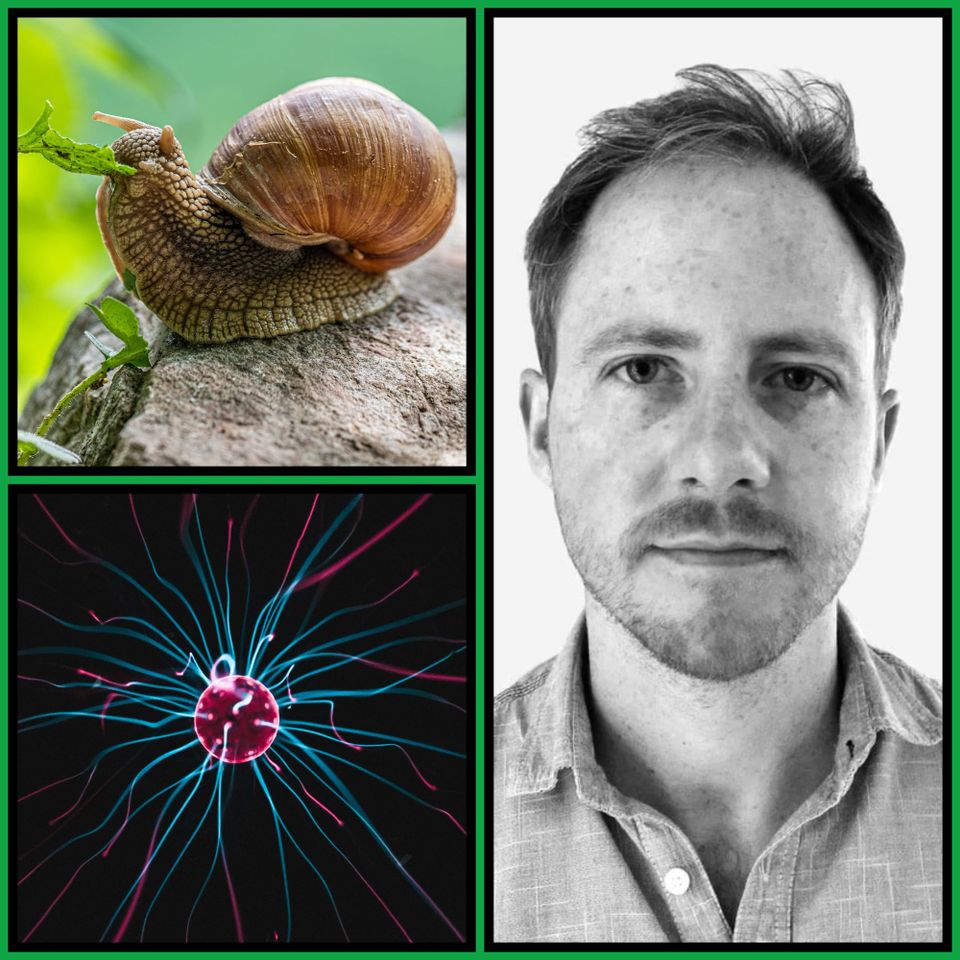
The Conscious Universe: Panpsychism with Philip Goff
What if consciousness isn't just in our minds but throughout the cosmos? Philosopher Philip Goff makes the case for the radical theory of panpsychism.
0:00 / 0:00
01 Aug 2026
The Conscious Universe: Panpsychism with Philip Goff
What if consciousness isn't just in our minds but throughout the cosmos? Philosopher Philip Goff makes the case for the radical theory of panpsychism.
ShareEpisode Notes
What if consciousness isn't something that emerges from the brain—but is embedded in the fabric of reality itself?
That's the provocative idea behind panpsychism— that consciousness goes all the way down to the fundamental building blocks of the cosmos. Philosopher Philip Goff, one of panpsychism’s leading advocates, argues that it offers the best solution to one of science's deepest mysteries: how consciousness arises at all. We also hear from novelist Philip Pullman, whose fantasy series His Dark Materials was partly inspired by panpsychism.
Goff reflects on another surprising development in his own thinking: his recent turn toward the Eastern Orthodox Church and what he calls "heretical Christianity.” He also describes how a profound psychedelic experience shook him to the core—and may have revealed a deeper reality.
The first interview with Goff was recorded at the Island of Knowledge think tank in Tuscany, a project supported by Dartmouth College and the John Templeton Foundation. The interview with Philip Pullman originally aired on Wisconsin Public Radio’s To The Best Of Our Knowledge. This Wonder Cabinet episode was not funded, endorsed or affiliated with Wisconsin Public Media or the University of Wisconsin-Madison.
- Philip Goff’s website.
- Books
- Podcast: "Phillip Goff Philosophy"
- TTBOOK: "His Dark Materials' Author Philip Pullman On The Consciousness Of All Things"
Transcript
Anne Strainchamps: Welcome to Wonder Cabinet. I'm Anne Strainchamps.
Steve Paulson: And I'm Steve Paulson.
Anne Strainchamps: Once upon a time, a British children's book writer imagined a world of flying witches, armored bears, and portals to other worlds.
Steve Paulson: Children with soul companions who take the form of animals, and religious authorities who think free will is evidence of original sin.
Anne Strainchamps: And this whole imaginary world is animated by a mysterious, elementary particle, a kind of shadow matter, a building block of the universe, inherently alive and conscious.
Steve Paulson: This fictional particle is called Dust, but it was inspired by a very real philosophy: panpsychism, the theory that everything in the world is made of consciousness — not just people and animals, but trees, amoebas, even electrons.
HBO Excerpt — Lord Asriel: What is the most important question we can ask?
Lyra: Where dust comes from.
Asriel: There you are. You've seen dust pouring into this world from the Aurora. If light can cross that barrier between the universes, if dust can, if we can see that city up there in the sky, then we can build a bridge and we can cross.
Lyra: Across multiple worlds.
Asriel: Why not? Let's go to the source. Let's ask what dust is. How do you like the sound of that?
Anne Strainchamps: That's a clip from the HBO adaptation of Philip Pullman's classic fantasy series, His Dark Materials. And no, the universe is not made of dust, but could it be made of consciousness?
Steve Paulson: Scientists and philosophers have been arguing about panpsychism for decades, and scientists generally say there is zero proof for it, but Philip Pullman says that doesn't mean it's not true. That's what he told me when we talked a few years ago on our old show, TTBOOK.
Philip Pullman: Science is a good servant but a bad master, in the old phrase. If you only allow yourself to see things through the filter of science, you'll miss a great deal of what's there. And what's there are the things that you can't measure, you can't be numerical about.
Steve Paulson: Like consciousness.
Philip Pullman: What panpsychism does, and this is what I like about it, is to suggest that consciousness is a normal property of matter. Everything is conscious. That's not to say that the cup of tea from which I'm now drinking is conscious and saying to me, "Come on, hurry up, you haven't finished this yet." No, but consciousness is something that pervades everything, although many philosophers find this hard to accept.
Poets don't find it hard to accept. William Blake, the great Romantic English poet, was a panpsychist, I think, before the word existed. I mean, he talks of every particle of dust breathing forth its joy. So the notion that the world is alive, the world is conscious, is something that I find very convincing, very persuasive.
There's a sense that the people who run the world have, up until now, treated the world as a sort of dead thing that they can scavenge for whatever they like out of it. They can pump oil, they can burn them as they will and hurl the smoke into the atmosphere, and it's all dead and it doesn't matter. Well, we're discovering now, to our great cost, that it's not all dead and it does matter. Again, the idea of Gaia, the Gaia hypothesis, taps into the same feeling, I think.
Steve Paulson: I've been interested in panpsychism for years, so I was really excited to meet one of its foremost advocates, the philosopher who inspired Philip Pullman.
Let me just make sure everything sounds okay.
Philip Goff: Hello, looking forward to having a little chat today. My name is Philip Goff. I'm a philosophy professor at Durham University in the north of England. I spend most of my time trying to work out the ultimate nature of reality.
Steve Paulson: Okay, well, that's simple. That's a good place to start.
Anne Strainchamps: We're back at the Island of Knowledge think tank in Tuscany, at a session on rational mysticism. The rest of us are eating lunch, but Steve and Philip Goff have snuck off to chat about panpsychism.
Philip Goff: You could think of panpsychism as continuing a trend that's been going on for some time now. At the start of the Scientific Revolution, we thought that we were the only conscious ones, and animals were unfeeling mechanisms. And then over time, we've attributed consciousness to more and more of the natural world — starting with higher primates, other mammals, and only fairly recently, birds and fish. And then, a year or two ago now, a couple of hundred scientists signed a letter saying they were taking insect and reptile consciousness as at least a serious possibility.
So panpsychists take this to its logical conclusion, attributing consciousness not only to the simplest forms of cellular life, but also to the molecules, atoms, subatomic particles that make up that life. So for panpsychists, we are conscious creatures in a conscious universe.
Steve Paulson: That's not exactly the logical conclusion, because when you said that there was this document — this manifesto — saying that even insects might have consciousness, they're still animals. And we at least tend to draw the line between animate and inanimate matter. It's the non-life that most people assume can't possibly be conscious. Why extend it so far down? I'm not sure if "down" is the right direction here, but...
Philip Goff: Well, one thing to say is panpsychists aren't just adding consciousness to the story we get from science of particles and fields. So it's not that they have the kinds of properties physicists talk about — mass, spin, and charge — and then we're adding this funny consciousness stuff. Actually, the panpsychist claim is that at the base of reality, all there is is consciousness of very simple forms. And what we call physical reality emerges from that more fundamental story of very simple forms of consciousness.
So in a way, it's turning the problem of consciousness upside down. The normal way we think about this is we start with what physical science talks about — physics, chemistry, neuroscience — and then try to get consciousness out of that. That hasn't been going incredibly well. It's sort of gone nowhere.
Steve Paulson: It's gone nowhere, for years. I mean, we learn more about the brain, but how consciousness somehow is generated by the brain — that seems to be a project that's hit a dead end.
Philip Goff: That's right. We've learned more about which kinds of brain activity go along with which kinds of conscious experience — that question of correlation, although even there, there's very little consensus and lots of disagreement. But how do patterns of neural firings generate a feeling, an experience, a first-person perspective? I think most people agree that we haven't really got even the beginnings of an explanation of that. So the panpsychists turn it upside down. Instead of starting with physical stuff and trying to get consciousness out of that, we start with consciousness of very simple forms and try to get physical reality out of that story about consciousness — that's a bit easier to do, surprisingly.
Steve Paulson: So when you talk about consciousness, you're talking about subjective feeling, you're talking about awareness? This is where it seems to defy common sense. I mean, you say consciousness goes down to atoms, to subatomic particles. They have feelings?
Philip Goff: Yeah, so it's important — when people think of consciousness, they sometimes think of something very cognitively sophisticated, like self-consciousness, awareness of your own existence. Nobody thinks that electrons are aware of their own existence, or they're sitting there feeling existential angst or wondering if it's Tuesday or something. As you say, what we're talking about is just subjective experience. Your consciousness is what it's like to be you.
So feeling tired, seeing colour, hearing sound — these are all parts of what it's like to be you. Now, what it's like to be a human being is very rich and complex, the result of millions of years of evolution. But consciousness comes in all shapes and sizes. What it's like to be a sheep is much simpler. What it's like to be a snail, simpler still. Is there something that it's like to be a bed bug? If so, it's much, much, almost unimaginably simpler. So there doesn't seem to be any conceptual limit to how simple subjective experience can be.
Steve Paulson: Well, except for when you get beyond the animal realm. Then conceptually, it seems like there might be some limits there.
Philip Goff: So there's two questions. One question is, is this a plausible view? Is it ridiculous? Is it something we should be taking seriously? Put that on one side for a moment. But is it coherent? I would say yes. I don't think there's any contradiction in the idea that an electron has some very, very simple form of experience. There's something that it's like to be an electron — very simple, corresponding to its very simple physical nature.
Steve Paulson: What about machines? And then, of course, the other question is, what about AI?
Philip Goff: Yeah, so it's an open question for a panpsychist. They don't necessarily think tables and chairs are conscious. They think maybe tables are made out of things that have very simple forms of consciousness, but the table as a whole doesn't necessarily have its own form of consciousness. In fact, it probably doesn't.
Panpsychists are probably more likely to think consciousness is biological rather than computational. This is the big debate at the present moment. But as a panpsychist, consciousness isn't about abstract information processing — it's the flesh and blood of the world. So you're less likely to think large language models are conscious, or anything remotely like that.
At the same time, panpsychists don't think consciousness is magical, supernatural, added by God at the moment of conception or something. So it has to be possible in principle to create artificial consciousness, but I think for a panpsychist you're probably more likely looking at something like an artificial living system — maybe in the first instance a bacterium, maybe in 5,000 years something with the complexity of a human being.
Steve Paulson: So I want to come back to this question of why panpsychism has sort of — there's a lot of interest in it right now. And really, as you say, over the last 10 or 15 years — I mean, there has been talk about panpsychism for centuries. This is not a new idea, it goes way back. But for whatever reason, it's kind of taken off in the last decade or so. And there are a number of prominent scientists, prominent philosophers who've, if not embraced the idea, at least sort of take it seriously. So why? What has changed?
Philip Goff: I guess maybe there's two sources. In science, there is the integrated information theory, which is one prominent contender for the scientific theory of consciousness. As I say, there's lots of disagreement there, but it's one contender.
Steve Paulson: You have to very briefly explain what that theory is.
Philip Goff: And the integrated information theory, very roughly, the claim is that when a system has more integrated information in the whole than in any of the parts, you get consciousness. Now, what is integrated information? They try to give a very precise mathematical definition of that, but actually this implies that consciousness goes into the inanimate realm — that everywhere there's some kind of consciousness, whether it's in the parts or the wholes. So there's at least an affinity here with panpsychism.
In the philosophical context, it's really the rediscovery of certain important work in the 1920s by Bertrand Russell. And I think Russell's core insight here was that physical science, for all its wonders, isn't really telling us what matter is. I remember when I first heard that, I thought, "That's ridiculous, what are you talking about? We read a book of cosmology, we learn this wonderful story about space and time and matter." But his point was, yes, we get a lot of information from physics, of course, but it's all about what stuff does. Not what it is.
What does physics tell us about an electron? It tells us it has mass and charge. And these properties are completely characterized in terms of things like attraction, repulsion, resistance to acceleration. It's all about what stuff does. Doing physics is like playing chess when you don't care what the pieces are made of — you just want to play the game, you just want to know what they do.
And of course, that's wonderful information, because if you know what matter does, you can manipulate it. We can produce incredible technology. But at the end of the day, physics doesn't tell us what an electron is. And in that sense, there's a huge hole in our standard scientific story of reality. Okay, so we've got a hole in our scientific story. We're looking for a place for consciousness. Maybe we can put consciousness in the hole.
Steve Paulson: So explain that. So if we don't know what matter is — or at least conventional science, physics, cannot explain what matter is. Are you suggesting matter is consciousness?
Philip Goff: Well, that is the claim, yes. We know consciousness is real. How do we know it's real? By being conscious. We're directly aware of our own feelings and experiences. So we know it's real. We have to fit it into the scientific story somehow. And this hole in the scientific story Russell identified perhaps finds a place for it.
So the claim is there is just consciousness of very simple forms behaving in simple, predictable ways, and what physics is doing is tracking the behaviour of these very simple forms of consciousness. So it's a way of bringing together two things we know to be real: the stuff we know about the physical world from doing science, and the stuff we know about consciousness by being conscious. Panpsychism offers a way of drawing these two things together in a single, simple, elegant theory of reality.
Steve Paulson: So you're saying consciousness is a fundamental force. I mean, we tend to think of the laws of physics, but consciousness is apart from that and even more foundational than those laws of physics?
Philip Goff: Consciousness is everything for the panpsychist. There is nothing but consciousness. I like to put it: matter is what consciousness does, for the panpsychist. So what we call particles, what we call fields in this view, just are the most rudimentary forms of consciousness. Through their equations, physics tracks them in terms of their behaviour, but what they are in terms of their nature is forms of consciousness.
Steve Paulson: Okay, so let's talk about human beings for a moment here. So where do brains fit into this? I mean, clearly we — well, I shouldn't say. I was going to say clearly we need a brain to be conscious, but... I don't know. Do we?
Philip Goff: I think we have to think very carefully about what the problem of consciousness is. It's not just another scientific problem — we just haven't done enough experiments, we just haven't done enough brain scans to crack it. It's a very unique scientific problem.
Each of us is directly aware of our feelings and experiences, and this direct access tells us something about its nature. A pain is essentially defined by how it feels, and you know how it feels when you feel it. So we know, to a large extent at least, what consciousness is because we're conscious. And this is very different to any other phenomenon science tries to explain.
Think about lightning. You don't know what the hell lightning is before you do the science. Is it the anger of the gods? Who knows? You have to do the science to find out it's electric discharge. Or, what is water? Is it a fundamental element together with earth and fire and air, as the ancient Greeks thought? Or is it H2O? You have to do the science.
But with consciousness, we have some understanding of what it is. And indeed, we have understanding that you couldn't get from experiments. So, for example, if we have a blind-from-birth neuroscientist, no matter what they learn about the physical processes associated with color experience, that blind-from-birth neuroscientist is never going to know what it's like to see red — the qualitative character of a red experience. So there's information about consciousness you can only get from the inside.
So here's how you should think of the problem of consciousness: it's not just, "Oh, we want science to tell us what's going on." It's rather that we have two ways of knowing about reality, and it's a philosophical question how these two things fit together.
Steve Paulson: So I want to come back to you. So why did you get so interested in this? I mean, obviously you are fascinated by this question of consciousness. I mean, the paradox — what is it? Is it strictly an intellectual question? How did you get here?
Philip Goff: As far back as I can remember, I've always been obsessed, captivated by how the different stories we tell about reality fit together. I was raised Catholic, and I remember hearing in church about Adam and Eve. And then I was also obsessed with the Big Bang and black holes. And I was like, how do these two creation stories fit together? The Big Bang story and the story of Adam and Eve.
There's the story we get from science. But there's also the story of morality — good and bad, right and wrong. There's the story about free agency — our choices, responsibility. There's the story about the mind — consciousness, belief, desires, passions, hopes, dreams. There's a story also about abstract objects — numbers, functions, sets — that my colleagues in the mathematics department talk about. How on earth do all these different stories fit together? Is one of them the fundamental one — maybe the scientific one? Or are there lots of different stories that somehow interact with each other?
Consciousness, though, I think is the most interesting part, because it's so hard to deny it's real, but it's also so hard to fit it into our standard scientific story of the universe. And that's why it's always captivated me.
Steve Paulson: You said you grew up Catholic, is that right?
Philip Goff: Yes.
Steve Paulson: And so it would seem, intuitively, that if you embrace panpsychism as sort of a framework for understanding reality, that fits more neatly with religious belief, or belief in some sort of ultimate reality and some sort of presence that goes beyond our individual brains. Is that fair to say?
Philip Goff: Actually, there's a bit of a divide in the panpsychist research community over this. Some philosophers — and I guess I'm more in this camp — see a certain consonance with certain spiritual convictions and panpsychism. I think if you're a panpsychist, it's easier to take seriously certain kinds of mystical experience. For example, people have mystical experiences in which they seem to be in direct contact with ultimate reality.
I think if you're a physicalist, that's very hard to make sense of, because for a physicalist, ultimate reality is the kinds of things science talks about — particles and fields — and you have to do science to find out about them. But if you're a panpsychist, and you think ultimate reality is made of consciousness, and we are conscious and we have direct access to our consciousness, it's maybe a little bit easier to take seriously that in certain states of mind, we might be directly in touch with ultimate reality. So certainly panpsychism doesn't entail anything spiritual, but it's less of a leap, maybe, to get from panpsychism to something spiritual.
However, other panpsychists think, "No, no, this is all superstitious nonsense. We don't believe in any sort of transcendent spiritual reality. We're just trying to make sense of mundane consciousness — feeling pain, seeing colour — and we just need a kind of new scientific paradigm to make sense of that."
Steve Paulson: But it's interesting you say that, because it sounds like you're saying that by coming around to this view — I mean, this intellectual view of the nature of consciousness, that it goes all the way down, this is what is real — that is comforting in some way. And I don't want to just say this is a new religion, but it sounds like it gives you personally some comfort or solace, something like that.
Philip Goff: In a way, we go back to where we started. I think philosophy is all about fitting together the different stories one tells about reality, the different things we take ourselves to know.
Well, quite recently, I have come to some kind of religious faith. I self-identify as a heretical Christian. This is really the new book I'm working on now, tentatively titled Heresy, which is exploring whether it is rational to trust a mystical experience.
When people have a mystical experience, certain things seem to them to be true. Perhaps it seems to them that they are in contact with ultimate reality. Perhaps it even seems to them that they are, in some sense, one with or unified with ultimate reality.
Now, we could just enjoy those experiences and see what benefits come from them. But as a philosopher, I want to ask, well, is it rational to trust that seeming? To believe, on the basis of the mystical experience, that things really are as they seem to be? And I guess I would like to argue that if you're a physicalist — no, you should think this is a delusion. If you have a mystical experience and you're Daniel Dennett, you should think it was something funny going on in your brain, like hallucinating you're riding on a dragon or something, because it just doesn't fit with your worldview.
But if I'm a panpsychist who has a mystical experience, I think there's nothing in my worldview to rule that out or to really cast doubt on it. So as a panpsychist, it's open to me to trust what that experience seems to be telling me about reality, and to maybe form the basis of a spirituality on that foundation.
Steve Paulson: So I have to come back to how you identified yourself spiritually — as a, what did you say, heretical Christian?
Philip Goff: Yes.
Steve Paulson: Do you want to explain what that means?
Philip Goff: I found my spiritual home in the combination of the mysticism of the Eastern Orthodox Church and the liberal flexibility of the Anglican Church. So the core of Christianity in the Eastern Orthodox Church is nothing to do with — Jesus being punished for our sins, that idea. People might be surprised to know that really came out of the Protestant Reformation 500 years ago. It's not something that goes all the way back to the start of Christianity. And that is no part of how the Eastern Church thinks about things.
For them, the core of it is: it's all about God and the universe becoming one together. They think God shared in our form of existence so that we can share in God's form of existence. They even say we are becoming gods — maybe with a small g. So we won't actually become God, we won't become identical with God, but they think what it is like to be us will be exactly the same as what it is like to be God. We will fully share in God's form of existence.
So that idea at the core of the Eastern Orthodox Church very much resonates with me. On the other hand, I don't agree with everything the Eastern Orthodox Church thinks. I don't like that they don't have women priests. Strictly speaking, I think they take gay sex to be sinful, which I think is manifestly false and harmful. For that reason, I choose to be part of the Anglican Church — there's more, in general, more flexibility in how you interpret Christianity.
So that's really the core of my faith. I'm a practicing Anglican, but the core of my faith is how Eastern Orthodox Christianity understands the heart of its religion.
Steve Paulson: So one thing that's striking to me is that this idea of panpsychism has kind of filtered into popular culture, and there are a few notable figures out there who have embraced these ideas. One is Philip Pullman, your British compatriot, author of His Dark Materials, The Golden Compass, and all those books. And he's come out and kind of cited your work, right?
Philip Goff: Yeah, we've had a couple of public conversations, and I've learned so much talking to Philip Pullman. I guess he's someone who's always been influenced by contemporary science and philosophy — ideas of the multiverse as well as ideas of panpsychism. So I think the panpsychist element has always been there.
But then I think since we've had our conversations, the more recent final three volumes in the His Dark Materials series have deepened the panpsychism. And yes, Philip Pullman has kindly credited me for helping influence some of those ideas. But he's influenced me as well. He said to me that we should think of panpsychism as very Copernican — that we don't think of our consciousness, human consciousness, as the sort of prototype, the model of what consciousness is.
Our consciousness is something a bit weird, really. It's resulted from millions of years of evolution. Our consciousness is just some highly developed form of what exists throughout the universe in very simple forms.
Steve Paulson: So I want to bring the notion of wonder in here, because the podcast that Anne and I do is called Wonder Cabinet, and it seems like kind of what you're talking about, it seems pretty wondrous to me. Of course, we're playing off of the idea of the old cabinet of wonders from a few centuries ago. And as an imaginative exercise, if you wanted to put something in an imaginary wonder cabinet — it could be an experience, it could be an idea, it could be a thought experiment, it could be anything — what would you want to put in it?
Philip Goff: I guess as a philosopher, I'm quite boring, and I come back to certain classic figures in Western philosophy. I think Plato got onto something correct with his idea that what we know through reason — about mathematics, logic, morality — is real. It's in some sense as real as the physical universe we can touch and see. And we have to somehow make sense of that. I'm not sure he got it completely right, but it's somehow real — ancient rationalism. And of course, he expressed this so well with his allegory of the cave.
My wife Emma illustrates my books, and she's done a wonderful illustration of Plato's cave for my forthcoming book, Heresy. I hadn't realised — because there's so much going on in this story, it's quite hard to portray it all in one image — but the climax of the story: the philosopher comes out of the cave, where everyone else is tied up staring at shadows on the wall, and comes out into the bright sunshine outside, and sees upfront things in the real world. This wonderful way of representing philosophical enlightenment. So maybe Plato's cave, and all it represents, would go in my wonder cabinet.
Steve Paulson: That was my first conversation with Philip Goff. But then something very surprising happened that led to another follow-up conversation. We'll be back with that right after the break.
Anne Strainchamps: Hi, it's Anne. I am so glad you're joining us. We have some amazing guests lined up for the weeks ahead — I'm really excited about them. And here's a tip: maybe you know this already, but if you follow Wonder Cabinet on Apple Podcasts, those new episodes will show up automatically, like a little weekly gift in your podcast feed. I hope you like it.
Steve Paulson: This is Wonder Cabinet, I'm Steve Paulson. After the conversation you just heard, I discovered that shortly after we spoke, Philip had a profound mystical experience induced by a powerful psychedelic. I was really curious to know whether it confirmed or changed any of his views on panpsychism. So a couple of months later, I called him at his home in Durham, England.
So, Philip, it is great to talk with you again. And since the last time we talked, you did something quite surprising — you took 5-MeO-DMT, which is this very powerful psychedelic. Why did you want to have this experience?
Philip Goff: Well, it's an interesting substance, maybe, to go for if you're a truth-seeking philosopher, because it is, in a sense, a very pure ego dissolution experience. There's nothing — there are no visuals, you don't meet elves, it doesn't connect with repressed memories or anything. It is just kind of pure, instant ego dissolution. And then it's very brief — I mean, from the outside, it lasts 10 minutes. It's a bit difficult to describe the time on the inside, as we'll maybe get into.
Although, just having said that, it sounds like a recommendation. I would just like to say — I would strongly recommend people, in a way, not to do this, or just be very, very careful. I was able to do it in very controlled circumstances, under the supervision of a professional therapist. But I think it's not emphasized enough that there are dangers to psychedelics. They're not generally thought to be physically dangerous or addictive, and so it's wild that they're connected with sort of heroin or something. But they are psychologically dangerous — they do tear apart our ordinary ways of thinking, and those ordinary ways of thinking are often important for psychological stability.
Steve Paulson: So there are dangers. So had you ever had a psychedelic experience before this?
Philip Goff: When I was a teenager — kind of a wild teenager — I took some psychedelics, some mushrooms, some LSD, and had some kind of mind-expanding experiences in some ways, some very bad trips, some very scary trips. But nothing quite like this, I don't think. It is something very different.
Steve Paulson: So what happened? Can you walk me through what the experience was like?
Philip Goff: So I can tell you how things seemed. It seemed like I was instantly and completely annihilated. Philip Goff was wiped from existence. And what remained was an indescribable form of consciousness, one that was beyond space, beyond time, and that somehow belonged to nobody.
Steve Paulson: You had no sense of yourself anymore at that point.
Philip Goff: Yeah, it felt like being killed. I mean, interestingly, it didn't feel to me like I was seeing that the self was an illusion. It felt like there is a self, but it was being destroyed.
I mean, here's a metaphor I came up with afterwards that's not perfect, but maybe captures something of this. Imagine my mind is a light bulb wrapped in cotton wool, and the cotton wool is what's particular to me, Philip Goff — you've got your cotton wool, and each person has their own particular cotton wool. Whereas the light bulb is this timeless, spaceless form of consciousness at the core of our being that doesn't belong to anybody. And then what it felt like was, very quickly, the cotton wool — what it is that's particular to me — was ripped away, and this pure consciousness just kind of shines out.
Steve Paulson: So you said this was terrifying. It sounds also amazing.
Philip Goff: Yeah. In a sense, it was both. And, as I say, what's nice about it is it is a very uniform experience. You can read Michael Pollan talking about his experience of it, the journalist, or the famous neuroscientist Christof Koch, who recently did this and has written about it, or Joe Rogan on YouTube. And it's very uniform. And it is pretty uniformly absolutely terrifying.
Partly, it feels like you're being killed, okay? So that's not nice. And this form of consciousness is so overwhelming — I mean, I would describe it as sort of a raging storm. Maybe you kind of need some Old Testament language of fear and trembling at beholding the divine or something. Actually, when I read Michael Pollan's description — I read this after my own experience — it was almost like Michael Pollan didn't know what to do with this experience. It's like, "Oh, it's not very nice — where are the elves? I don't know." So maybe the psychedelic-friendly crowd, that I quite like, maybe they need to rediscover some kind of Old Testament vocabulary for this particular experience.
Steve Paulson: So the last time we talked, when we talked in Tuscany, you said at the very beginning of our conversation — I'm quoting here — "I spend most of my time trying to work out the ultimate nature of reality." Did this experience get you any closer to understanding reality?
Philip Goff: I would say yes. I believe this has given me direct insight into the ultimate nature of reality. I don't believe this was a hallucination. We can maybe discuss why I think that.
Steve Paulson: Well, let's talk about that right now. Why? Yeah, that is the obvious — you know, the other explanation is this is the mind on drugs, on a very powerful hallucinogen, and you can feel totally transported, but you just jumbled up the neurochemistry in your brain, and this is what happens. Why do you think that's not a good explanation?
Philip Goff: I like to come back to what the great William James says at the end of his famous discussion of mystical experiences, in his book The Varieties of Religious Experience. So most of that is a sort of psychological study of different kinds of mystical experiences. But then he says, well, would it be rational for someone having a mystical experience to accept it as real, that things really are as they seem to be? And he gives an interesting answer.
He says, well, if you say no, you have to say it's a hallucination. There seems to be a sort of double standard, because we all think it's rational to trust ordinary sensory experiences, but they could be delusions too, right? If you study a bit of philosophy, you realize we could be in the Matrix — this could all be a delusion created in us by evil computers. You can never get outside of your consciousness to check whether it's corresponding to reality. But we think it's okay to just trust that ordinary experiences are connecting us to reality — you wouldn't be able to get science done unless you could make that commitment, that choice.
So if it's okay in the case of ordinary experience, why is it not okay for the mystic to trust how things seem to be in their experience? Okay, it could be a delusion, but all experiences could be a delusion — I can't see what justifies that double standard. If it's rational for me to trust ordinary experience — you know, I'm not saying with certainty — but if it's rational for me to trust ordinary experience, it seems to me rational for me to trust that experience too.
Steve Paulson: And so you were saying that you think this experience got you closer to — well, for want of a better word — ultimate reality, or some deeper truth?
Philip Goff: What I experienced was a form of consciousness. It was a form of consciousness that was timeless, was spaceless. And the other characteristic, I would say, is that this was a region of reality in which there was no differentiation at all. There was no distinction between I and other, this and that. I mean, that was the sense really in which I wasn't there. This was a form of consciousness that didn't belong to anybody. So, I don't know — either we say I wasn't there, or maybe I was everywhere or something.
So I am inclined to think this was what philosophers call veridical — that just means not a hallucination, a genuine insight into reality. And so I'm inclined to think there is this undifferentiated, timeless, spaceless form of consciousness underlying all things, at the foundation of my mind, at the foundation of everything.
Steve Paulson: So you have spent years talking, writing, studying about panpsychism — this philosophy that sort of says that consciousness is in pretty much everything, going down to the level of electrons. Did this change your thinking at all about it? Did it challenge that view? Did it affirm it in any way?
Philip Goff: Interestingly, I would say it was very consistent with the panpsychist view, and maybe that's why it was easy for me to not think of it as a hallucination. Maybe if Daniel Dennett had this same experience — if Daniel Dennett had smoked some toad venom and he had this experience — he would have reason to think he's hallucinating, because it clashes with what he already takes himself to know.
Steve Paulson: He's the hard physicalist or materialist who doesn't think there's anything that's beyond the brain in terms of conscious experience. It's all just generated by the brain.
Philip Goff: But for me, as you say, I already believe there is consciousness at the fundamental level of reality. All this does is tell me a little bit more about what that consciousness is like.
Steve Paulson: Yeah. So, Philip, one final question before I let you go. At the very end of our last conversation, you talked about how much you liked Plato's allegory of the cave — it's as if we're all sort of chained inside the cave, prisoners there, and we mistake the shadows that we see for reality. But then someone gets out of the cave and suddenly sees the real thing. Do you feel like you escaped the cave, if only for a brief time, during this experience?
Philip Goff: Wow, what a great question. Do you know, I haven't thought of it in those terms — I haven't connected my experience to Plato's cave.
I do believe I experienced a deeper reality, something more real, more fundamental than the world of ordinary experience. Whether what I experienced is ultimate reality or not is a further question. Maybe what I should say is I experienced the world outside the cave, but not quite the form of the good. In Plato's analogy, the sun outside of the cave is the form of the good that gives life and energy to the living things outside the cave. And for me, that deeper part of divine reality is beyond what I experienced. But yeah, I definitely think I got closer to ultimate reality.
Steve Paulson: Okay. I think that's a great place to leave it. And we're going to go from the profound to the mundane, because I know you've got some kids to feed, and it's dinner time where you are now.
Philip Goff: Absolutely. Although that's another part of the wonder of life — I do think the ordinary world is real and so full of value as well. Thanks, Steve.
Steve Paulson: Thank you so much, Philip. That's Philip Goff, a philosopher at Durham University and the author of a number of books, including Galileo's Error: Foundations for a New Science of Consciousness and Why? The Purpose of the Universe.
Anne Strainchamps: Philip joined us at the Island of Knowledge think tank in Tuscany, where scientists and philosophers come together to talk about some of the big ideas of our time. We'll bring you more of those conversations in the coming months.
Steve Paulson: Support for Wonder Cabinet's Island of Knowledge episodes comes from Dartmouth College and the John Templeton Foundation.
Anne Strainchamps: Thanks, as always, to our audio engineer, Steve Gotcher, and our digital producer, Mark Riechers. Wonder Cabinet is based in Madison, Wisconsin, and Vershire, Vermont. I'm Anne Strainchamps.
Steve Paulson: And I'm Steve Paulson. We'd love to hear from you. Send questions or comments to us at wondercabinetproductions.com, and sign up for the newsletter while you're there.
Anne Strainchamps: Be well. See you next time.
Subscribe to make sure you never miss an episode.