
22 Aug 2026
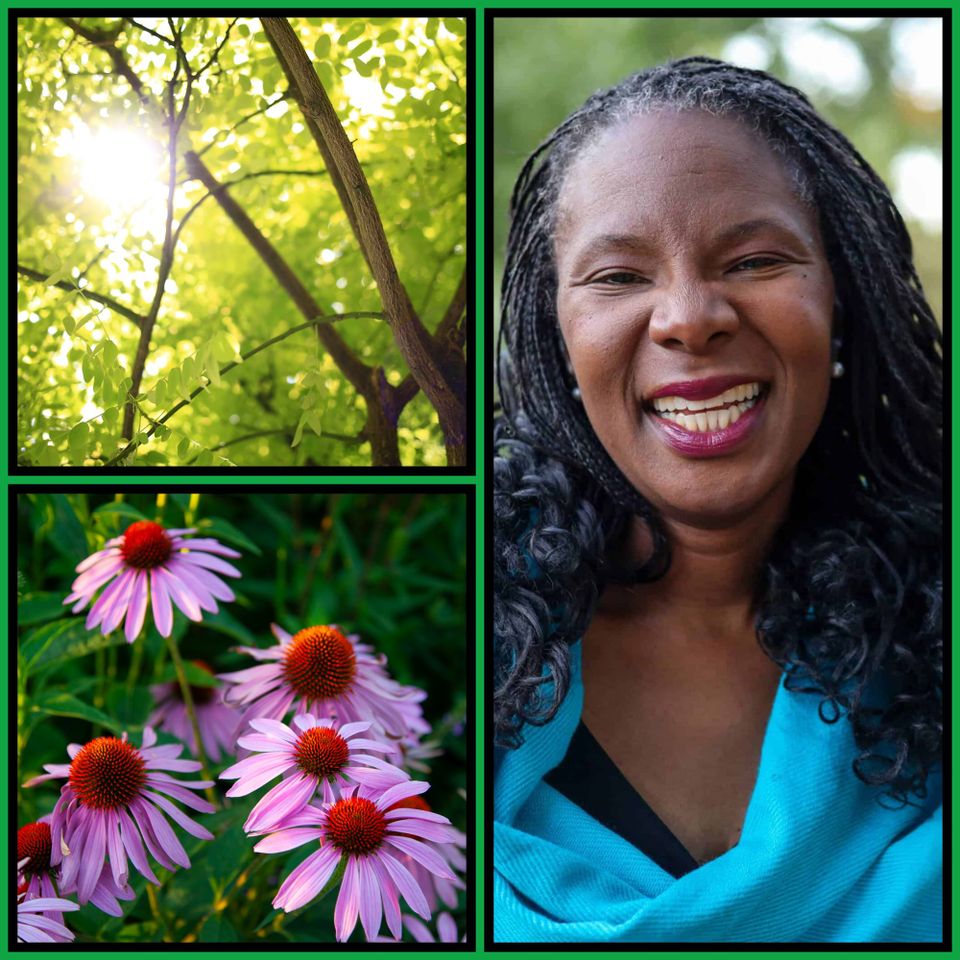
The Ecowomanist Theology of Rev. Dr. Melanie L. Harris
A founder of ecowomanism on Black ancestral land wisdom, generational memory and healing through earth-honoring faiths.
0:00 / 0:00
22 Aug 2026
The Ecowomanist Theology of Rev. Dr. Melanie L. Harris
A founder of ecowomanism on Black ancestral land wisdom, generational memory and healing through earth-honoring faiths.
ShareEpisode Notes
Rev. Dr. Melanie Harris is a professor of Black Feminist and Womanist Theologies at Wake Forest University, an ordained minister in the African Methodist Episcopal Church and one of the founders of ecowomanism — a theology and environmental philosophy centering the voices, wisdom, and spiritual practices of Black women and women of color.
In this conversation, Harris traces her own eco-memories back to Dearfield, Colorado, one of the historic Black-owned farming settlements founded by families who migrated west during the Great Migration — including her own grandparents. She reflects on growing up with a rare and precious connection to land and growing things, even as her family navigated the very real dangers racism posed to simply being outdoors in rural America.
Harris speaks candidly about how, in many African American communities, painful histories tied to slavery and cotton have led families to intentionally distance children from the land — a protective severing that ecowomanism seeks to gently repair. Drawing on her mother's practice of singing and humming to plants, she describes music, spirituality and land stewardship as deeply entwined threads of Black religious life.
She also talks about the hidden ecological history of Black women and why it matters to see women like Harriet Tubman and Fannie Lou Hamer not just as liberators and Civil Rights leaders, but as environmentalists who understood the connection between racial justice and earth justice.
The episode closes with a meditation on the high desert of New Mexico, where the conversation was recorded – a portrait of land, memory, grief and grace held together.
This episode was produced in partnership with the Center for Humans and Nature and with support from the Kalliopeia Foundation.
- Melanie Harris academic bio
- Book: “Ecowomanism: African American Women and Earth-Honoring Faiths”
- Book: “Preaching Black Earth”
Transcript
Anne Strainchamps: I'm Anne Strainchamps.
Steve Paulson: And I'm Steve Paulson.
Anne Strainchamps: A couple of years ago, I spent a magical few days with a group of women environmentalists, conservationists, field biologists, and activists — women who spend their days working urgently and sometimes desperately to change how humans treat the earth. This was at a writing retreat in northern New Mexico. They were all working on books during the day, and at night they cooked for each other. Watching an ethic of care develop among women who hadn't even met each other before was remarkable. It really hit me, something which of course should be obvious, that how we treat the earth and how we treat each other should be the same.
Steve Paulson: Our guest today is someone who's thought a lot about that, and who was at that dinner table.
Melanie Harris: Reverend Dr. Melanie Harris. I was born in Denver, Colorado. My parents were John Arberia Harris Sr. and Naomi Olivia Harris. She now goes by Reverend Doctor as well.
Anne Strainchamps: Melanie Harris is a professor of Black feminist and womanist theologies at Wake Forest University and Divinity School.
Steve Paulson: She's the founder of ecowomanism, an environmental philosophy and theology rooted in the experience and history of Black women and women of color, including her own.
Melanie Harris: My mother was raised during Jim and Jane Crow in the height of the segregated South. And my father's parents actually were those who migrated during the Great Migration to come all the way west to Dearfield, Colorado — one of 30 Black settlements that really began as a Black-owned, Black farming community. We did have access to land, had access to farm, had access to green space. Which was remarkable.
Anne Strainchamps: Remarkable because many African American children grow up without a deep connection to a natural environment.
Melanie Harris: In many African American communities, depending on which generation you're part of, there have literally been attempts to erase the remnants of slavery — the memory of cotton, for example. And so there are intentional ways African American families have, in an attempt to protect children, actually limited children's capacity to even understand growing and how things grow.
Anne Strainchamps: Melanie's work shows us another way, a restorative path that reclaims ancestral legacies of Black environmental stewardship and spiritual wisdom.
Steve Paulson: While also grappling with racism, trauma, and the complicated layers of land and memory.
Anne Strainchamps: What are your earliest memories of feeling connected to nature?
Melanie Harris: My mother used to sing to the roses in our garden and to the plants. And so I learned how to express spirituality through the African American spiritual tradition and song, in conversation with the earth.
Anne Strainchamps: What did she sing?
Melanie Harris: She would sing anything! In the tradition of African Americans, it's very traditional to have a hum as a way of grounding the soul, but also grounding sound. So oftentimes the songs would be humming — the humming of a tune of an actual gospel song, traditionally.
Anne Strainchamps: Do you do that yourself?
Melanie Harris: I do. I do.
Anne Strainchamps: And do you grow things?
Melanie Harris: I do. I have a small garden. We live in a community of a lot of green hands and a lot of community hands. And so it's been a gift to share different recipes, but also plant practices and growing practices, with neighbors.
Anne Strainchamps: I love this image of you tending your garden, hands in the dirt, and just humming or singing. Is that what it's like?
Melanie Harris: It is very much like that. I think for many peoples of African descent, music is a core connector to the ancestors and a core connector to our religiosity, sometimes even our theologies. And so that groundedness, and the image that you just evoked of hands in the dirt but also hands in the depth of the soul — those kinds of movements dance together in the communing of earth and the communing of spirit.
Anne Strainchamps: If your hands are in the dirt and you're tending growing things and you're singing while doing that – what does that feel like for you?
Melanie Harris: It's a real deep question, in part because so many people are looking now for ways to connect with earth. Many people have had a disconnected reality with the earth. And so this connection in ecowomanism — and this is not original with me, bell hooks and many others have written about this — but it's important for Black self-recovery to be aligned with planetary recovery. The work of protecting the earth and protecting the self is worth getting our hands dirty for. And in some sense, that worthiness is an important part of recovering the essence, the value, the worthiness of the Black self in a white supremacist culture, whereby the Black self is often told that they are inferior, that they do not have value, that they do not have worth. So this is a really important time, not just for racial justice, but also for environmental justice. And ecowomanism is one step in that direction.
Anne Strainchamps: I want to talk a little bit more about your spiritual background. Did you grow up in the church?
Melanie Harris: I did. I grew up in the Christian church. My mother was the daughter of a Black Baptist minister in the South, and my father's family was Methodist. So the African Methodist Episcopal Church is the church that I was raised in. I was later ordained in that tradition, and that's my home tradition in the Christian church. I came up at a time where there were women in the pulpit, which was really radical.
Anne Strainchamps: So you remember sitting in the church and listening to women preach? That is extraordinary.
Melanie Harris: It is. As a girl I was introduced to a very feminist and womanist way of being in the church — that women did have authority. I don't think I knew about all the sexism that those women were facing in the reality of their own lives as ordained women.
Anne Strainchamps: So womanism — the word was coined by Alice Walker in her wonderful collection of essays, In Search of Our Mothers' Gardens. Am I getting this right?
Melanie Harris: That is correct. Alice Walker was the person who coined the term. She's really considered the mother of womanist thought. She was a mentor.
Anne Strainchamps: You know Alice Walker?
Melanie Harris: Yes, yes.
Anne Strainchamps: How did you even meet her? I mean, my generation grew up thinking of Alice Walker as a kind of goddess.
Melanie Harris: She is a goddess! Probably as a girl, I was introduced, like most of my age, to The Color Purple pretty early. Steven Spielberg's film The Color Purple was a kind of mapping of cultural awareness for many African American families, and many of us knew the movie by heart. We knew all the lines by Oprah Winfrey, et cetera. I actually was introduced to her as a thinker at Spelman College, when I went away to college and had a chance to do a deep dive into Black feminist thought. Spelman is an African American women's college. At the time, Johnnetta B. Cole was the president — a powerful anthropologist, exceptional leader in higher education. And so I was introduced as a thinker to Black feminist thought as not just a way of being, but also a way of studying and of learning.
Anne Strainchamps: I also went to a women's college – Bryn Mawr. And when you have a chance to study with powerful older women in an institution that has been a women's institution for a long time — for me it was life-changing. It sounds like it was for you.
Melanie Harris: Yes, I think the sisterhood that I understood there has followed me all of my life. It's one of the reasons why I cherish women's voices so much and so deeply. Later in my life as a master's student, I had a professor – Vincent Harding, the religious historian, African American – who did a lot of work on the civil rights movement. He was the one who penned many of the speeches of Martin Luther King Jr. He and Alice Walker were connected through the movement, and so later it was he who made the introduction.
Anne Strainchamps: What was the first time you met her?
Melanie Harris: I met her for the first time in Atlanta. She was doing a book reading, and that was a very exciting moment for me. She was very humble and embracing and very loving and honoring. And I think we both remember that day of introduction being a really sacred moment.
Anne Strainchamps: Are you two still very much part of each other's lives?
Melanie Harris: She has been a wonderful mentor. I'm really grateful for her work. She's adopted quite a lot of us — she has many, many daughters, which has been a deep, deep gift. She is an extraordinary mind and prophetic guide, particularly in the work of environmental justice, but in everyday things, everyday women's lives. Her wisdom carries me in very deep ways.
Anne Strainchamps: Your contribution to womanism is to layer in the earth. What does ecowomanism mean to you? And what was your path into this?
Melanie Harris: Ecowomanism is an approach to climate justice and environmental justice that centers the voices and perspectives of women of African descent and women of color more broadly — in part because these are the voices that have often been ignored in the wider environmental movement. We do see this layer of systemic racism in the history of how the environmental movement, at least in the United States but also globally, has silenced a lot of women of color. And so what we do in ecowomanism is to focus on the climate solutions, for example, that come from Wangari Maathai, that are coming from the work of Alice Walker, that are coming from many, many women of African descent. A lot of the work that I do now is to think about earlier African American women — Harriet Tubman, for example — through the lens of her as an environmentalist, rather than just as someone who was a woman pioneer.
Anne Strainchamps: I don't think a lot of people think of Harriet Tubman as an environmentalist.
Melanie Harris: Well, we know so much about her journey and her work of liberation in the Underground Railroad. But what we often don't consider is that it was her agricultural knowledge that was able to read trees — to read the direction of the moss, and how the moss was growing on trees, in order to know which direction was north. We often don't think about the ways in which she had to know the lands, had to know the swamps, had to know and be able to navigate, in order to help people get to freedom.
Anne Strainchamps: Can you say more?
Melanie Harris: Sure. I think in our culture there are intentional ways of silencing women's knowledge and wisdom, and those have been in place for a very, very long time. And so oftentimes it's women that have to take the lead in highlighting those voices again, and helping women to recognize they can get through very difficult and challenging times in their own personal and also community lives, because women have done it before. One of the gifts of Harriet Tubman is that she has been adopted and sometimes appropriated in the ways that we think about women's history in the United States of America — her race has been whitewashed throughout a lot of different contexts, some of them white liberals, some of them abolitionists, some of them Black. But she had to have the wisdom on how to navigate all of those in order to continue to fund the Underground Railroad movement. And so when we focus just on her, we find not just conceptual maps, but also wisdom maps.
Anne Strainchamps: What do you mean by wisdom maps?
Melanie Harris: Wisdom maps in terms of recognizing that she had to have an extraordinary discernment, spiritual discernment, on how to work with different people, on how to be able to commune in her own spirit. She was a Christian. And so, again, we see the African cosmology, this interwovenness between communing earth to human, human to spirit. There are, in many African cosmologies, three different realms: the earth realm, nature realm; the spiritual realm, where the ancestors are, where God is understood, where spirit is understood; and the human realm. And so earth, spirit, and human realms are all interwoven. They're all interconnected. This is very much akin to the way that we think about cosmologies in many Buddhist understandings. Thich Nhat Hanh's phrase, for example, interbeing, has deep resonance with an African cosmology.
Anne Strainchamps: How much do you think Harriet Tubman would have personally been drawing on African cosmologies?
Melanie Harris: Well, we know that her Christianity was very important to her, that her spirituality was very important to her. We also know, from the historians of African religions, that there were particular African remnants that were still present in African peoples who brought over these kinds of religiosities, spiritualities, even practices from the African continent, even as they crossed over during the transatlantic slave trade. Many African American women, not just immediately preceding her but also following her, did talk very deeply about a God who was bigger than racism, a God that was bigger than the slave trade, a God that was bigger and more powerful. So that's a good question. I believe that looking at her life through an ecowomanist lens helps us to wrestle with these theological questions — what might have been going on in her mind. We can think about another environmentalist who I consider a proto-ecowomanist, Fannie Lou Hamer. And Fannie Lou Hamer, of course, worked very deeply in the civil rights movement, confronted a lot of sexism even in the civil rights movement. Towards the end of her life she recognized that she might have to step back in order to do the freedom and liberation work that she was most interested in: confronting poverty by creating Freedom Farms. She created this model of pig farms, trying to eliminate poverty in the deep South. And she did so in a very radical way, because she invited white people into the process of liberation.
Anne Strainchamps: You’re right, we don't think of her as an environmentalist.
Melanie Harris: Or as a warrior in food justice — but she is one.
Anne Strainchamps: So ecowomanism is not just about charting a future path. It’s also about finding a lineage that was always there, just hidden.
Melanie Harris: Hidden in some ways, right, but also intentionally hidden. There are lots of systems and lots of groups and lots of people who would like African Americans to assume that they have no lineages to the environmental movement, or that they have no connection. Ecowomanism is a corrective to that. It's a kind of counter-memory or counter-narrative in that sense.
Anne Strainchamps: Sometimes where you talk with someone shapes the conversation in ways you don't even realize at first. Melanie and I met at Ojo Caliente in the high desert of northern New Mexico, an ancient site of healing hot springs. And this is the sound of the creek flowing in the Mesa River bottom, a miraculous sound to hear in a desert landscape. We'll talk about religious symbolism, divine motherhood, and Melanie's own connection to this landscape after the break.
Steve Paulson: Hey, it's Steve. I am so glad you're with us, and I have a favor to ask. This is a new podcast and we're really hoping to reach more listeners. So we'd love for you to tell your friends about Wonder Cabinet, and it will really help when you give us a good rating on Apple Podcasts or wherever you listen. And if you're not already subscribed to our newsletter, you can sign up at wondercabinetproductions.com.
Anne Strainchamps: I'm talking with Reverend Dr. Melanie L. Harris, a professor of Black feminist and womanist theologies at Wake Forest University. She's the author of Ecowomanism: African American Women and Earth-Honoring Faiths, and the editor of Preaching Black Earth. I wanted to ask you to talk a little bit about a moving piece you wrote — called "Sacred Blood Transformation, Ecowomanism" You know, those eco-memories we're talking about, some of them are filled with violence and pain.
Melanie Harris: Yeah, you're absolutely right. One of the theorists who's helped me the most in unpacking this is Kimberly E. Ruffin. She comes up with a concept called the beauty-to-burden paradox. It’s essentially naming the fact that for most African American environmental history, we have racial trauma that's also environmental trauma. So when we think about the scene of the lynching tree, for example, we have an image of sheer racial trauma — the lynching of Black bodies, usually with a white mob celebrating the destruction of this Black body. And the tree is exploited, or woven into, this racial violence. And so when we peel back a layer, there are at least three components to this image: there is the white mob and the descendants of the white mob; the Black body and the descendants of that Black body and their families; and then the earth herself, the earth through the tree.
Anne Strainchamps: Why does it matter to talk about the tree?
Melanie Harris: I think it matters in part because of the reality of exploitive nature. That form of terror makes the tree complicit in terror against the Black body and Black community. So when we think about reparations then, it's not just the white mob and the descendants of that group and the descendants of the Black lynched body that need to be in conversation. What also needs to be repaired is the relationship between the lynching tree and the Black people. What also needs to be repaired is the relationship between the white mob and the tree. I think the reason we don't, in this society, often think of the tree as having a voice is because of how disembodied most white understandings are from the earth. There's a different understanding of the earth being something only to be consumed, only to be used, only to be exploited. But in most indigenous cultures, and African American indigenous religious tradition, the earth is understood to be brother, to be sister, to be mother, to be father — to be in relationship, or in deep kinship, with. And so there's something dangerous about the logic of domination and how it informs other logics and practices, such as white supremacy. And I think it's in part because it disconnects the earth being from the human being.
Anne Strainchamps: And so then how do you deal with the fact that Christian theology has been part of that logic of domination? How do you deal with that personally? You're ordained in a Christian church.
Melanie Harris: Yeah, this is the work. The work of Christian theology is not just to study God-talk, but to examine critically God-talk. I was trained at Union Theological Seminary, and so a very deep way of understanding liberation theology from James Cone and many others is to bring racial analysis, bring gendered analysis, bring queer analysis to the text. Ecowomanism is also particularly unique in that it's not a Christian-centered perspective. Many women of African descent who do work in environmental justice practice more than one — sometimes one, but often more than one — religious tradition. And in my work, most of that shows up in Christian Buddhist practice, whereby people of color, particularly African American women, in the middle of trying to survive in a white supremacist society – which is very sexist and racist – the way to come to peace of mind often happens through a practice such as prayer or meditation or breathing meditation. And so many people of color find breathing meditation particularly healing. And for many Black Buddhists, this is how they have come to Buddhism. It's not that they reject all of the Christian beliefs — some do, some don't. But there is something beautiful about being able to reclaim your mind in the middle of a racist context. And so the contemplative practice of meditation ends up becoming a vehicle through which peace can be brought. You know, there are lots of different connections between liberation theology and Buddhist practice, particularly engaged Buddhism. So it helps us to see both the present moment — the work that's being done by many other Buddhist women who are here, for example, the work that's being done in Black Buddhism and womanist Buddhism — but to also go back, in the same way we were talking about before, to recognize there was something Martin Luther King Jr. noticed in Thich Nhat Hanh, and there was something Thich Nhat Hanh noticed in Martin Luther King Jr. There was some connection between the nonviolence of the civil rights movement and the non-harming way of being in Buddhism that Thich Nhat Hanh certainly lived into and taught most of his life.
Anne Strainchamps: That's really beautiful. Going back to the lynching tree and the image of the tree — I don't know how to read the kind of horrible symbolism of the Black body on the tree and Jesus' body on a cross. It feels like a kind of obscene mirror image.
Melanie Harris: James Cone will write a whole book about it, The Cross and the Lynching Tree. They are the same. It's the same horror. It's the same terror. And it's the reason why so many African American peoples do practice a particular kind of Black Christianity — because they trust the power, the resurrection power, the resilience, the power of Jesus' story, in part because Jesus knew the sorrow, the suffering, and the crucifixion. He knew the pain of being completely tormented to the point of complete annihilation. And many Black peoples deeply identify with the crucifixion story of Jesus Christ. And many peoples of color globally identify. This is one reason Christianity continues to be a really important religious tradition for many peoples who are oppressed — not just African American, but certainly in Latino and Latina life across the world. This is one of the gifts, I think, of how Christianity, when taught and understood through a liberationist lens, can have towards working through climate justice. So to your earlier question: how do we deal with or work with Christian hegemony, and how do we deal with the weight of the history of Christianity? In most liberationist paradigms and perspectives, it's not okay to throw away the entire tradition — in part because for many Black women, for many people of color, the capacity of Christ to cultivate a radical love and radical compassion for the oppressor, is necessary towards moving through a moment of white supremacy or microaggression at work or wherever it happens. To be able to call on the model of that kind of compassion is crucial for surviving a context that doesn't necessarily want you to live.
Anne Strainchamps: And what do we do then with the tree? Because we were talking earlier about the generation of African Americans who had been enslaved and then began the Great Migration, and about how many of their descendants wanted nothing to do with the land. How do you rebuild your connection with a tree when one of those eco-memories might be of a lynching tree? How do you heal your relationship with trees?
Melanie Harris: That kind of healing can happen through practice. It can come through trauma-informed practice. It can come with careful attention to the need for healing deep, deep trauma. bell hooks talks about this in her work Sisters of the Yam, in a wonderful essay, "Touching the Earth" — she talks about the fact that she didn't necessarily inherit a green thumb. At that point in her life, living in a very small apartment in New York City, it was all she could do to get this little plant to stay alive in the window. But that movement towards earth, towards reconnecting with something growing, helps her to reconnect to her own childhood, seeing the vastness of beauty in gardens and farms, in her own family lineage. Many peoples of African descent, even today, have a chance to be able to recover their relationship with earth. Nurturing and cultivating this, providing opportunities and spaces, safe spaces for this, is crucial — particularly for those of us who are recognizing that without the earth we will not be able to be free.
Anne Strainchamps: Coming back to the women's piece: do you have, personally, a concept of the divine feminine — a divine feminine that is meaningful to you?
Melanie Harris: I do. In both traditions that I practice most, the feminine divine is crucial. I think I've been gifted. I went to Spelman, and so sisterhood was introduced to me very, very early in my thinking life. I also have a very powerful mother. And I have often known the divine, the love of God, the love of the essence of Buddha nature, through my mother. Now, she's not perfect, and nor am I. But I have known love primarily through my family and the women in my family — the men too, but a lot of the models of living life and surviving and thriving in a deep way of resistance, but also rest, of recovery, and also being able to be fully present to the self and to others. That has mostly come through the women.
Anne Strainchamps: I'm the great-granddaughter of ministers – great-grandparents I never knew. And I grew up feeling that the church really had nothing to offer me as a young woman. I saw male divinity, a male God, a male spirit, and an image in Mary of a woman who received divinity. It just didn't feel like there was any kind of divine feminine. Does that make sense?
Melanie Harris: It does. It's an invitation to consider that I come from a lineage of Alice Walker and The Color Purple, and I come from people, Black peoples, where the feminine divine has always been cherished in some way. So your sharing reminds me of this scene in The Color Purple where Shug and Celie are in conversation, and Shug essentially tells Celie — and I'm paraphrasing here — that until you get the white Quaker Oats box image off of your brain as the image of God, you won't necessarily feel the experience of the divine. And that to really allow yourself to experience the divine feminine through earth, through the color purple, is one of the most important ways to be able to then unlock the mind, to decolonize the mind, in the language of Alice Walker — to be able to recognize not just the divinity in earth, but the divinity in you. One of the tools of patriarchal Christianity and patriarchal religion — not just in Christianity, but in a number of religious traditions — is to separate the woman's identity from the divine. And so it is by reading The Color Purple, or being in circle with other women and recognizing other women's stories, by cherishing these women's stories, that I think we can reconnect, even if we've not been raised with them, even if we don't have them in our own lineage. It doesn't mean that appropriation is helpful — it's not. But I think that there is a power in wisdom sharing, of listening to other women's stories, and to recognize: how did they put their life back together? Because inevitably, living the human life, a woman's life is going to fall apart. Everything that she knew, everything that she depended on, will likely come to pieces — in part because a woman emerges and grows and evolves into a new being probably every seven years. I think that's the divinity, but also the reality. One is always emerging as a woman's spirit, and so one's always expanding, always growing.
Anne Strainchamps: At a practical level, if I'm somebody who has not had that deep connection with the earth and with nature that you described growing up with, how do you cultivate that, begin to rebuild or regrow it?
Melanie Harris: One of the gifts of the ecowomanist method is to start with what you have, to start with the memory that you may have. So to think about the last time — even if it was when you were a child — that was one of the connecting points that you had with the earth. Sometimes it's remembering the beauty of a sunset, or where you were when you were happiest and noticed a kind of balance of energy in everything around you. If one can identify just that, just a memory, then the next step is to really reflect on what was happening then. Where was I? How do I put myself back into that place and space? And to also begin to reflect: how do I create this moment for the next seven generations? And I think the reality is, with climate change happening as quickly as it is, we can't guarantee right now that even the moment that we had as a child with the earth will be able to happen in the next seven generations. So that opens up an invitation for us to think: what is it that I can do to create at least some nurturing of this same kind of eco-memory for multiple generations?
Anne Strainchamps: Last question. I'm just curious, because we're here at this place with these natural springs. What has come to your mind while you've been here?
Melanie Harris: We're in the desert, so water has a particular life form and power here. Seeing the beauty of the desert, I think, is key. When I first started coming to New Mexico on a normal basis and doing work here, I had to shift my northern and northeastern viewpoint in theology around flourishing and green, because the beauty of the divine feminine appears differently in the desert. And so knowing the curves of the mountains, and knowing the colors of the mesas, and knowing the sharpness and the beauty of the cliffs, is how the divine shows up here differently than the green of the East. To be able to see the ocean in the sky in New Mexico is key. And what becomes important then is the transformation, or changing, of the eye — rather than the changing of the space. I have indigenous roots in Cherokee and Blackfoot, but the indigenous peoples of Okeewenge and the Tewa communities here in New Mexico are deep spiritual teachers, and I feel a deep kinship to the Tewa peoples here. So that's how I experience the land. I experience it as full desert, and the full beauty of the desert. And in many different times in my life, particularly when I was bereft and had no answers on what was to come next or how to move, it was only by being in the desert that I was able to hear the deep echo, the deep silence — and to hear in that silence an earth resolve and answer. So a lot of healing has happened for me here, in part because of the love that I experience here.
Anne Strainchamps: That is the most beautiful answer.
Melanie Harris: Thanks for the question.
Anne Strainchamps: Thank you so much. That's Reverend Dr. Melanie L. Harris, a professor of Black feminist and womanist theologies at Wake Forest University and Divinity School. She's a founder of ecowomanism, editor of Preaching Black Earth, author of Ecowomanism: African American Women and Earth-Honoring Faiths, and an accomplished singer and musician.
Steve Paulson: Thanks to the Center for Humans and Nature for sponsoring this episode, and to the Kalliopeia Foundation for funding it. And as always, thanks to our audio engineer, Steve Gotcher, and digital maestro, Mark Riechers. I'm Steve Paulson.
Anne Strainchamps: And I'm Anne Strainchamps. You can send us email at wondercabinetproductions.com. We're always glad to hear from you.
Steve Paulson: Until next time, be well.
Subscribe to make sure you never miss an episode.