

29 Aug 2026
Tree Thinking with Robert Moor
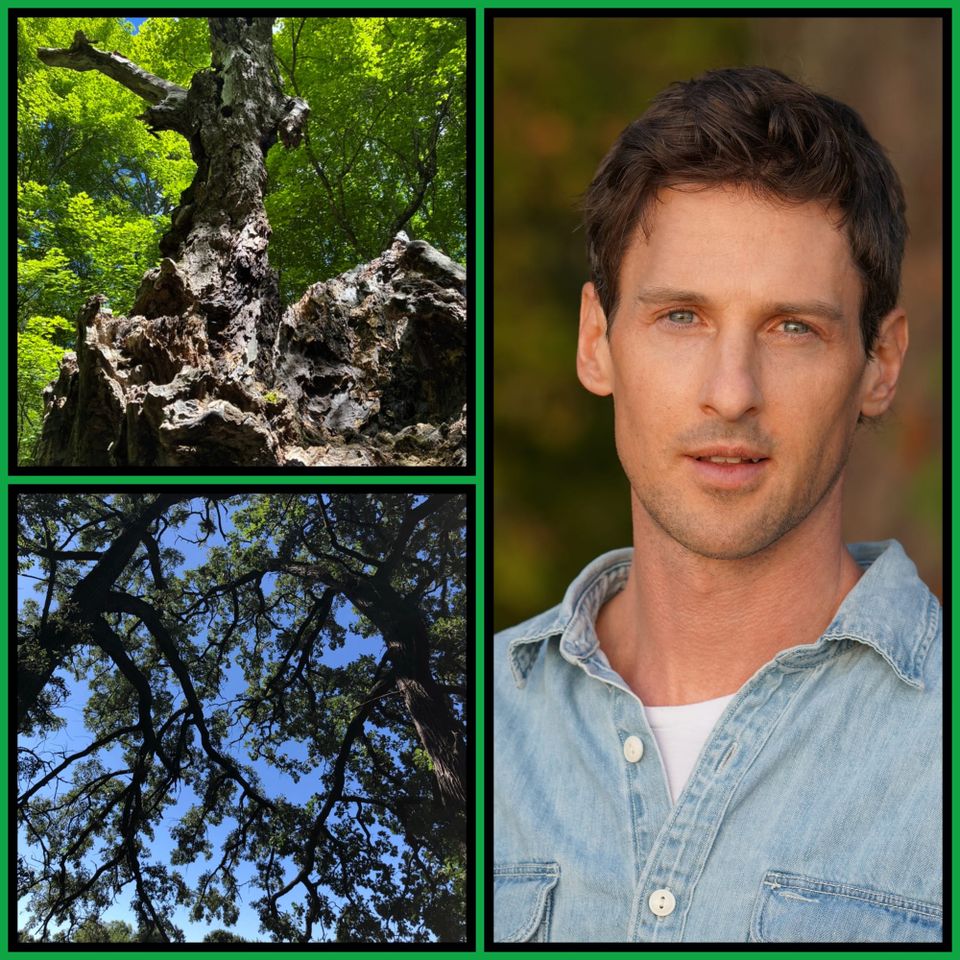
Robert Moor is a “tree person.” He says when you spend a lot of time in trees, time slows down - and branching and pruning can become life lessons.
0:00 / 0:00
29 Aug 2026
Tree Thinking with Robert Moor
Robert Moor is a “tree person.” He says when you spend a lot of time in trees, time slows down - and branching and pruning can become life lessons.
ShareEpisode Notes
Can you imagine being a tree? Robert Moor has spent years trying—climbing into their canopies, studying their biology and learning to see trees in ways most of us don’t. He considers himself a “tree person.”
Moor believes that when you spend a lot of time in trees, time slows down—and branching and pruning can become life lessons. He’s interested not just in how trees grow, but in what they might teach us about ourselves. In his book In Trees, he says his goal isn’t to anthropomorphize trees but to “arborize” humanity.
Moor has taken his obsession with trees to unusual places: climbing to the tops of giant sequoias; traveling to Tokyo to meet master bonsai artists; becoming a “tree sitter” to protest an oil pipeline. He’s fascinated by “family trees” and Darwin’s Tree of Life, and by our own evolutionary history in the trees of Africa. He traveled to Ethiopia to see Lucy, the famous 3-million-year-old fossil skeleton, and to Tanzania to sleep in a chimpanzee nest. (It was a miserable experience.)
He knows something about living among trees: 13 years ago, he and his husband moved from New York City to a cabin in the woods of British Columbia—and never left.
- Website
- Book: In Trees
- Italo Calvino’s The Baron in the Trees
- Bonsai artist Masahiko Kimura
- Julia Butterfly Hill
- Tree climber Tim Kovar
Transcript
Anne Strainchamps: Welcome to Wonder Cabinet. I'm Anne Strainchamps.
Steve Paulson: And I'm Steve Paulson. Sometimes I wonder what it's like to be a tree, to grow by branching and rooting, reaching for air and sunlight, standing in one place year after year.
Anne Strainchamps: Living an entangled life. Trees can seem like utterly foreign species, but we literally came from them. Eons ago, our hominid ancestors lived in trees, so maybe their way of being is somehow familiar to us.
Steve Paulson: And maybe if we got closer to trees, our own lives would look different.
Robert Moor: I think a tree person is a kind of a tree obsessive, a person who thinks about trees and sees trees in a way that other people don't.
Anne Strainchamps: This is Robert Moor, author of the new book, In Trees.
Robert Moor: There's a condition I think you're probably familiar with called plant blindness, which is that most of us walk around and plants are just this green backdrop to our daily lives. And tree people are those unusual individuals who notice trees, who see them, who love them, who study them. And I became one of those people once I moved here to British Columbia and trees sort of jumped into the foreground of my mental landscape.
Steve Paulson: Robert Moor is the kind of writer who takes an obsession to levels that most of us would never dream of. So when he wanted to cultivate a more intimate relationship with trees, he didn't just study their biology. He became a serious tree climber and went up into the canopies of some of the tallest trees on Earth.
Anne Strainchamps: Then he went off to Africa to sleep in the wild in a chimpanzee nest.
Steve Paulson: Rob is fascinated by the way time slows down in trees and how branching and pruning can become life lessons. He says his goal is not to anthropomorphize trees, but to arborize humanity.
Anne Strainchamps: Arborize humanity. I love the phrase, but what does it mean?
Steve Paulson: Well, I'm not exactly sure, and this may not be an answer, but we're in Vermont for the summer, surrounded by trees. And you know that trail loop up into the woods that I walk?
Anne Strainchamps: The really steep one where you and the dog go?
Steve Paulson: Yeah. So I go up there several times a week, and there are certain trees I always look for, like that cluster of really tall maples, six of them growing within a few feet of each other.
Anne Strainchamps: The ones we call “the sisters.”
Steve Paulson: Yeah, I always stop to look at them, and sometimes I press my hands into their bark, and the fact that they're so close together fascinates me. I mean, their roots and mycelial networks have to be completely entangled, and looking up, it appears that they have a single crown. So there are all these things that I wonder about. How much of their lives, their identities, do they share with each other? What does it mean to know your neighbor in this wordless but very intimate way?
For me, these are not strictly biological questions. There's something more, and I'm not sure what it is. So this conversation with Rob Moor left me with lots of questions that I'm still mulling over.
Anne Strainchamps: There's also a backstory to how Rob came to write this book. He'd been living in the East Village in New York, a very urban lifestyle, and then moved with his husband to a cabin in the woods in Smuggler Cove, British Columbia. And they planned to stay a year, but it's been 13. And those are the trees that inspired this book.
Steve Paulson: And on our Zoom call, I could see the forest just beyond the patio where Rob was sitting.
Anne Strainchamps: The trees were listening.
Steve Paulson: Rob, tell me what it's like being there. Can you describe the place where you live?
Robert Moor: Sure. I mean, it's a provincial forest that backs up onto the Salish Sea. So you have a mix of cedars and Doug firs and alders. There's a couple of Pacific yews back there. It's not an old growth forest, but it's a beautiful forest.
And It's become woven into my life. It's funny, the first couple of times we went hiking back there, my husband and I got lost. We ended up walking in circles for hours. And now the thought of that happening is just hilarious. I mean, you come to know a place so well that you can almost never get lost there.
Steve Paulson: So at the very beginning of your book, you say a tree is not just a thing that's made of bark and leaves and sap and wood. It's a way of being. And for me, that was the big takeaway from your book. I mean, there's the science of trees.
There's also the history of how humans co-evolved with trees. And it's worth mentioning, of course, that our ancient hominid ancestors were arboreal. I mean, we literally came out of a forest. You also say trees embody a certain kind of wisdom that we can learn from. I'd love to have you talk a bit about that.
Robert Moor: That was, I think, the big discovery of writing this book. As you say, that relationship is incredibly ancient. We're descended from arboreal species. And to some degree, we remain an arboreal species. You know, we can still climb trees.
And if you climb trees throughout your life, as, for example, the Mbuti people in the Congo do, you can still do it with incredible ease. It's something that comes very naturally to us. And I think that relationship's very deep. But when I started talking to tree biologists, and in fact I took a class in tree biology at the University of Victoria, what they began to explain to me is that a tree is actually really hard to define because plants have evolved a tree-like shape, a tree form, multiple times. It's actually something that plants do when they want to get tall.
They develop woody tissues and they start branching out. And one of my tree professors, my tree biology professor Patrick von Otterkost, told me a tree is really just a growth form. That was his phrase, a growth form.
Steve Paulson: Does that mean it's just a tall plant?
Robert Moor: Well, it's just a way a plant grows, really. It's a way of being. And so once I started thinking of a tree as a process rather than as a type of thing, suddenly I started seeing them in new ways. I thought, well, what is a tree? If it's a way of being, if it's a way that a thing grows, how does it grow?
Well, it branches out, it prunes back what doesn't work, it gnarls around what does work. And then by the end of the book, I discovered the sort of missing piece to all that, which is it sends down deep roots, that it's deeply rooted, to its local ecology and to the community of life in that place.
Steve Paulson: I think we all have an image of what a tree looks like, you know, how it branches out. And one thing that's striking is it looks a lot like images I've seen of a brain, how the neurons branch out and go in all these different directions. How far can we take that analogy?
Robert Moor: Well, you know, that's actually something that you find throughout the literature of neuroscience is the language of trees. You know, they refer to one part of the neuron as a dendrite, which of course comes from Latin for tree. But also the way that they describe the brain growing is blossoming and pruning. Which is such a beautiful, poetic phrase. And it's really true.
You know, when our brains first grow, when you're a baby, your brain is maximally branchy. It's as branchy as it will ever be. You have the most neurons, you have the most neural connections, and most of your life is spent pruning away those connections, pruning off some of those neurons that you don't need or those connections that actually aren't serving you. And that's how we get a sense of clarity. It's not perfect.
We live in this optimization-obsessed culture in which everything is striving towards perfection. But that's really not how a lot of life is. We're just surviving and we're growing around our past mistakes. And in fact, I have come to see that as sort of part of the beauty of life. That's what gives our lives character.
Steve Paulson: So I got this very strong impression from reading your book that you don't want to just think about trees. You seem to have a compulsion to be in trees. And you say there was a day when you suddenly got this urge to climb a Douglas fir that was near your house. Can you tell me about that day?
Robert Moor: Yeah, it's true. I mean, I climbed trees as a kid. I'm sure you did as well.
Steve Paulson: I climbed trees all the time as a kid. And I always felt like I could always keep going up further and further as long as I could reach another branch. And I kind of did this into my 20s and 30s, but then I stopped. And I definitely have this image that tree climbing is for kids, not for adults, unless you're an arborist. But you went in a different direction.
Robert Moor: Well, and I think you're actually unusual in continuing to climb trees into your 20s and 30s. Most people I know stop around 13 or 14. You get a little bigger and a little more awkward and other things take over your life and you get distracted and then you just don't ever resume doing it. And yet I think a part of us misses it, right? I mean, we remember the joy and the freedom that we felt up there.
And this struck home to me. I was reading this book by Italo Calvino called The Baron in the Trees.
Steve Paulson: Oh, I have read that book. This guy who basically goes up in a tree and spends the rest of his life climbing from one tree to the next.
Robert Moor: That's right. Yeah. He remains in the treetops for his whole life. And I was thinking about that and the beauty of that image. And I was sitting out by the seashore and I was looking at this old Doug fir that had this beautiful ladder of branches leading up.
And I decided to just give it a go. I said, you know, why not? I'll try and climb a tree again. And I knew that I remembered how to do it. I'd done it so many times before, I figured it would be easy.
And it turned out it wasn't easy at all. In fact, I hadn't lost the ability, but I'd lost that thing we have, that boldness that we have when we're kids that allows us to do it. I suddenly was full of fear and hesitation and it was a terrible feeling. I really felt very old in that moment. I felt like I had grown cautious, not just in terms of climbing trees, but in all sorts of realms of my life. I felt that boldness, that wildness I had as a child, it kind of withered.
Steve Paulson: So what did you do then?
Robert Moor: Well, this I think is what makes me unusual as a writer is that I set myself the task of relearning to climb trees from the best tree climber I could find. So I scoured the internet and I found a guy named Ben Atkinson who lives in England and who makes these videos of himself climbing trees. And he does it in this beautiful way. You know, he doesn't just climb up and down the trunk like most of us did as kids. He'll actually tiptoe out onto the branches like he's on a kind of a balance beam.
And he'll jump from one branch to the next and he'll grab hold of that. He really explores the whole tree.
Steve Paulson: So you have to be so comfortable with your body and you have to, I guess, get over the fear of falling.
Robert Moor: Yeah, that's right. I mean, that is one of the first things he told me is we have to get off what he calls the neurotic merry-go-round. Your brain is your own worst enemy. You'll overthink it and then you'll become nervous. This is one of the things that he taught me.
I traveled to the Lake District of England and he brought me up into this beautiful sycamore tree. And we were standing there and my leg was shaking. Climbers call it “sewing machine leg.” It was just, you know, I couldn't stop shaking. And he said, let's play a game.
I'm going to poke you in the chest and you swat my hand away. You know, we're 15 feet off the ground at this point. And he didn't poke me hard. He just did it gently. But I started swatting his hand away.
And after a couple of times, he said, look down. And I realized that my leg had stopped shaking. He said, just let your body do it. Your body knows how to do this if your brain can get out of the way. And so that's what I tried to do.
And I tiptoed out onto those branches like he did. I wasn't quite as good as he was, but I got better at it that day and started to feel that freedom and that wildness that I'd felt as a kid, as well as this feeling I'd forgotten, which is a kind of gratitude, a feeling of thankfulness that this tree was holding my life in its hands and that those branches, if they were to fall... I would fall too. I think that's a very deep feeling in us, a kind of philosophical feeling that we need to find our way back to. So we have a bit more gratitude and a feeling of maybe healthy precariousness in terms of our existence here on Earth.
Steve Paulson: So I'm just curious, when you were tiptoeing out to the edges of the branches, were you holding on to branches or were you just standing there?
Robert Moor: No, most of the time I was just balancing. And what you find is this intense focus. Rock climbers like Alex Honnold who do free soloing, they talk about this, that your brain is completely wiped free of all thoughts and you have this very intense, present tense awareness of what you're doing. Of course, my brain being a writer then immediately started analyzing that feeling and I started thinking all over again and then I lost my sense of calm. But I had it for a couple of seconds there. I felt that clarity.
Steve Paulson: So you really took this to another level, and I know later on you went and found another person who taught you how to climb really tall trees, and that requires different skills, I think. You know, technical skills, how to do this, and also equipment. I mean, you need ropes, and you need a way to sort of haul yourself up.
Robert Moor: Yeah, so there's a tree climber named Tim Kovar who leads these courses in Oregon, and what he will teach you is how to climb big trees with ropes. And so essentially you shoot a line up over a tall branch, either with a bone and arrow or a crossbow or a slingshot, and then you pull a climbing rope up into the branches of that tree, you secure it, and then you climb up and down on that rope. And you can actually climb all around on the branches as well without falling, you know, without fear of falling. And it allows you to climb just immensely tall trees and get into these new worlds that you never even knew existed.
Steve Paulson: So you're just hauling yourself up hand over hand, climbing up the rope, or is there anything else that pulls you up?
Robert Moor: No, it's just you use what are called ascenders. The ones I use are actually from caving. They're not for rock climbing, but it looks like a staple gun, and it has these little teeth that grip the rope when you pull down on it, but it allows you to slide it up. So you slide one ascender up. That one connects to your waist harness, and then you stand up in your foot stirrups.
You slide the foot ascender up and hand, foot, hand, foot. You just inchworm up the rope. It's very straightforward, really.
Steve Paulson: So I know you ended up hanging out with a lot of tree people, you know, fellow climbers. And I got the sense that they share certain personality traits. Free spirits, nonconformists, and they seem to have a really intimate relationship with the natural world. Was that your impression?
Robert Moor: That's absolutely my impression. Yeah, I think that spending time around trees changes you, especially spending time in the treetops. I do think it makes you a little bit more tree-minded. I think you get a little branchier, you get a little more open-minded, but also you become very rigorous. I mean, being up there requires a seriousness because your life is in your own hands.
I also think that they just appreciate the otherness of a tree, and they appreciate the otherworldliness of being up in the treetops. There's something they call tree time. Being up in the branches, your understanding of time starts to change. Time melts, and you lose track of time. It slows down, and it speeds up.
You really feel very disconnected from the ground world. It's an entirely different phenomenological state of being up there. And it's one that I think is very healthy. It sort of jostles us out of our everyday existence and makes us appreciate life a little bit more.
Steve Paulson: So then there was a time when you became part of this team that was climbing up giant sequoias, part of a David Attenborough nature documentary, is that right?
Robert Moor: That's right. It was called The Green Planet. And my friend Steen, who I'd taken that tree climbing course with, He gave me a call one day and just offered me this opportunity to work as part of the crew. We didn't get paid or anything, but what we did get was an opportunity to climb the giant sequoias in Sequoia National Park, which normally is not something people are allowed to do. They don't let you just climb up into General Sherman or something.
Steve Paulson: These are the biggest trees in the world.
Robert Moor: It's true. By mass, they're the largest trees on Earth. They're incredibly ancient, you know, more than, I think, 3,000 years old and incredibly tall. And so the chance to climb these trees was just awe-inspiring.
It truly was. I mean, it was also terrifying. As I say in the book, when I got to the top of one, I looked down and felt an adrenaline rush so powerful I actually tasted metal in my mouth. It was just an intense rush of fear and awe all at once, but it was such a privilege.
Steve Paulson: And isn't there a whole science of tree canopy biology? I mean, like the scientists who really look at the very tops of these huge trees, and there's a different ecosystem up there. I mean, with all kinds of stuff that's living that we would never know from just looking from the ground.
Robert Moor: Yeah, it was once assumed that the treetops were an ecological desert. And so they didn't really study them. And that began to change, I believe, with the work of Steve Sillett. And when he started climbing up into the Coast Redwoods, which are the tallest trees on Earth, he discovered there are entire ecosystems up there. There were plants growing up there.
There were huckleberry bushes. There are aquatic animals. There are salamanders you find up there. There are all kinds of different species that are actually exclusively growing up there, living up there in the treetops.
It's kind of a forest atop a forest. And I discovered this one day while tree climbing with a bonsai artist named Ryan Neil. We climbed a coast redwood and we discovered a tan oak which is about a foot tall. It's probably 30 years old, growing in this tiny patch of soil that accumulated in the branches of a redwood. It was just astonishing.
And what these scientists are finding is that trees are doing all these things up there we didn't know, that we could have never imagined. So the coast redwoods, for example, have learned to drink the fog through their needles so that they don't have to pull the water up from the roots. And bigleaf maples have learned to extend roots out of their branches into these patches of moss so that they can drink in water and nutrients. There's amazing things going on up there above our heads.
Steve Paulson: And we have this image that trees are big. I mean, most of them. And yet then there are bonsai trees, which seem to go against much of what we're talking about. And I know you became fascinated by bonsai trees. I mean, this tradition of growing and shaping these tiny trees that people in Japan have been doing for centuries.
Robert Moor: Yeah, I did become fascinated with bonsai trees, first just because I bought a bonsai. And I was trying to keep it alive. It's actually a dwarf garden juniper. It's not even a tree, it turns out. It's more of a shrub.
But in trying to keep that little tree alive, I really learned to appreciate the art of bonsai, which is the art of care. It's the art of keeping these trees, sometimes for a thousand years, these trees alive in tiny pots and shaping them into living works of art. It's a real paradox that trees are trees because they can grow large, right?
That is one of their defining features. And yet you can keep one small just by restricting its root base more or less indefinitely. And then the other thing that's amazing that I learned was when my little bonsai started to die, my bonsai teacher said, just plant it back in the soil and it will sprout back up. So you can take a bonsai, any bonsai out of its pot, plant it back in the soil. And as long as those roots can grow, it will regrow into a full-size tree.
Steve Paulson: So what is the art of the master bonsai artists? What is it that they do?
Robert Moor: They describe what they're doing is creating nature in miniature. The art of bonsai was developed in Japan as Japan began urbanizing so that people could have a bit of nature inside their homes. And they would tend to their bonsai. Often they were seasonal plants which would flower or fruit.
They would change out the accent plant and the scroll behind the bonsai to represent the seasons. You know, the Japanese have not just four seasons, but 72 micro seasons called ko. And so they're profoundly attached to seasonality. And the idea of the bonsai was really that you would take that natural wild landscape that maybe you didn't have access to in a city or in your house, and you'd shrink it down so that you had a taste of it. At one point in this New Yorker article, I described bonsai as bouillon.
You know, it's the reduced essence of nature. It's not an exact reflection. It's sort of the flavor of nature.
Steve Paulson: So you went to Japan and you met some master bonsai artists, especially this guy named, was it Masahiko Kimura?
Robert Moor: Kimura is a remarkable figure. They call him the Picasso of bonsai, or some people call him the magician of bonsai. He really modernized the art of bonsai and in some ways completely broke it apart because he started using power tools for the first time. And what he discovered by using these power tools was that he could take fairly young trees and radically transform them. I mean, he would carve their trunks using these power sanders.
He would sometimes flip them upside down and turn the roots into branches and the branches into roots. He did all these incredible things that really blew people's minds and initially created a lot of controversy. People were not fond of it.
Steve Paulson: Right, I mean, this doesn't sound natural, I guess.
Robert Moor: No, it was a very quiet art form before Kimura came around. And, you know, some people said, this isn't bonsai, it's sculpting. You know, that he was doing something too aggressive. But as his artwork began to gain more admirers, you know, he had this one beautiful tree that I've seen called the Flying Dragon that was undeniably a masterpiece. He began to win people over.
And now I would say he's at the apex of the art form. He's revered as a kind of master artisan.
Steve Paulson: I've seen photos of some of his trees. They are amazing. And they're essentially living sculptures.
Robert Moor: Yeah, I mean, being able to walk through his garden in Tokyo, just outside of Tokyo, is an astonishing experience. I mean, some of these trees are well over 500 years old, and they're larger than you would think. They probably go up to your waist. But what's amazing about them is the complexity and the elegance of his designs. I've often noticed that bonsai artists, when they look at bonsai, they kind of crouch down and they tilt their head to the side, and they climb the tree with their eyes. They're trying to see what the artist has done, and they're following that line of the trunk. And what Kimura's trunks do is just astonishing. You almost can't follow the lines because they're so complicated. It really brings to mind, you know, smoke rising up from a wildfire that's all curling and involuting. It's just gorgeous.
Steve Paulson: So we've been talking about how so many people love trees. And of course, they've been hugely important in the environmental movement. But one of the recurring themes of your book is that environmental thinking has a really complicated history. And we celebrate great writers like Henry David Thoreau and John Muir. But when you start digging into their writing, sometimes they come across as kind of out-and-out racist. I mean, sort of like, wouldn't it be wonderful, these forests, if the native inhabitants, the people, just weren't living there?
Robert Moor: Yeah, I think that a love of nature, if it's not framed correctly, can really start to lead to a disgust with human beings. And I think a lot of us have felt this. I mean, who hasn't been walking through some, you know, quote-unquote pristine natural landscape and seeing some litter there beside the trail and thought, “God, I hate people.” And this is something that you find in the writing, especially of John Muir, looking at Native people, Native American people, as kind of a blight on the land, kind of dirty and an eyesore.
He did not have a great love for the Indigenous people of California. And he also didn't have a very great respect for the amount of stewardship that had gone into creating these landscapes that he enjoyed so deeply, that he loved so deeply. He didn't see the history of, for example, prescribed burning and tending to all of these various plants and animals that really led those landscapes to be the way they are. He was blind to that.
He liked to see it as a sort of Garden of Eden that was perfectly designed when the white man came traipsing out of nowhere. That is something that I think many of us, hopefully in the environmental movement, have learned to grow beyond that way of seeing.
Steve Paulson: But that's a thread that has continued up to today. I mean, there are people who just want pristine wilderness, and they do see humans as the problem. I mean, if just humans could be removed, we would have pristine nature.
Robert Moor: Yeah, I think that's right. And I think that that is a trap. It's an intellectual trap. I mean, you'll hear it even sometimes. My friends will say, you know, these are the ones who really love nature.
And I think their heart is in the right place. They'll say, well, if humans, you know, go extinct because of climate change or whatever, at least the earth will still be around. At least, you know, other species will survive. And I think that that actually reveals a profound flaw in our thinking. One of the things that indigenous philosophers and indigenous thinkers often talk about is relationality, that the indigenous worldview is based on maintaining relationships between living things, that there's a sort of web of relations, and you have to tend to that web of relations, otherwise the world will get worse.
And not only will other beings suffer, but you'll suffer. You'll get sick and all sorts of calamities will befall you. I think that we have fallen away, somehow we've drifted away from that relational worldview, which I call the rooted worldview. I think we're a profoundly uprooted culture.
And that is a symptom of it, right? That we think it would be fine if human beings died off because other species will survive. Well, sure. But the idea is, the hope is that we will live in right relation with those species, that we will all be connected in this web of relationality and we'll all be flourishing together.
Steve Paulson: I mean, there is this really problematic and you might call shadow history that comes with environmental thinking. And one of the points that you make is that a tree is not just a tree. It's also a symbol. And it's become racially coded in some places. I mean, for a lot of white Americans, we tend to have very positive associations, you know, of nature, of tranquility, maybe a place of adventure.
But in the Jim Crow era, trees were used to lynch black people. And as you put it, they were refashioned to be murder weapons. I mean, I'd never really thought about it that way, but I mean, trees became hugely symbolic in some really awful ways.
Robert Moor: Yeah, there's certainly a dark side to trees. Hitler, for example, loved trees. He loved the oak, the way that the sturdy, mighty oak represented the German people. The coast redwoods, actually, were used by eugenicists as a symbol of the endangered white man, the noble white race. And then, as you say, in the Jim Crow South and before, trees were fashioned into murder weapons, into tools of racial terror.
This is something I learned while traveling through Alabama with my Black cousin. Gia Gray, who I describe in the book, sort of rediscovering this branch of my family tree and returning to Alabama where our shared ancestors were from. And this is something that she and other Black Americans have driven home to me, is that for white people, trees are universally positive. We don't see a dark side. But for Black Americans, it's often different.
Amikajo calls it a double vision. They see the beauty and the health in trees, but also they see this dark history. And it's very hard not to because a lot of those trees are still around. You know, there are instances in Alabama where the town's old lynching tree stands in front of the courtyard and it's still there to this day. So that is a living reminder of this painful past in which trees were very deliberately destroyed - used not just as murder weapons, but used as symbols. There were postcards, there were stories, there were jokes, all told about lynching trees that continually reminded Black Americans to stay in your place, otherwise you'll suffer. You know, the fate of the dogwood tree, for example.
Steve Paulson: We're going to take a short break, and when we come back, Rob will take a deep dive into evolutionary history and tell us why he traveled to Tanzania to sleep in a chimpanzee nest.
Anne Strainchamps: Hi, it's Anne. I am so glad you're joining us. We have some amazing guests lined up for the weeks ahead. I'm really excited about them. And here's a tip.
Maybe you know this already, but if you follow Wonder Cabinet on Apple Podcasts, those new episodes will show up automatically, like a little weekly gift in your podcast feed. I hope you like it.
Steve Paulson: This is Wonder Cabinet. I'm Steve Paulson. My guest is the essayist Robert Moor, who has just written a wonderful book called In Trees, An Exploration.
Steve Paulson: So you are really taking this idea of the family tree in all kinds of directions, which is just totally fascinating. And you go not just to who you are related to today and who's been part of your family over the last century.
You go way back in evolutionary history. I mean, the Darwinian family tree to our ancient hominid ancestors. And again, it's worth pointing out that we came out of trees. We co-evolved with trees. So why did you want to go so far back in history?
Robert Moor: So one of the light bulbs that went off in my head initially when I was researching this book was when I ran across a paper by an evolutionary biologist named Robert J. O'Hara who talks about “tree thinking.” This is a term that he coined, which is that we can't think about evolution as a linear story. If we think of it like that old illustration of the chimpanzee rising up from a crouch and then becomes a human creature. That's the wrong way to think of evolution, because it's a straight line.
And it's what they call a teleology. It implies that all of evolution was leading to us. And the truth is, of course, it was this incredibly branchy process. This was Darwin's tree of life. It's not entirely an accurate metaphor, but it's pretty close.
And so one of the challenges I set myself with this book was to start applying tree thinking to other parts of my life, to see the world in trees. And the most obvious one to me was to start looking at our evolutionary tree. So I decided to go as far back as I could and ask the question, how did human beings come down out of the trees? What mark did that leave on us? And so I went to Ethiopia first. I got to visit Lucy, the fossil remains of Lucy,
Steve Paulson: Which may be the most famous fossil discovery in history.
Robert Moor: The grandmother of humanity, she's sometimes called. And they keep her bones in a vault. You know, they have a sort of replica that you can visit in Addis Ababa. But I managed to sort of coax one of the paleoanthropologists there to bring her out of her vault.
And, you know, I asked him, who'd you last bring this out for? And he said, I think it may have been Barack Obama. Yeah. It was quite an honor to get to see Lucy up close, these three million-year-old bones, and to stare into her face and think about that span of time and what she would think of how humanity turned out.
Steve Paulson: And I know there are some mysteries in terms of how our ancient ancestors actually did come out of the trees. I mean, at one point they were a tree species, which meant that they slept in the trees. There's some speculation that maybe they were actually bipedal while they were still living in the trees. And then there's this whole question of how did they come down to land and how did they sleep without getting killed by predators?
Robert Moor: So there was a long span of human history, early human history, where we were sleeping in the treetops, we were dropping down to the ground to go gather food, and we were learning to walk on two legs. The real question is, how did we abandon sleeping in nests? And this is a question I actually approached, again, in sort of unconventional fashion. I decided to sleep in a chimpanzee nest. I spent the night in a chimpanzee nest.
I will tell you, it was not a very comfortable night. Yeah.
Steve Paulson: Wait, so wait, you went to a place where chimpanzees were living, like a research site? You saw a chimpanzee climbing into a sleeping nest and decided, you know, I want to try sleeping there?
Robert Moor: What happened was I ran across the work of a scientist named Fiona Stewart, and she does this. She sleeps in chimpanzee nests, and then she sleeps on the ground. And at night, while she's sleeping there, she'll sort of count her bug bites, she'll take her temperature, she'll count how many times she wakes up throughout the night. She's basically using her body as a scientific instrument. She's trying to figure out why do chimps sleep in nests and how did early humans manage to sleep on the ground?
Sort of what are the pluses and minuses? And what she learned is, you know, you get woken up a lot less when you're sleeping up in the treetops. You actually get bitten by fewer mosquitoes as well. And you're a lot safer. You know, the tree is kind of a natural alarm system because the branches move. So if a leopard, for example, is trying to sneak up on you while you're sleeping, you're going to feel that bounce in the limb and it'll wake you up. And so it's a very safe place to sleep. And this is actually a real riddle for evolution because it turns out that human beings sleep differently from chimpanzees. Chimps sleep longer than we do. They sleep about 12 hours per night.
We only sleep, you know, about seven or eight, but we sleep much deeper. We go into deep REM sleep. And that is a really strange thing because it means we're paralyzed for a portion of every night. We're lying there totally defenseless and paralyzed and we're sleeping on the ground. So the question for evolutionary biologists is how did that ever take place?
How did we ever learn to sleep safely on the ground? There's an anthropologist named David Samson who has a theory, which is that we did it through communal sleeping, that we slept in groups and throughout the night, one or more people would wake up and serve as a sentinel. This actually still takes place among the Hadza people of Tanzania. It's just a natural thing. You wake up throughout the night, you tend to the fire, you just sort of look out into the night and then you fall back asleep and you do this in natural shifts.
And what that did was it unlocked this incredible cognitive breakthrough because it meant we were getting deeper sleep, which meant we had more emotional regulation and more creativity and better memories and better group cohesion. All of these things, group sleeping, would have unlocked. And it actually allowed us to then become the species that we currently are.
Steve Paulson: Which means that it was all through being a group. That's really kind of the secret of human evolution, right? I mean, how our species has become so successful is that it's the social bonding.
Robert Moor: I think that's right. I think we are the most cooperative primates by far. I mean, there is no other primate, for example, where a mother will entrust her child to another mother. That's an incredibly dangerous thing to do if you're a chimpanzee, for example. because there's a chance that mother will kill your child.
Humans do it all the time without even thinking, we'll hand our babies off. There's all sorts of things that human beings do cooperatively that have allowed us to thrive in every ecosystem on earth. I mean, this is one of the amazing things to think about is we are so closely related genetically to the chimpanzees and the bonobos, but they stayed behind. They stayed behind in the treetops in East and Central Africa. And we didn't, we fanned out across the whole world.
And so we are really the species that abandoned arboreality to become arborescent.
Steve Paulson: So I want to go back to you sleeping in a chimpanzee nest. So you said it was not very comfortable. How did you get into the nest and what was it like?
Robert Moor: It was not so hard to get into. I climbed up a rope. I set a rope into an anchor and a higher branch and I sort of rappelled down into it. And, you know, these nests are woven fresh by the chimpanzees every night. So I really wasn't bothering the chimpanzees.
Steve Paulson: They go to a new nest every night?
Robert Moor: They build a fresh nest. It's almost like, you know, like making their bed. They just weave a new one together. It only takes them, I don't know, maybe 20 minutes or something to weave one of these nests together. And it's really quite amazing to watch because I realized I have no idea how they do it.
There's no way, even with all of my supposed human intelligence, I could never weave one of those nests out of living branches, but they do. And it's this kind of ovoid shape. It's when you sink down into it, those various branches will compress and it forms a kind of net. And so it's kind of scary when you first are rappelling into it because you feel like you're going to fall through the bottom. But the more you sink into it, the tighter those branches interlock until you feel quite secure.
And so I didn't feel scared of falling out of the nest. The only real problem was just that it was too small. My legs were too big and too gangly. And so they would kind of dangle out of the nest and it made my back arch and my back started to cramp.
I also kept getting that thing, you know, when you're falling asleep on an airplane and you jolt awake. I had that repeatedly throughout the night. And I think that may be a very deep evolutionary thing. I think it could go all the way back to our nest dwelling ancestors. At one point I was lying there and I was so uncomfortable. I mean, I was sure it was almost sunrise, you know, because I'd just been in there for an eternity. And I turned on my phone and I checked the time and it was 11 p.m. And so I thought, I can't do this any longer. I'd been in the nest for, I think, five or six hours. And I thought, I got to get out of here.
So I eventually abandoned my experiment and rappelled to the ground and crawled into my sleeping bag. And I've never been more thankful in my life to have a sleeping bag.
Steve Paulson: To be a ground person.
Robert Moor: Yes, to be a ground sleeping ape was a wonderful blessing.
Steve Paulson: So there's one final piece of your investigation of trees and tree people that I want to talk about. And that has to do with the people who sit in trees as acts of resistance. And this has become pretty popular in some radical environmental circles. I mean, you know, a favorite tactic if you want to prevent an old growth forest from being cut down or maybe a pipeline going in is you sit in trees and the people who want to cut down the trees are not going to cut them down if it's going to kill people. But there's also legal peril. I mean, this is typically against the law. And you kind of got caught up in some of these circles.
Robert Moor: Yeah. So the way that happened was I had been reading about a treehouse that someone had built, a treetop blockade to try to stop the construction of this oil pipeline called the TMX Pipeline. that runs from the tar sands in Alberta out to the coast where I live. I'm opposed to that pipeline. I think it's a terrible idea to be building out this infrastructure that'll last for 50 or 100 years and subsidize the dirtiest form of oil on earth.
So I had intended to just go interview these people. I was really curious about this tree-sitting tactic, which, of course, is made most famous by Julia Butterfly Hill, the woman who lived in the tops of a Coast Redwood for two years. I'd heard about this since I was a kid, but I'd never seen it up close. And so I went out there to Burnaby, and I climbed up into this tree on a rope, and I was dangling there interviewing this guy named Tim Takaro, who was living in the treehouse. And he was explaining to me how they do these blockades, they do it in shifts. It's not like Julia Butterfly anymore. It's really hard to find someone who can live in a tree for two years. So they do like four or five day shifts and then someone else will sneak in and climb up the rope and that person will rappel down and they switch out. And as I was interviewing this guy, I realized that I was actually perfectly suited to this.
By that point, I'd been climbing trees with ropes for years. I was very comfortable up there. I had no kids. I have a very understanding husband who is okay with me being away for long spans of time. And I think I knew a thing or two about storytelling and how to get a story out into the public.
And that's a big part of tree sitting. It's not just sitting in the tree. It has to do with telling a story that the public can really get excited about and hopefully start to build a movement around the tree and shift public policy.
Steve Paulson: So you ended up staying in the trees for a long time, or at least in several different shifts.
Robert Moor: Yeah, I think I ended up spending seven shifts in the tree, so more than a month in total over that summer. And what eventually happened was people kept getting arrested. It was illegal to be there. And one of the things I told the blockaders from the very beginning was, I can't get arrested because at that time I was only a permanent resident of Canada. I wasn't a citizen and I didn't want to imperil my permanent residency.
I own a home here, my husband's here, my whole life is here. So the thing they told me was, it's okay. You actually don't have to be willing to get arrested. You just have to seem like the kind of person who's willing to get arrested because that will slow the police down. It means they have to put together this special tactical team to get you out of the tree.
And that'll take a lot of time and a lot of resources. And that's the whole name of the game. It's just buying time. But what eventually happened was everyone else who could get arrested had been arrested. And there was no one else left who could be in the tree besides me and this guy, Tim.
And so we were up in the trees and it was this cold, rainy morning. And I wake up and look out of the treehouse and the police have surrounded my tree. They built a fence around my tree, a steel fence. And they built one around Tim's tree. And they have a loudspeaker and they're calling up to me saying, you have 10 minutes to vacate the tree. Otherwise, we're going to arrest you. And so I called Tim on his cell phone. I said, what are you going to do? And he said, I'm just going to, I'm going to run away. You know, I'm going to live to fight another day.
So he repelled out of that tree. He didn't even really run. He just sort of briskly walked away into the forest and they didn't chase him. And so I did the same. I repelled out of the tree.
I ran off into the forest. And then I realized that actually we needed someone there on site to record the felling of these tree houses so we could send the footage to the news. And so I went, I stashed all my gear. I completely changed my outfit. I actually put on a kind of a disguise.
I borrowed a camel hair coat from this guy I bumped into on the highway. And I came back around the other side of the blockade now as a journalist. And I documented all of it. You know, in the book I say I felt like Spider-Man transforming back into Peter Parker.
Steve Paulson: Right.
Robert Moor: It was a really surreal and strange day and ultimately a very sad day because these tree houses that we'd managed to keep up for more than a year came down and ultimately the pipeline was completed.
Steve Paulson: So, I mean, there's a question about these kinds of protests. Do they do any good in the end? As you say, the pipeline was put in, and I mean, there's many stories like this of tree sitters who will prevent the cutting for some time, but it seems like in the end, these trees do get cut, but maybe not always. I mean, I don't know. How do you gauge the effectiveness of these kinds of protests?
Robert Moor: Yeah, I think you're right. Most of the blockades do fail. Most tree sits ultimately result in the tree sitter being arrested and the tree being cut down, sometimes right in front of their eyes, which is a very painful thing for someone who has been growing so close with that tree over the course of however many months, sometimes or years, to then watch it collapse. cut down it's it's it's often a you know an exercise in heartbreak being a tree sitter. However, some of them do succeed. Julia Butterfly famously succeeded. There's one I recount in New Zealand that was very successful and there have been a couple more recently that that have been successful, including in Fairy Creek, a place in British Columbia where I live, that turned into the largest civil uprising in Canadian history. 1,200 people showed up to be arrested, centered around these tree sits at the very top of the mountain.
And I think that that is really the hope, that the tree sitter is just sort of a symbol for the movement as a whole. And hopefully the next tree sit or the next blockade will build upon that resistance And over time, it will get to the point where some of these begin succeeding. You know, if you look at, for example, Standing Rock, that blockade did not succeed, but it trained a whole generation of blockaders who then went on to start blockades elsewhere for other kinds of fossil fuel extraction. And so there's hope that every effort we make is not lost, that we're always building upon the past and that future generations will build upon what we did.
Steve Paulson: You mentioned Julia Butterfly Hill, the most famous tree sitter of all. I mean, it's this astonishing story. She sat in this redwood tree for two years. I mean, sort of this really heroic thing that she did. You met her recently. Tell me what that was like.
Robert Moor: First, I'll say it was not very easy to meet her. She did her best to wriggle out of it. The first time I wrote to her, she wrote me back and she'd recently had a car accident and she'd suffered some personal losses. And she said, I don't feel up to talking with you, which is totally understandable.
You know, she really became a national and international icon after her tree sit. And I think she had a lot of people demanding her time and she's been very wary ever since. But so I waited a year and I wrote to her again and I said, you know, hopefully things are a little bit better for you now. Do you feel comfortable talking with me? And this time she said, well, I don't really feel that it makes a lot of sense for me to talk to someone about the importance of saving trees if they're going to go and publish a book which is printed on dead trees.
So if you can get your publisher to agree to print the book on 30% or more recycled paper content, then I'll talk to you. And this is something that, you know, of course I was excited to do. It's a great idea to publish the book that way anyway. So I reached out to my publisher. It turns out it's getting harder and harder to publish books on recycled paper. There are fewer printers, it's more expensive, and so on and so forth. It took me another, I think it was two years of emails back and forth with my publisher before I finally got it in writing that they would publish the book on recycled paper. And then I came back to Julia and I said, all right, I've got this agreement from the publisher and can I talk to you? And she said, sure. Come down to California.
And so I came down to California. I met her in Sausalito. She lives in this sort of solar powered van and her life has been pretty tough since she came down out of the trees. She's had a number of bad accidents. She has this degenerative disease, which makes it hard for her to walk. But she still has such a bright spirit and such a fierce outlook on life.
I found it very inspiring talking with her. I think she's really one of our great civil rights heroes.
Steve Paulson: Well, one of my favorite passages in your book is when you asked if she has hope for the future, given all the damage that we've done to the planet. And I'm quoting here. She said, I don't like to talk about hope because it usually doesn't lead anywhere. I mean, when people hear there is hope, that means there's an excuse to do nothing. If they hear there's no hope, they just give up.
And then she goes on to say, hope only exists in this moment. Am I creating hope in this moment or am I not?
Robert Moor: Yeah, isn't that a beautiful sentiment?
Steve Paulson: It's just sort of like, wow, you couldn't say it any better than that.
Robert Moor: Yeah, I think a lot of us struggle with that idea of is there any hope? Is there any hope for the environmental movement right now? We're in a moment, obviously, of backsliding, you know, for the environmental movement at large and for the climate movement specifically. But I think that that organic way of thinking about hope that Julia has, are we creating hope? Are we creating hope right now?
Also, it's very arborescent. One of the things I say about arborescence is it's non-binary. If you're thinking of things as black and white, this or that, you're not thinking like a tree. A tree thinks in branches, and there's multiple branches, and it's a process of growth. It's not a categorical thing. And I think she has a very arborescent way of looking at the future.
Steve Paulson: Yeah. So Rob, I have one final question for you. Do you have a favorite tree?
Robert Moor: I do. I think I have one right now. You know, it changes over time. Maybe I have two. One is the Bodhi tree. I love the Bodhi tree in India. I spent more than four months living in the town of Bodh Gaya in a monastery, and I would visit the Bodhi tree almost every day. And, you know, that's the center of the Buddhist world. And so you just see these monks from all around the world in all these different robes performing these various rituals of respect. And it's such a beautiful thing to see how revered that tree is and how inspiring it is for people.
Steve Paulson: I mean, that is one specific tree you're talking about?
Robert Moor: Yeah, it's one tree. It turns out it's not the tree that the Buddha sat beneath it. Ficus religiosa doesn't live that long, but they keep replanting it from cuttings from the original tree. And so it's a sort of descendant, maybe even a clone of the original tree. And it's, to me, the most profound expression of a sacred tree.
You know, that's something you find across cultures everywhere. is these trees that are deemed sacred and off limits. You know, trees are a source of timber and firewood. And so we want to cut them down, but every culture says, not this one, you know, this species or this individual tree, this is sacred. Don't touch that. And I find that really inspiring. I find that hopeful that we aren't just this all consuming species, that we do have this reverence for certain trees.
Then the other tree that I particularly love is just a bigleaf maple that's in the forest here behind my house that I often visit. It's growing on the side of a cliff, and, you know, it looks so tenuous. It has these forked trunks, and one of them is growing at this really perilous angle, and you can see its roots are exposed, and they're kind of snaking down the cliffside. And it seems like it's just barely holding on, but it's been doing that for decades, who knows how long, and every time I go back and it's still there.
It just gives me hope. It's this symbol of tenacity.
Steve Paulson: Well, it's so interesting to hear you describe that tree because I have a favorite tree. I'm in Vermont right now, and in the woods above the house where we are, there's this old maple tree that has been hit by lightning. Most of it's lying on the ground, probably been for decades. It's all hollowed out. There are various creatures that live in it, but there are still living branches that are shooting up to the sky.
And it's in a glade. So I'm sort of hiking through this dark forest and I come out to this sunny spot and there's my tree. It's like a miracle that this tree is there. And as you say, it's like against all odds, it's surviving. It's still there. Every time I see it, it's like, Wow, that is just miraculous.
Robert Moor: Yeah, that's the wisdom of a tree. That is what we can learn from them. That beautiful gnarledness, that tenaciousness, that grandness, that big open crown, and those deep roots, being deeply rooted to place and to life. I think that is really what trees offer us.
Steve Paulson: This has been so much fun to talk with you. Thank you so much.
Robert Moor: Thank you. This has been great.
Steve Paulson: That's the essayist Robert Moor, talking from his home in Smuggler Cove, British Columbia. He's the author of two books, On Trails and In Trees.
Anne Strainchamps: Wonder Cabinet comes to you from the streets of Madison, Wisconsin, and the woods and forests of Vershire, Vermont. Thanks, as always, to our audio engineer, Steve Gotcher, and our digital producer, Mark Riechers. I'm Anne Strainchamps.
Steve Paulson: And I'm Steve Paulson. We'd love to hear from you. Send questions or comments to us at wondercabinetproductions.com and sign up for the newsletter while you're there.
Anne Strainchamps: Be well. See you next time.
Subscribe to make sure you never miss an episode.