

06 Aug 2026
Crayfish consciousness and the panpsychist world
Steve considers the subjective crustacean experience.
0:00 / 0:00
06 Aug 2026
Crayfish consciousness and the panpsychist world
Steve considers the subjective crustacean experience.
ShareEpisode Notes
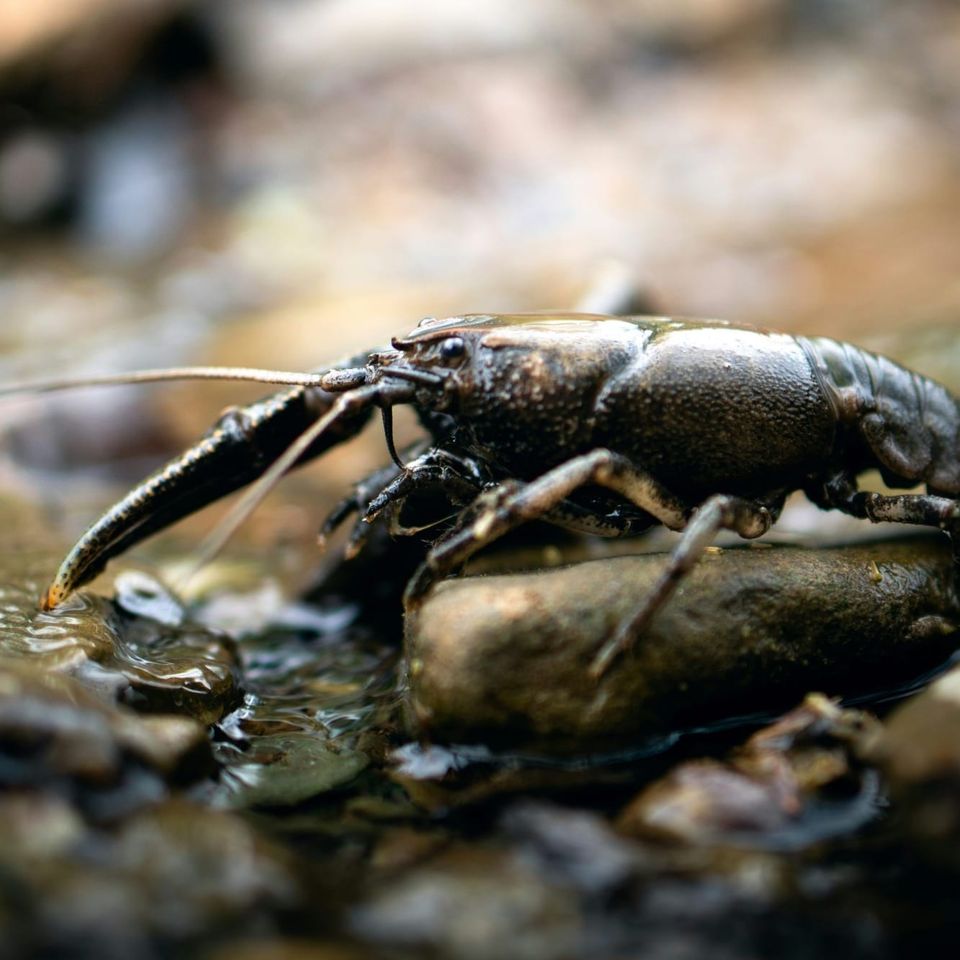
This summer Anne and I are back in Vermont, where we have a small pond nestled in the hill below our house. For a swimming pond, it’s tiny—60 feet long and half again as wide. I can swim the entire length in a dozen strokes. What I love about this watery enclave is its wildness. I often feel dozens of tadpoles softly bouncing off my hands and face as I glide through the water. The pond is full of pint-sized creatures - newts, frogs, water striders, caddisflies… and crayfish, which we imported a few years ago to eat the algae.
Some days, I stand by the pond’s edge, peering into the shallows to watch various little dramas unfold: crayfish jousting with each other or trying to catch a newt, or two dragonflies darting around each other at impossible angles. Are they mating? Fighting? Last summer a great blue heron stopped by our pond nearly every day, which delighted us since our crayfish population had spiraled out of control.
There are times when I try to imagine pond life from the perspective of its inhabitants. How do these tiny critters perceive the world around them? What are they thinking? Do tadpoles think? What is crayfish consciousness? These aren’t fanciful questions. Recently, a group of prominent biologists and philosophers signed a declaration stating that amphibians, reptiles, fish and insects almost certainly have some form of consciousness.
I kept wondering about the nature of consciousness while I was editing my interview with the philosopher Philip Goff for this week’s episode on panpsychism. This is the provocative theory that everything in the world is conscious—not just humans and other animals, but trees, amoebas, even electrons. As you might imagine, many scientists find this idea far-fetched, bordering on ridiculous—don’t you need a brain to be conscious? But panpsychism is catching on among a growing number of scientists and philosophers because prevailing theories of consciousness have hit a dead end.
“It’s gone nowhere,” says Goff, who’s the most prominent panpsychist philosopher today. “Most people agree that we haven't really got even the beginnings of an explanation. So the panpsychists turn it upside down. Instead of starting with physical stuff and trying to get consciousness out of that, we start with consciousness of very simple forms and try to get physical reality out of that story.”
When Goff talks about consciousness, he’s not referring to the capacity for emotion or self-reflection. Instead, it’s something far more basic: simple subjective experience. “I don't think there's any contradiction in the idea that an electron has some very, very simple form of experience,” he says. “There's something that it's like to be an electron — corresponding to its very simple physical nature.”
Panpsychism is also showing up in popular culture. It partly inspired Philip Pullman’s classic fantasy series His Dark Materials. The plot in Pullman’s books revolves around a mysterious substance called Dust—which exists everywhere and is somehow connected to consciousness. In this imaginative world, Dust is the spark of free will and human creativity; it’s what the religious authorities are desperate to suppress.
I confess, it’s hard to wrap my head around the idea that a flower – let alone an electron – could be conscious. But crayfish and frogs? I have no doubt we’re all swimming in an ocean of consciousness in our little pond.
–Steve
Subscribe to make sure you never miss an episode.