17 Jun 2026
The Wonder of Now
Scientists say the “present moment” is an illusion, but it’s what gives our lives meaning.
0:00 / 0:00
17 Jun 2026
The Wonder of Now
Scientists say the “present moment” is an illusion, but it’s what gives our lives meaning.
ShareEpisode Notes
There’s often a particular moment in an interview that I can’t stop thinking about — some insight I keep mulling over for days or even weeks. I had a moment like this when I was editing my interview with the physicist and novelist Alan Lightman at the Morgan Library in New York.
I asked Alan, who’s in his late 70s, if anything has changed in how he thinks about his own mortality. “When you get to be a certain age, you start seeing the full arc of your life,” he said. “I used to think that only things that were permanent had meaning, things that lasted for a long time. I’ve come around to the belief that the moment is what matters, like us sitting here right now talking. That's what matters because nothing lasts. If you don't at least appreciate the moment, then you don't have anything at all.”
Then he said the thing I keep thinking about: “Maybe when we use the word ‘moment,’ we're meaning something other than chronological time. We mean something like being present, being alive.”
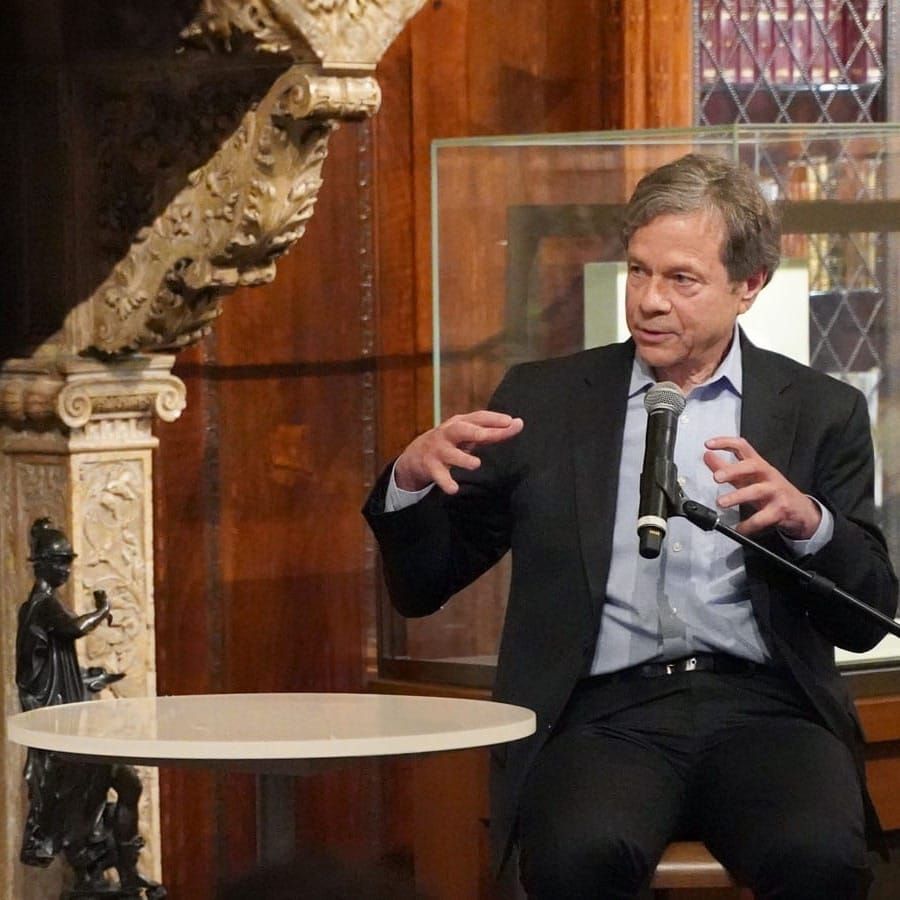
Lightman speaking with Steve at the Morgan Library and Museum.
I heard a strikingly similar comment in a recent conversation with Joan Halifax, the founder and abbot of the Upaya Zen Center (which you’ll hear on an upcoming Wonder Cabinet episode). When I asked how she experiences wonder, she said, “It’s ‘beginner’s mind,’ seeing things in a very fresh way, even in circumstances that are really challenging, like sitting with a dying person. It’s the sense of awe in being able to come alongside another human being at the threshold between life and death. That for me is a ground of wonder.”
Roshi Joan, who’s in her 80s, recently survived two open-heart surgeries, which has led her to reflect more directly on the prospect of dying. She believes the people who most readily experience wonder are children and very old people, and she said her own experience of wonder has changed as she’s aged.
When she was a young anthropologist at Columbia University, she was fascinated by studying different belief systems across cultures. “Now I’m at the age where I look at them as just frameworks, simply as constructs,” she said. “Constructs objectify the world instead of being in the immediacy of lived experience. So I enjoy life more deeply. And I find myself more and more curious not to objectify but to experience — just simply to be marinating or floating in the ocean of the experience itself.”
There’s now an emerging body of scientific literature on what it means to be in “the present moment.” I’ve been dipping into Jo Marchant’s new book In Search of Now, and it’s fascinating to see how scientists are wrestling with these questions about time, and how difficult it is to formulate a science of lived experience “According to the most trusted models of physics, ‘now’ doesn’t exist. ‘Now’ is an illusion constructed by our brains,” she writes. And yet “the unfolding present is what gives human existence meaning, what makes our lives worthwhile.”
Marchant then asks, “If the physical universe has no present moment, no flow, then what, exactly, are we experiencing? How do we carve out time, sensation, self and meaning from a blank canvas?”
That’s a question I’ll keep pondering, and I look forward to exploring different dimensions of “being present” in future episodes of Wonder Cabinet.
— Steve
Subscribe to make sure you never miss an episode.